
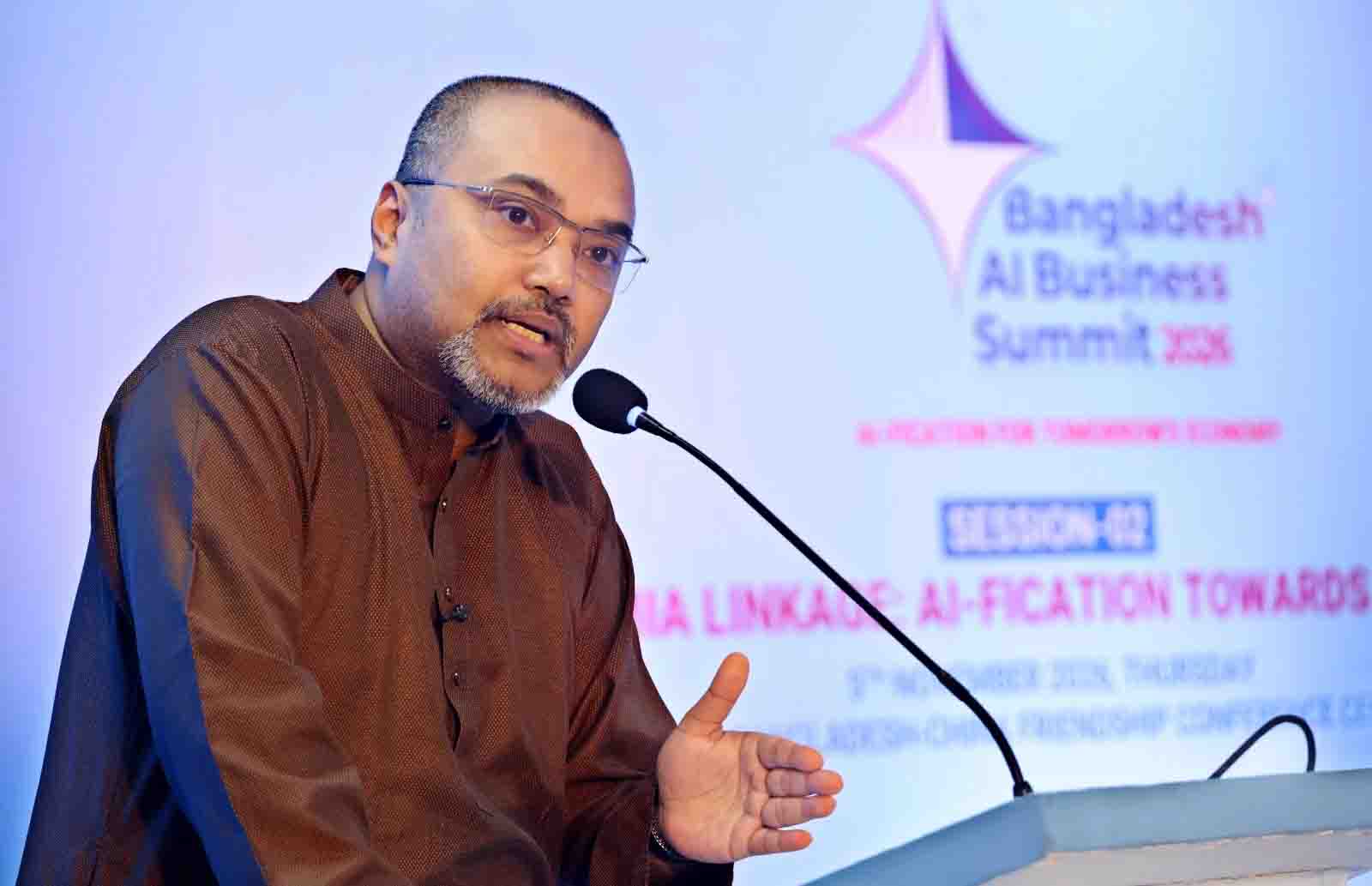
Mahdi Amin urges industry-academia collaboration to boost AI innovation, jobs
Prime Minister’s Adviser and Prime Minister’s Office (PMO) Spokesperson Mahdi Amin today stressed the need for stronger collaboration among industry, academia and the government to develop local solutions to national challenges, promote innovation and create employment opportunities.
“We want to build an ecosystem where industry, academia and the government work together to solve our real-life problems through research, innovation and practical applications of technology,” he said.
Mahdi was speaking at the second session titled “Industry & Academia Linkage: AI-fication towards Business Innovation” of the Bangladesh AI Business Summit 2026 held at the Bangladesh-China Friendship Conference Centre here.
Mahdi said Bangladesh had a significant pool of talented people, including engineers, scientists, researchers and professionals working at leading universities and multinational companies abroad.
However, the country needed to create appropriate platforms to utilise their expertise and encourage them to contribute to national development, he said.
“Talent is not our problem. The real question is whether we are providing the right platform where their potential can flourish,” he said.
Mahdi said the government was planning to expand startup funding and grant facilities to encourage innovative ideas emerging from universities, educational institutions and research organisations.
He said students, teachers and researchers with promising business ideas and research-based innovations would receive financial support to turn their ideas into viable enterprises.
“Those coming from academia, including students and teachers with good ideas and research proposals, will be provided with funding support to help them develop their initiatives into businesses,” he said.
Referring to the employment potential of entrepreneurship, Mahdi said large factories would continue to play an important role in economic development, with different projects, loan facilities and financing mechanisms available through mainstream banking.
However, he said the government also wanted to promote a large number of small entrepreneurs to accelerate job creation.
He said the government planned to transform brain drain into brain circulation by creating opportunities for expatriate professionals to contribute to Bangladesh through investment, academic partnerships, joint research and knowledge-sharing initiatives.
The Adviser said successful academics abroad could collaborate with local universities, conduct joint research and help address domestic challenges through locally developed solutions.
Highlighting the importance of industry-academia partnerships, Mahdi said Bangladesh needed to reduce its dependence on foreign products and consultants by developing homegrown technological solutions.
He identified traffic management, agricultural productivity through weather-based forecasting, industrial efficiency and manufacturing productivity as areas where local research and industrial collaboration could deliver significant results.
He also stressed the need to establish stronger links between local businesses and educational institutions beyond Dhaka, saying universities and businesses at the district level should work together to develop solutions suited to local needs.
Referring to artificial intelligence (AI), robotics and machine learning, he said these technologies could eliminate some existing jobs while creating new employment opportunities.
“Whether AI will become a threat or an opportunity will depend on how we use and command it. We must ensure that these technologies serve humanity and address real-life problems rather than merely serving narrow interests,” he said.
He called for updating academic curricula to make education more practical, relevant to industry needs and responsive to emerging technologies.
Quoting Prime Minister Tarique Rahman, Mahdi said the government wanted an education system with two fundamental objectives: developing individuals with sound moral values and preparing them with the skills and capabilities required for employment and entrepreneurship.
He said education should not focus exclusively on producing doctors, engineers or scientists, as individuals had different talents and career aspirations, including sports, culture, arts and technical education.
For the first time, the government had also announced initiatives to provide alternative career pathways through technical education for students who failed to achieve expected results in SSC and HSC examinations, he said.
Mahdi said Bangladesh’s demographic dividend and energetic young population represented one of its greatest development assets.
“The government’s responsibility is to create the policy environment in which our young generation can realise its full potential through education, employment and entrepreneurship,” he said.
He said the government was working to expand startup funding and grants for promising ideas emerging from educational institutions, students, teachers and researchers.
The government also wanted to extend seed funding opportunities to aspiring entrepreneurs in the informal economy, enabling them to establish small businesses, he added.
Emphasising the role of small and medium enterprises (SMEs) and micro-entrepreneurs, Mahdi said large factories remained important, but smaller businesses could collectively generate substantial employment.
“If we can create one lakh entrepreneurs, and each of them employs two, four or five people, we can generate lakhs of jobs within a short period,” he said.
He said the government would succeed only by developing a broader economic ecosystem that supports large companies, SMEs and micro-entrepreneurs through appropriate policy and financial assistance.
Referring to the July mass uprising, Mahdi said the country now had a government elected through people’s votes and empowered by the people after a prolonged period.
He said the government’s vision was to build a Bangladesh based on equality, human dignity and social justice, where political affiliation would not determine an individual’s opportunities for success.
Calling for collective efforts from all stakeholders, he urged industry leaders, academics, researchers and policymakers to work together to realise the aspirations of the country’s youth.
He said the government would refine and improve its policies through consultation, dialogue and feedback from stakeholders to ensure transparency, accountability and effective implementation.
Mahdi also expressed hope that other ministries would follow the Science and Technology Ministry’s initiative to strengthen engagement with the private sector.
The Bangladesh AI Business Summit 2026 was jointly organised by the Ministry of Science and Technology and the Dhaka Chamber of Commerce and Industry (DCCI).
Speakers at the discussion stressed the need to strengthen industry-academia collaboration to promote artificial intelligence (AI)-driven business innovation, technology transfer, commercialisation and industry-oriented skills development in Bangladesh.
Former DCCI president Rizwan Rahman chaired and moderated the session.
The panel discussion featured BUET student and NEVOLYN Founder and CEO Md Rahinur Rahman, IUT student and ANTS Founder and CEO Tausiful Islam, AIUB CSE Department Head Prof Dr Muhammad Firoz Mridha, Transcom Limited Group CEO Simeen Rahman, FLAXA President Syed Nasim Manzur, Dhaka University CSE Department Chairman Prof Dr Md Abdur Razzaque and Foreign Ministry Director General (International Trade, Investment, Technology and ICT) Dr Syed Muntasir Mamun.
