
Government targets inflation through reforms, efficiency, and lower business costs.
Finance Minister Amir Khosru Mahmud Chowdhury today said the government’s strategy for bringing down inflation would focus on policy reforms, reducing the cost of doing business and improving supply-chain efficiency, while expressing hope that a new pay scale for government employees would contribute to lowering corruption.
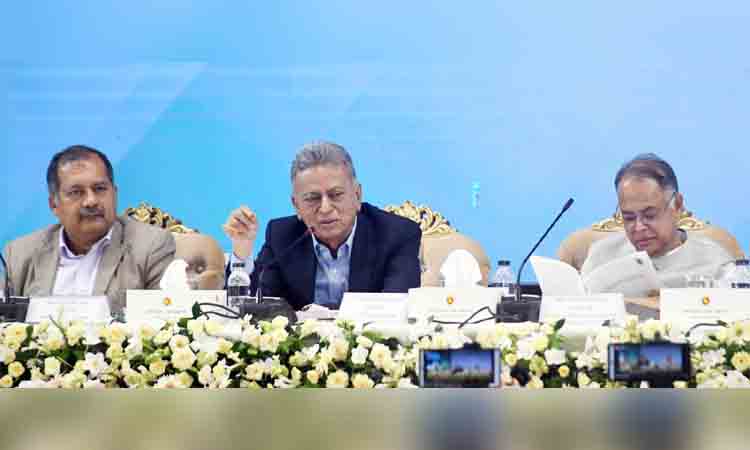
Speaking at a post-budget press conference at the Osmani Memorial Auditorium in the capital this afternoon, following the presentation of the FY2026-27 national budget on Thursday, the finance minister acknowledged that inflation remains one of the country’s biggest economic challenges and warned that the problem cannot be solved through short-term administrative measures alone.
“Inflation is not a three-month issue. It has been building up for years, and over the last three years it has become a persistent challenge. On top of that, the Middle East conflict has added a new external pressure,” he said.
The finance minister noted that Bangladesh is facing both domestic and international inflationary pressures. He said rising global fuel prices, supply disruptions caused by geopolitical tensions and increasing import costs continue to affect local markets.
At the same time, he pointed to structural weaknesses within the economy, including inefficiencies in business operations, logistics and financing.
“Banks are carrying huge capital shortages because of years of looting and money laundering. As a result, the cost of funds remains very high, and that cost is ultimately reflected in prices,” he said.
The finance minister explained that obtaining business permits often takes months, while inefficiencies at ports, customs and regulatory agencies increase costs throughout the production and distribution chain.
“From obtaining a licence to receiving goods from the port and transporting them to factories, costs continue to rise at every stage. All these costs are eventually added to the price consumers pay,” he said.
He stressed that inflation cannot be controlled by market raids or law enforcement actions alone.
“Prices cannot be controlled by deploying police, RAB or government officials. Inflation must be controlled through sound policies and efficient management,” he added.
The government, he said, plans to reduce business costs through deregulation, digitalisation, improved logistics and greater transparency. It also intends to move away from excessive reliance on spot purchases of fuel and essential commodities and instead adopt long-term procurement strategies.
“If we can reduce our domestic cost of doing business, it will have a positive impact on inflation. We want to build reserves and maintain better planning in fuel, food and fertiliser procurement,” he said.
On the issue of government salaries, the minister defended the decision to introduce a new pay scale, noting that public servants have not received a major salary revision for nearly 11 years despite significant increases in living costs.
“The government employees have also been suffering from inflation. While wages in the private sector have adjusted over time, government employees have not had a pay-scale revision for more than a decade,” he said.
Asked whether higher salaries would reduce corruption, the minister replied: “When people face financial hardship, there is naturally a tendency to seek unethical means. We hope that as incomes rise and living standards improve, corruption will decline.”
He added that improving the quality of public services and strengthening accountability would remain essential alongside salary adjustments.
The proposed budget projects inflation at 7.5 percent in FY2026-27 and places strong emphasis on reforms aimed at lowering structural business costs and improving economic efficiency.
Information and Broadcasting Minister Zahir Uddin Swapon, Power, Energy and Mineral Resources Minister Iqbal Hassan Mahmood, Education minister Dr. A N M Ehsanul Hoque Milon, Health and Family Welfare Minister Sardar Md. Sakhawat Husain, Agriculture Minister Mohammed Aminur Rashid, State Minister for Planning Zonayed Abdur Rahim Saki, Adviser to the Honorable Prime Minister on Post, Telecommunication and Information Technology Rehan Asif Asad, Prime Minister's Adviser and PMO Spokesperson Dr Mahdi Amin, Prime Minister's Special Assistant on Investment and Capital Market Tanvir Gani, Cabinet Secretary Nasimul Gani, Principal Secretary to the Prime Minister A B M Abdus Sattar, Bangladesh Bank Governor Md Mostaqur Rahman, Finance Secretary Dr. Md Khairuzzaman Mozumder, chairman of the National Board of Revenue (NBR) Md. Abdur Rahman Khan were present on the dais.
