
NCTB to correct controversial Grade Six ICT textbook illustration without extra cost.
The National Curriculum and Textbook Board (NCTB) has taken an initiative to correct a controversial illustration in the Grade Six Information and Communication Technology (ICT) textbook for the 2027 academic year, replacing the image of a weighing scale used as a symbol of wisdom in the pyramid of knowledge.
Around 38 lakh ICT textbooks, including 17 lakh already supplied to the field and another 21 lakh stored in printing press warehouses, will be corrected by revising and reprinting the relevant pages or forms before being rebound and sent to upazila-level distribution centres.
The process will not involve any additional expenditure by the government.
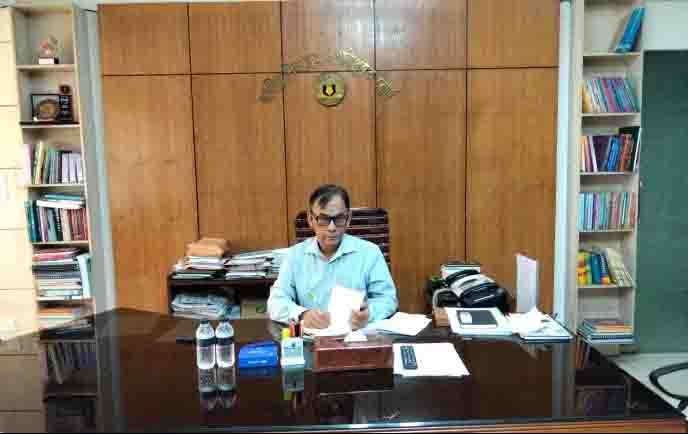
NCTB Chairman Professor Mohammed Fakhrul Mawla disclosed this in an exclusive interview with Bangladesh Sangbad Sangstha (BSS) recently.
During the interview, he spoke in detail about correcting the unintended error in the ICT textbook, the government's financial involvement and the overall progress of printing new textbooks.
At the outset of the interview, the NCTB chairman said, "The printing of the Grade Six ICT textbook for the 2027 academic year had already been completed.
"About 17 lakh copies had already been sent to district and upazila levels. We have learned that the image of the human brain used in the textbook for the current academic year has been replaced by an earlier design of a weighing scale as a symbol of wisdom, he added.
"There will be no symbol in the pyramid of knowledge on the controversial page of the textbook. We are considering revising it accordingly."
He said, "As soon as the matter came to our attention, we held an emergency meeting with the printing presses and other concerned parties and decided to bring back the 17 lakh books already distributed to the field out of the total 38 lakh ICT textbooks for prompt correction."
"The corrected books will be delivered to the upazila level again by November 30," he said.
Asked whether the government would incur any additional financial expenditure in revising, reprinting and redistributing the 38 lakh ICT textbooks, Prof Mawla said, "I want to make it absolutely clear that the government will not incur a single Taka in additional expenditure or financial liability for reprinting and distributing these 38 lakh books.
"The printing press owners concerned will bear the entire cost of revising the forms or specific pages of the books and reprinting them at their own responsibility.
"We have held a specific meeting with the press owners. They have voluntarily agreed to undertake this responsibility.
"As a result, not a single penny will be spent from the government treasury for this purpose," he said.
Asked how such an error could occur in a sensitive matter like textbooks and whether the NCTB could avoid responsibility, the chairman said, "Experts and chief coordinators concerned are involved in every page of a textbook. They are supposed to scrutinise each page meticulously.
"However, since the issue escaped their attention, it can be considered an unintentional error or, at most, negligence.
"Nevertheless, whether it was deliberate or whether there was any other motive behind it is being thoroughly investigated," he said.
He said, "A committee headed by a member involved in curriculum-related matters has been formed for this purpose."
The investigation has already begun, he said, adding that departmental action will be taken against those responsible after receiving the report.
Regarding allegations of excessive use of boat images or political symbols in textbooks for different primary-level classes, the NCTB chairman said that after the current democratic government assumed office, a special expert panel comprising four teachers from the Institute of Education and Research (IER) of Dhaka University was formed to revise all textbooks from pre-primary to Grade Nine.
This year's textbooks underwent only factual and theoretical revisions. Emphasis was also placed on correcting sentences and spelling.
However, no changes were made to the illustrations. As the previous content was retained, the illustrations corresponding to that content also remained unchanged.
The experts had expressed the opinion that the illustrations were consistent with the requirements of the textbook content.
Moreover, considering that the process of formulating a new curriculum for the 2028 academic year would begin soon, the textbooks were revised within a short timeframe.
The images of boats had also remained exactly the same in the 2025 and 2026 textbooks. No new boat images were added to the textbooks prepared for the 2027 academic year.
The chairman said these issues would be fully addressed through extensive revisions under the 2028 curriculum.
"At that time, we will be able to correct these controversial issues and images," he said.
He added that there was a systematic and long-term policy framework for changing the curriculum and its content.
"Very soon, discussions will be held with the government's policymakers, and the next curriculum reform and revision process will be completed in phases," he continued.
Highlighting the latest progress in printing textbooks for the new academic year, the NCTB chairman said the printing of around 31 crore textbooks for the 2027 academic year, covering pre-primary to secondary levels, was progressing at a very fast pace.
Printing and binding of textbooks for pre-primary and primary levels had reached nearly 100 percent completion. Meanwhile, the overall printing progress for Ebtedayee and secondary-level textbooks had exceeded 58 percent.
He further said, "The government is taking an extremely strict position regarding textbook quality this year. Quality is being maintained through joint monitoring during both day and night.
"Some 950,000 substandard forms and around 12,000 books from different printing presses have been rejected for failing to meet the required standards," he said.
Professor Mawla said the NCTB was fully committed to ensuring that 100 percent quality-assured and error-free textbooks reached every upazila by November 30 so that students could begin classes in a festive atmosphere on the very first day of the academic year.
