
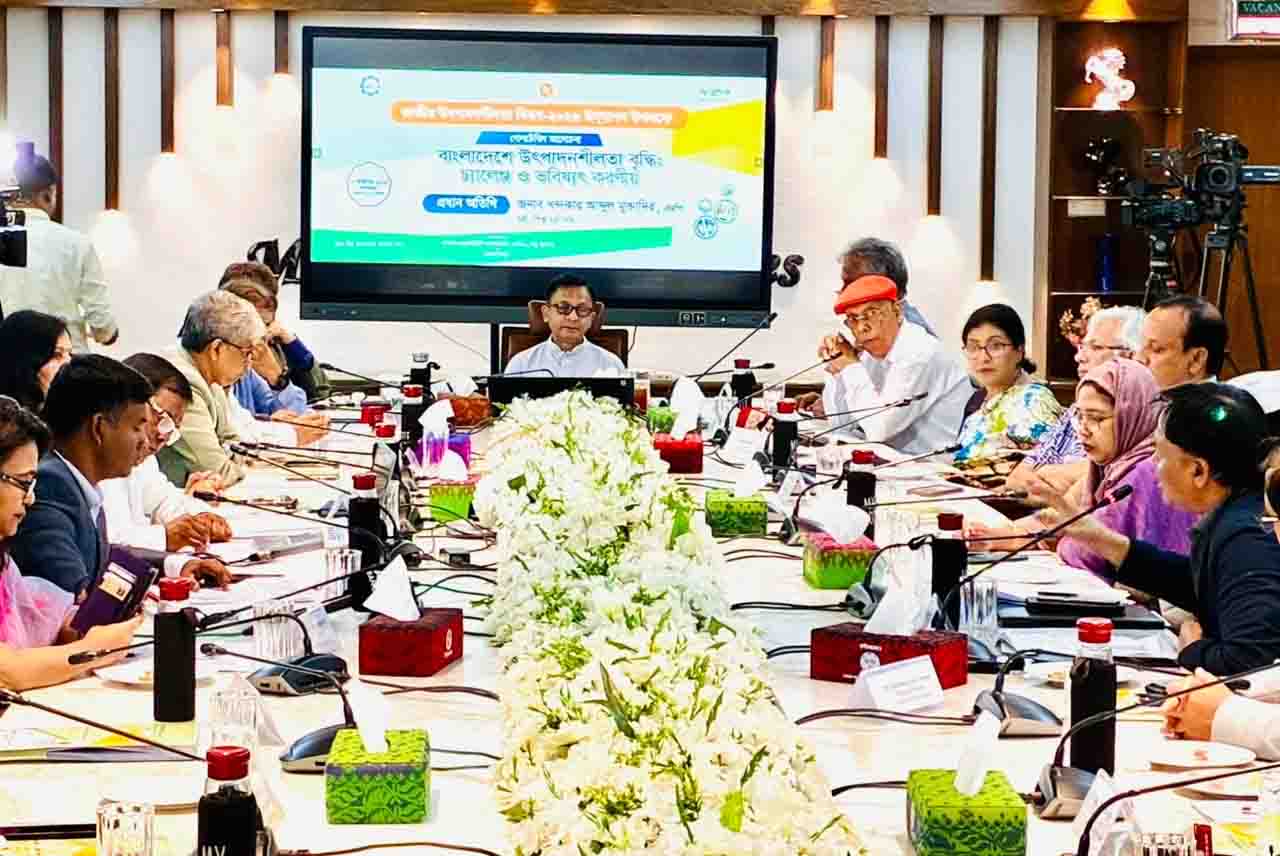
Industries minister stresses productivity to sustain economy.
Industries Minister Khandakar Abdul Muktadir today said that there is no alternative to increasing productivity to ensure the sustainability of Bangladesh’s industry and economy amid the country’s deep integration with the global economy.
“It is not possible to suddenly withdraw from the deep integration that Bangladesh has developed with the global economy. In the reality of global competition, there is no alternative to increasing productivity to ensure the sustainability of our industry and economy,” he said.
The minister was speaking as the chief guest at a roundtable discussion titled “Productivity Growth in Bangladesh: Challenges and Future Actions”, organised by the National Productivity Organisation (NPO) and the daily Jugantor to mark National Productivity Day 2026 in the city.
The minister emphasised the need to improve technology and skills to remain competitive in the global market.
He said overlapping activities and duplication among government development projects must be eliminated to improve national productivity.
Before approving new projects under the Annual Development Programme (ADP), he said, the objectives and activities of existing projects should be examined through technology-based systems to identify possible duplication.
“National Skills Development (NSD) is primarily a regulatory issue, while productivity growth is a policy issue. The two should not be treated in the same way,” he said.
The minister noted that similar activities across projects undertaken by different ministries could undermine the achievement of intended outcomes.
He suggested examining new ADP project proposals through artificial intelligence-based systems to determine whether other ministries or agencies are already implementing projects with similar objectives.
Such a system could improve the efficiency of public expenditure and reduce waste, he said.
“Reducing duplication and overlapping in government projects would help address a significant part of the inefficiencies in ADP implementation,” the minister added.
Highlighting the realities of global competition, he said productivity growth was important for every country, not just Bangladesh.
If a country cannot produce goods competitively, other countries will capture its market share, he added.
He said domestic industries could receive temporary protection where appropriate, but they must develop the capacity to compete within a specified timeframe.
The minister said productivity should not be viewed merely as an increase in factory output; rather, it should become a culture across society and the economy.
The main objective of productivity growth is to produce more and better-quality goods and services using less labour and fewer resources, he said, adding that modern technology and machinery had also improved productivity in everyday life.
Referring to Bangladesh’s readymade garment sector, the minister said the industry had demonstrated that workers could improve productivity through technological adaptation and skills development, even when access to higher education was limited.
“Our main shortcomings are not confined to skills alone. Deficiencies in leadership, proper planning and strong determination are also major challenges to productivity growth,” he said.
He stressed the need for practical planning, effective use of technology, a skilled workforce and accountable leadership to advance the country’s industry and economy.
Industries Secretary Abdun Naser Khan, FBCCI Administrator Fazlul Hoque, Jugantor Editor Abdul Hai Sikder, Centre for Policy Dialogue (CPD) Executive Director Naznin Ahmed and NPO Director General Md Naeb Ali also spoke at the event.
Distinguished personalities, government officials, business representatives and stakeholders from relevant sectors attended the discussion.
