
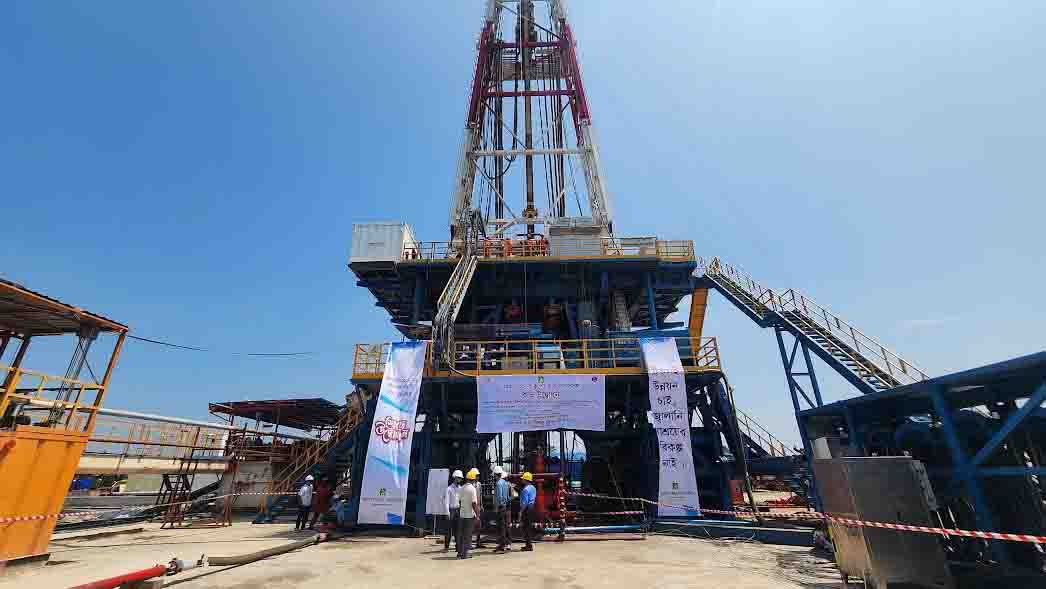
Titas-28 begins supplying 12.5mmcfd gas to national grid.
The Well No. 28 (Titas-28) of the Titas Gas Field in Brahmanbaria has been officially inaugurated today.
With opening, 12.5 million cubic feet of gas is being added to the national grid daily starting today.
State Minister for Power, Energy and Mineral Resources Aninda Islam Amit formally inaugurated the well here this afternoon.
Engineer Khaled Hossain Mahbub Shyamal, MP, from Brahmanbaria-3 and Chairman of the Parliamentary Standing Committee on the Ministry of Commerce; Energy and Mineral Resources Division Secretary Ziaul Haque; and Engineer Md. Md Abdul Jalil Pramanik, Managing Director of Bangladesh Gas Fields Company Limited (BGFCL), were present, among others.
Speaking at the event, Aninda Islam Amit said the ongoing gas crisis must be addressed by increasing local production alongside importing gas.
Currently, Liquefied Natural Gas (LNG) is being imported at nearly three times the cost, he said, adding that it is not sustainable to bear such high costs for a prolonged period.
So, the state minister, said plans have been adopted to progressively improve the gas supply situation by 2030 through enhanced production capacity.
He said the commencement of the daily supply of 12.5 million cubic feet of gas from Titas-28 to the national grid would revitalise industrial production, boost power generation, and accelerate the country’s economy.
Simultaneously, he said, drilling operations for wells Titas-29, Titas-30, and Titas-31 are also underway.
Amit said the government has taken initiatives to boost both domestic gas production and import capacity in the energy sector.
He said a target has been set to secure a total of 3,300 million cubic feet of gas daily (mmcfd), including 1,200 mmcfd from combined sources and another 1,000 mmcfd from a land-based LNG terminal.
Meeting the country's gas demand will be possible if a supply of 5,000 mmcfd can be ensured by 2030, he said.
He further stated that the commissioning of the Titas-28 well would play a vital role in strengthening the country’s energy security.
A long-term plan spanning the next decade has been adopted, which includes drilling 150 wells by 2030 and another 150 wells by 2035, he said.
Of these, he said, the drilling of 31 wells has already been completed and work on seven additional wells is underway.
The state minister said once the drilling of the 150 wells is completed, they will yield about 1,762 mmcfd.
Additionally, he said, gas supplies will be ensured through 1,100 mmcfd from two existing Floating Storage and Regasification Units (FSRUs) and through two more planned FSRUs.
Amit said the country’s normal daily gas demand is about 3,800 million cubic feet.
Prior to the conflict in the Middle East, the daily gas supply stood at 2,600–2,700 mmcfd, he said.
Due to the crisis, the state minister said, this figure dropped to 2,350 mmcfd.
But, he said, due to urgent government initiatives, the supply situation has improved since September 15.
Simultaneously, gas exploration activities have been intensified in both onshore and offshore areas, he added.
BGFCL sources said drilling operations are progressing for wells Titas-29, 30, and 31, as well as Bakhrabad-11, in Brahmanbaria.
Once those are completed, these wells will add another 55 mmcfd to the national grid.
Consequently, it will be possible to supply a total of additional 67.5 mmcfd to the national grid within the next three to four months.
Drilling for the Titas-28 well began on December 15 last year. Subsequently, on June 19, the well began supplying gas to the national grid on a trial basis. During this trial period, gas worth about Taka 200 crore was added to the national grid.
The well has a depth of 3,601 metres (about 13,000 feet), and the cost of drilling it was around Taka 200 crore.
