
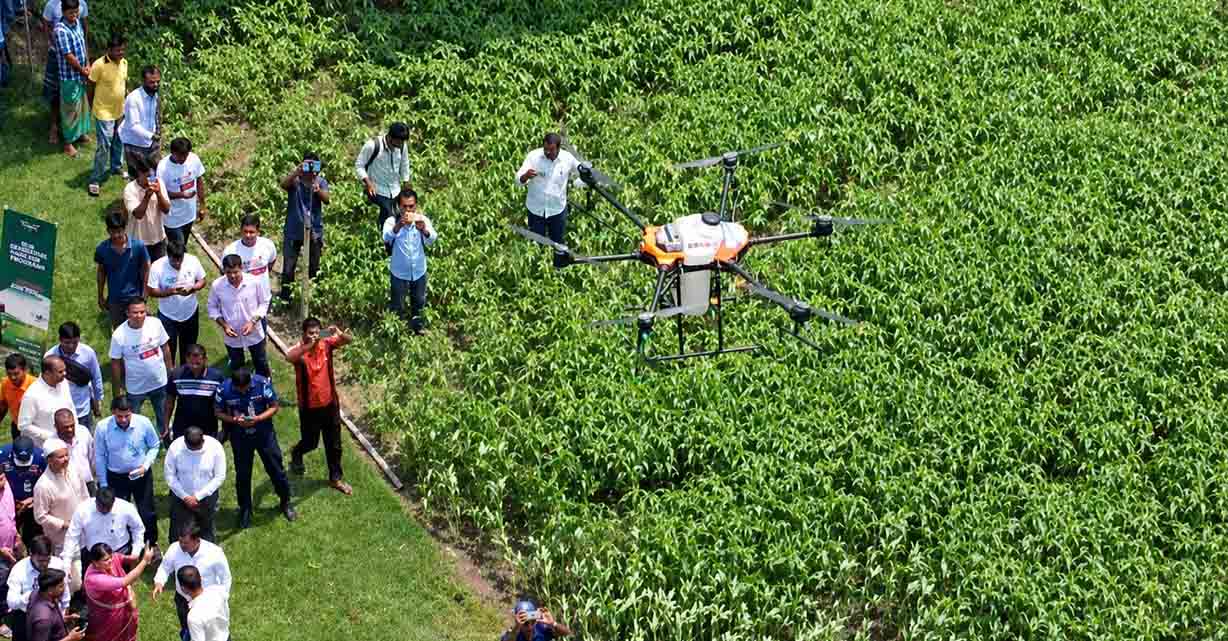
A New Dawn in Pangsha's Fields
A heavy sprayer strapped to the back. Hours of trudging along narrow paddy ridges. Droplets of pesticide drifting onto skin and into lungs. For generations, this has been the unchanging portrait of the Bangladeshi farmer. That portrait may finally be about to change.
Recently, in a field in Pangsha, Rajbari, more than a hundred farmers stood watching something they had never seen before. A state-of-the-art drone hummed overhead, slicing through the air, releasing a fine mist of fertiliser and pesticide onto the crops below. Work that would have taken a single farmer hours on end was finished in a little over five minutes — and not a drop of chemical touched a human body.
The occasion was the "WeGro–BARI Green Agriculture Drone and Nano Technology Performance Demo," jointly organised by the Pangsha Upazila Administration and the agri-fintech company WeGro Technologies Limited. The farmers who gathered along the edges of the field were witnesses to a new way of working the land.
The nano urea sprayed in Pangsha that afternoon is the fruit of homegrown science. Professor Dr. Md. Jabed Hossain Khan and his team at the NAME Lab of Jashore University of Science and Technology (JUST) have transformed the particles of conventional urea into nano-scale form and rendered it as a liquid. Under the leadership of Professor Dr. Ahmed Khairul Hasan of the Department of Agronomy at Bangladesh Agricultural University (BAU), a method of applying this nano urea directly to the soil — coated with biochar-derived carbon — is now undergoing field-level validation. The coating slows the release of nutrients, allowing the plant to absorb fertiliser gradually as it needs it, and dramatically reducing waste.
Just one litre of nano urea can do the work of roughly 45 kilograms of conventional urea. Trials have shown yields rising by an average of more than 14 percent — even as fertiliser use is cut roughly in half. But laboratory results, however elegant, mean little until they reach the soil of a smallholder's plot. The question of how they would get there is what brought WeGro into the field.
Researchers' laboratories, government administration, the Department of Agricultural Extension, and the small plots of marginal farmers — these have long existed as separate worlds. Stitching them together has been WeGro's quiet, painstaking work. The company is already deploying the Internet of Things (IoT), drones, soil sensors and modern farm machinery across the holdings of nearly 30,000 farmers nationwide.
Speaking at the event, WeGro's Managing Director and CEO Mahmudur Rahman did not mince words. "For generations, our farmers have walked their fields with sprayers strapped to their backs, in direct contact with toxic pesticides. The price they have paid is cancer and a litany of chronic illnesses. With a drone, not a single drop falls on the farmer. Work that once took hours is finished in minutes. And with nano urea, the cost of fertiliser falls to nearly a tenth of what it was — yet yields rise. Technology that was once the privilege of large commercial farms, WeGro is now placing in the hands of the smallest farmer in Bangladesh."
Experts argue that the arrival of drones in Bangladeshi agriculture is not merely a technological upgrade — it carries within it the seed of a deeper social transformation. Decades of pesticide exposure have left their mark on rural Bangladesh, in cases of cancer, respiratory illness, and chronic skin disease; drone spraying severs that contact entirely. What once consumed long hours on a single bigha of land is now completed in roughly five minutes, at a cost of about 150 taka. And the drone delivers its payload with surgical accuracy — exactly where it is needed, exactly in the dose required. Waste, in the older sense of the word, has all but vanished. This, in the language of agronomists, is precision agriculture. The response of local farmers, too, has been one of quiet optimism.
The event was attended by Rajbari's Deputy Commissioner and District Magistrate Afroza Parveen as chief guest. Special guests included Agriculturist Dr. Md. Shahidul Islam, Deputy Director of the Rajbari Department of Agricultural Extension, and Agriculturist Muhammad Tofazzal Hossain, Pangsha Upazila Agriculture Officer. Pangsha Upazila Nirbahi Officer Md. Rifatul Haque presided over the proceedings. The guests stood in the field and watched the drone at work, describing the meeting point of homegrown research, modern technology, and the soil of the marginal farmer as a tangible step on the road to a Bangladeshi agricultural revolution. Agriculturist Shakil Ahmed, Head of Business Expansion and Strategy at WeGro Technologies, was also present.
It was, in the end, just one afternoon in one field in Pangsha. A small thing. But those who stood beneath the steady hum of the drone overhead understood something the rest of the country may take longer to grasp: the future of Bangladeshi agriculture, in all likelihood, will be written exactly this way.
