
Swiss neutrality: 400 years shaped by war, diplomacy and political choices
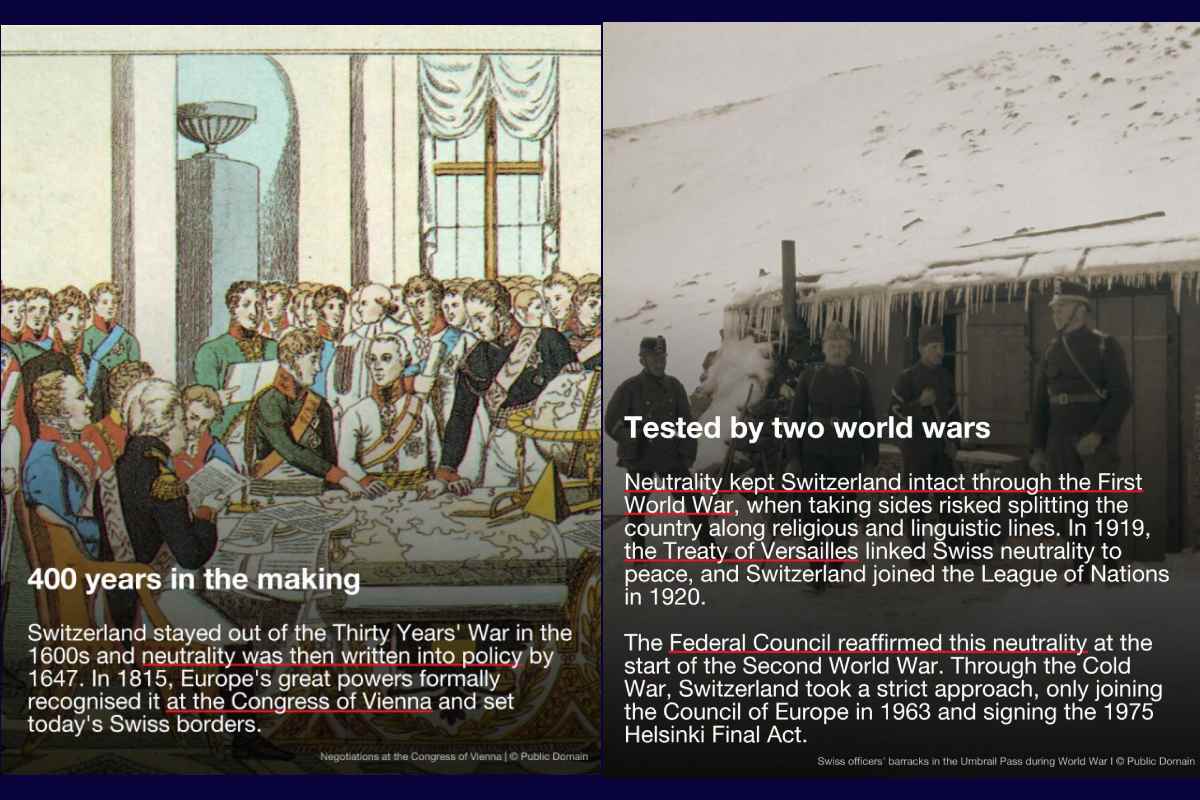
Swiss neutrality did not emerge overnight. It has been shaped over centuries by wars, diplomacy and a series of political choices that have influenced Switzerland’s position in Europe and the wider international system.
For around 400 years, neutrality has remained an important part of Switzerland’s national identity and foreign-policy tradition.
But neutrality is not simply about staying out of wars.
It has evolved over time in response to changing geopolitical circumstances, international law and Switzerland’s own political decisions.
The roots of Swiss neutrality can be traced to the aftermath of European conflicts, when Switzerland increasingly sought to avoid becoming directly involved in wars between major powers.
Over the centuries, the policy became closely associated with Switzerland’s sovereignty and its role as a country that could maintain relations with different sides during periods of international tension.
Switzerland’s neutrality was formally recognised by the European powers at the Congress of Vienna in 1815, helping establish the country’s permanent neutrality in the European political order.
The policy has since remained a defining feature of Swiss foreign policy, although its practical meaning has changed with the international environment.
Today, Swiss neutrality continues to raise questions about how a neutral state should respond to wars, sanctions and major geopolitical crises.
At the same time, Switzerland has sought to maintain an active international role through diplomacy, humanitarian engagement and its longstanding tradition of hosting international organisations and peace-related initiatives.
The history of Swiss neutrality therefore reflects more than four centuries of simply avoiding military alliances. It is a story of how a small European state has sought to protect its independence while navigating a changing international landscape.
The question remains: what does Swiss neutrality really mean in the 21st century?
