
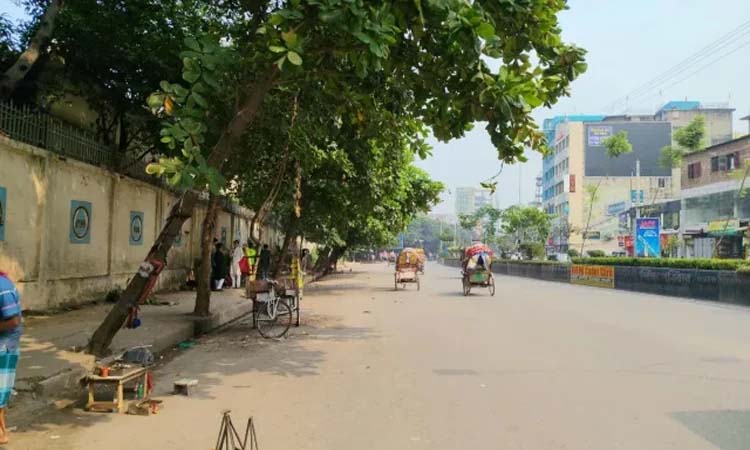
Dhaka reclaims footpaths, expands greenery for a liveable city
For years, walking along Dhaka’s busy streets meant navigating through crowded pavements, makeshift shops and food stalls, or stepping onto traffic-filled roads to reach a destination.
Footpaths intended for pedestrians had gradually turned into marketplaces, leaving little room for safe movement and adding to the capital’s traffic congestion.
That familiar picture is now beginning to change. Across the capital, authorities are clearing illegal occupations, restoring footpaths for pedestrians and introducing greenery and beautification projects to create a cleaner, safer and more liveable city.
The transformation is particularly visible in Mirpur, where the Dhaka North City Corporation (DNCC) has reclaimed footpaths in several busy locations, including Shah Ali Market, Sony Cinema Hall intersection, Muktobangla Market, Paikpara, Bangla College, the Sher-e-Bangla National Cricket Stadium area and Mirpur-10 roundabout.
Other cleared stretches include the pavement in front of Mirpur-10 Fire Service Station, Falpatti, Shah Ali Plaza, Anwar Mansion, Kazipara, Porbota, Shewrapara and SOS Hermann Gmeiner School.
A recent visit to these areas revealed a striking difference. The familiar calls of street vendors and rows of temporary stalls have largely disappeared from the reclaimed pavements.
Pedestrians can now walk more freely, while newly planted trees and flowerpots are helping discourage renewed encroachment and add a touch of green to the urban environment.
For many residents having access to unobstructed footpaths after years of inconvenience feels like reclaiming a basic civic right.
DNCC Administrator Md Shafiqul Islam Khan said street vendors would no longer be allowed to occupy footpaths.
“We were compelled to remove illegal structures and vendors from the footpaths.
Some syndicates and vendors themselves are responsible for the situation, as they gradually occupied not only the pavements but also parts of the roads, leaving ordinary people with nowhere to walk,” he said.
The transformation is also gaining momentum in southern Dhaka. The Dhaka South City Corporation (DSCC) has cleared illegal occupations from footpaths in Gulistan, Motijheel, New Market, Matsya Bhaban and Segunbagicha, among other areas.
Recently, the main road and pavements between Gate No. 1 of New Market near Nilkhet intersection and Gate No. 4 beside Chandrima Super Market have been cleared.
The road stretching from Priyangon Super Market to Nilkhet intersection has also been freed from encroachment. Flowerpots and ornamental plants have been placed in these areas to improve their appearance and discourage renewed occupation.
Beyond reclaiming public spaces, the DSCC is pursuing an ambitious urban greening programme. According to the corporation, a total of 2,30,120 trees have been planted along roads, at intersections, in playgrounds, parks, gardens, educational institutions.
Of those, 2,15,000 trees have been planted along 31 kilometres of road medians, while another 8,000 have been planted across 1.3 kilometres of intersections. A further 2,300 trees have been planted along 1.17 kilometres of road islands.
The corporation has also planted 3,500 trees across seven parliamentary constituencies, with 500 in each constituency. Around 900 trees have been planted around 12 of the 23 playgrounds developed under various projects.
Another 800 fruit-bearing, wooden, medicinal and ornamental trees have been planted in 14 of the city's 25 parks and gardens.
Educational institutions are also being brought into the greening initiative. Some 520 trees have been planted at Motijheel Government Boys' High School and 100 at the University of Dhaka, where another 400 trees are planned.
The DSCC is also planning to beautify road medians in collaboration with different organisations, offering selected stretches for development and maintenance.
The initiative covers numerous prominent roads and intersections across the capital, including Kakrail, Moghbazar, Shahbagh, Nilkhet, Dhanmondi, Panthapath and Malibagh.
One notable example of combining urban renewal with cultural identity can be found in Segunbagicha. After clearing and renovating its footpath, DSCC installed new dustbins and benches for pedestrians and repaired the boundary wall.
The wall now features graffiti portraits of 10 distinguished personalities who have contributed to the country's arts and culture, including Shilpacharya Zainul Abedin, filmmaker Satyajit Ray, poet Rabindranath Tagore and National Poet Kazi Nazrul Islam.
DSCC Administrator and freedom fighter Md Abdus Salam said the initiatives were designed to improve the urban environment, promote pedestrian-friendly infrastructure and enhance residents' quality of life.
He made it clear that illegal occupation of roads and footpaths would not be tolerated. Repeated violations, he warned, would invite further eviction drives, confiscation of goods and, where necessary, legal action and arrests.
Urban planners said accessible footpaths, safe pedestrian movement and adequate greenery are essential components of a modern, liveable city.
Reclaiming pavements allows people to walk safely without entering busy roads, while organised greenery can improve the urban landscape and contribute to environmental balance, they said.
However, sustaining the progress will require more than occasional eviction drives.
Humayun Kabir, a bank official, described the initiative as a long-awaited response to the aspirations of city residents. He cautioned that preventing renewed encroachment, ensuring regular monitoring and maintaining cleanliness and continuing planned greening would remain major challenges.
He also stressed the importance of addressing the livelihoods and rehabilitation needs of street vendors through humane and well-planned measures.
As Dhaka begins to reclaim its footpaths and introduce more green spaces, the transformation offers a vision of a city where pedestrians can walk without fear, roads function more efficiently and public spaces become welcoming places for everyone.
The real test, however, will be whether this change can be sustained.
A truly liveable Dhaka will depend not only on clearing its footpaths but also on protecting those as shared public spaces for generations to come.
