
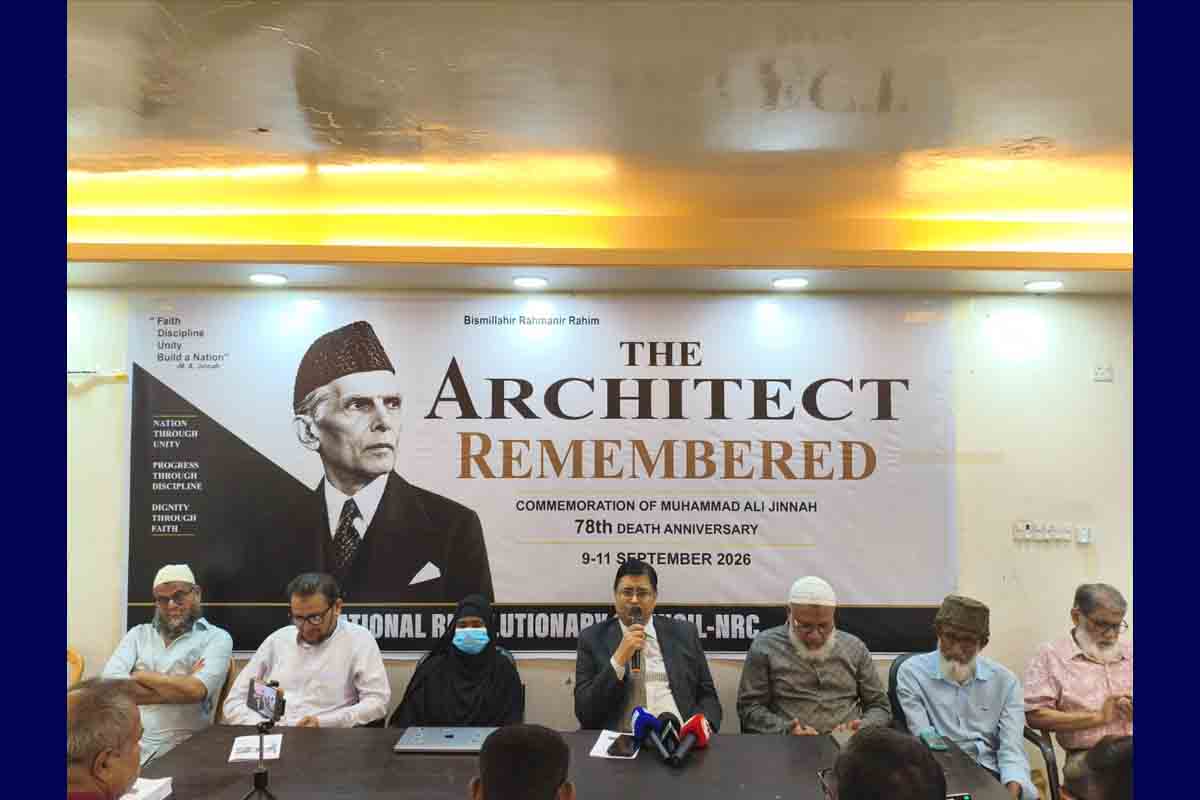
Jinnah remembrance programme begins in Dhaka
A three-day remembrance programme marking the 78th death anniversary of Muhammad Ali Jinnah, the founder of Pakistan, began in Dhaka on Wednesday, with speakers reflecting on his role in the history of the subcontinent and debating the relevance of his political ideas for Bangladesh today.
Titled “The Architect Remembered,” the programme is being organised by the Jatiya Biplobi Parishad, a Muslim nationalist political forum, at the NRC Centre in Purana Paltan.
Speaking as the chief guest at the opening session, senior journalist, editor and poet Maruf Kamal Khan Sohel said Jinnah played a decisive role in the creation of Pakistan and argued that the political history leading to Pakistan was also connected to the eventual emergence of Bangladesh.
“Without Muhammad Ali Jinnah, Pakistan would not have come into being, and without Pakistan, the nation-state of Bangladesh would still have remained a dream,” he said.
Khan, who previously served as press secretary to former prime minister Khaleda Zia, said the people of the region inherited a long and interconnected history of the Indian subcontinent.
He recalled the political movement led by Jinnah and said the people of the time honoured him with the title Quaid-e-Azam, meaning “Great Leader”, out of admiration for his leadership.
The senior journalist also called for a reassessment of the way Jinnah has been portrayed in Bangladesh in recent years. He described Jinnah as a prominent anti-colonial leader and the architect of a separate Muslim state in South Asia.
A concept paper titled “Reclaiming Jinnah” was presented at the programme by Tamima Zobaida, a PhD researcher at Waseda University in Japan.
Zobaida said Jinnah’s political career could offer lessons for Bangladesh’s efforts to rebuild constitutional and democratic institutions following the July movement.
According to her, Jinnah not only played a central role in securing an independent homeland for Muslims under British colonial rule but also sought to establish constitutional structures and democratic institutions after Pakistan’s independence.
Drawing a parallel with Bangladesh, she argued that the country now needs to focus on constitutional reconstruction and democratic institutional reform.
She further observed that ideas surrounding Muslim nationalism and democratic Muslim politics are attracting renewed interest among sections of Bangladesh’s younger generation. Against this backdrop, she said, Jinnah is once again emerging as an influential historical figure for some young Bangladeshis.
The discussion reflected a broader debate over how the political legacy of Jinnah should be understood by a new generation in Bangladesh and across South Asia.
The opening session was presided over by Khomeni Ihsan, convener of the Jatiya Biplobi Parishad, while the organisation’s member secretary Dr Nabil Ahmed conducted the programme.
Among those who addressed the gathering were Professor Lt Col (Retd) Akram Ali, Dr Farid Uddin, Engineer AKM Rezaul Karim and Advocate Mostafa Jamal Chowdhury.
Mohammad Kamran Saeed Usmani, president of Pakistan’s Young Muslim League, joined the programme online and addressed the participants.
The welcome speech was delivered by the organisation’s senior joint convener Mohammad Shamsuddin.
Several other leaders and activists, including Mezbauddin Ahmed, Mohammad Abdul Jabbar, Minhajul Abedin Sharif and Shah Nazmul Hasan Ferdous, attended the event.
The organisers said the three-day programme aims to encourage discussion on Jinnah’s political role and historical legacy rather than simply commemorate his death anniversary.
As part of the observance, a photo exhibition documenting different aspects of Jinnah’s life has been arranged at the NRC Centre.
The exhibition will remain open to the public throughout the three-day programme, from 11am to 7pm each day.
On Friday, the final day of the programme, participants will visit the Shrine of the National Three Leaders after Juma prayers. A prayer meeting will subsequently be held at the central mosque of the university after Asr prayers.
The organisers said the programme is intended to provide an opportunity to revisit Jinnah’s place in the political history of the subcontinent and examine how his ideas and legacy are being interpreted by younger generations today.
