
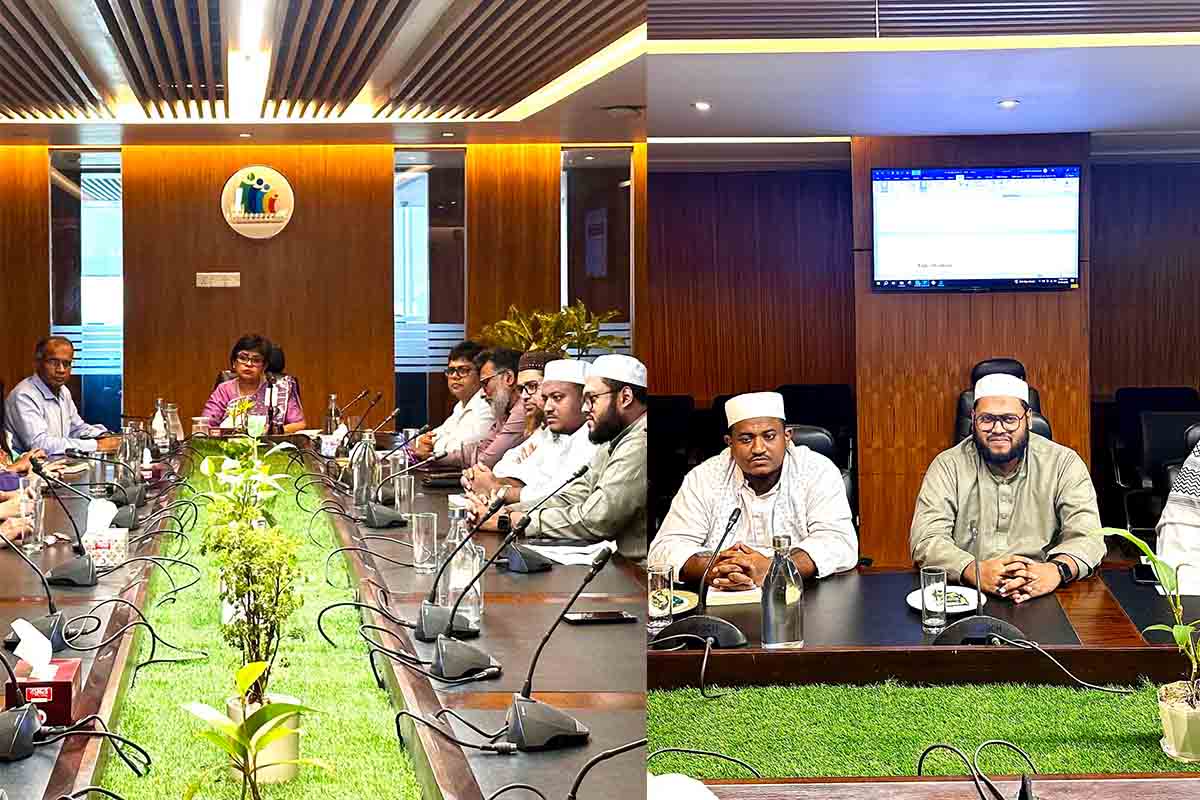
NSDA formulating competency standards for Arabic
The National Skills Development Authority (NSDA) is formulating competency standards and a curriculum for Arabic language for the first time in Bangladesh to tap employment opportunities in the international labour market for people proficient in the language.
The initiative could open up potential employment opportunities in around 50 countries where Arabic is widely used, including 22 countries where it is the primary language and 28 where it is spoken as a second language.
The initiative also aims to establish a uniform standard for Arabic language training and create opportunities for citizens to receive quality training at NSDA-registered training institutions.
A day-long validation workshop on the Competency Standard (CS) and Course Accreditation Document (CAD) for Arabic language was held at the NSDA conference room in Agargaon, Dhaka, on Tuesday.
Arabic language experts, academics, trainers, representatives of government and private organisations and industry representatives took part in the workshop.
NSDA Executive Chairman and Secretary Dr Naznin Kawsar Chowdhury chaired the workshop.
The participants discussed the knowledge, skills, training content, learning outcomes and assessment methods required for learning Arabic. They also provided opinions and recommendations on the proposed competency standard and curriculum.
In her address, Dr Naznin said skills development training needs to be made standardised, recognised and employment-oriented in line with the demands of the international labour market.
“Competency standards and training frameworks are being developed with the participation of industry, academia and relevant experts to make them timely and effective,” she said.
She said the initiative was taken in line with the government’s commitment to creating employment, developing skilled human resources and tailoring skills development programmes to the demands of the international labour market.
“Language skills are no longer limited to communication. They play an important role in education, employment, migration and international careers,” she said.
“If young people can be equipped with proficiency in Arabic through quality training, new opportunities will be created for them both at home and in the international labour market,” she added.
The competency standard and CAD will be finalised based on the recommendations and opinions of stakeholders. Arabic language training will subsequently be offered through NSDA-registered training institutions in accordance with the prescribed standards.
This is expected to establish a structured system for training, assessment and recognition of Arabic language skills.
The NSDA has been working to develop skilled human resources proficient in different languages based on international labour market demand. Competency standards and curricula for English and Japanese have already been developed.
Work is currently underway to formulate competency standards and curricula for Chinese, Korean and Italian, alongside Arabic.
Among those attending the workshop were Dhaka University Arabic Department Chairman Prof Dr Md Mizanur Rahman, Islamic Foundation Director of the Zakat Fund and Research Department Dr Waliur Rahman Khan, Bangladesh Betar Chief Executive of External Services Dr Mohammad Enamul Haque, Bangladesh Open University Open School Assistant Professor Dr Mohammad Qutub Uddin, former Islamic Foundation Director Maulana Mofazzal Hossain Khan, Arabic language trainer Md Nuruddin, Markazul Lughatil Arabia Bangladesh Founder Director Mohiuddin Farooqui, Qatar Embassy Senior Translator Hamed Jamil Hossain and Jamiatul Ustaz Shahidullah Fazlul Bari Arabic Language and Literature Department teacher Alamgir Murtaza.
