
The government between 1972 and 1975 had no engagement with the public, which is why it had to resort to state violence to cling to power.
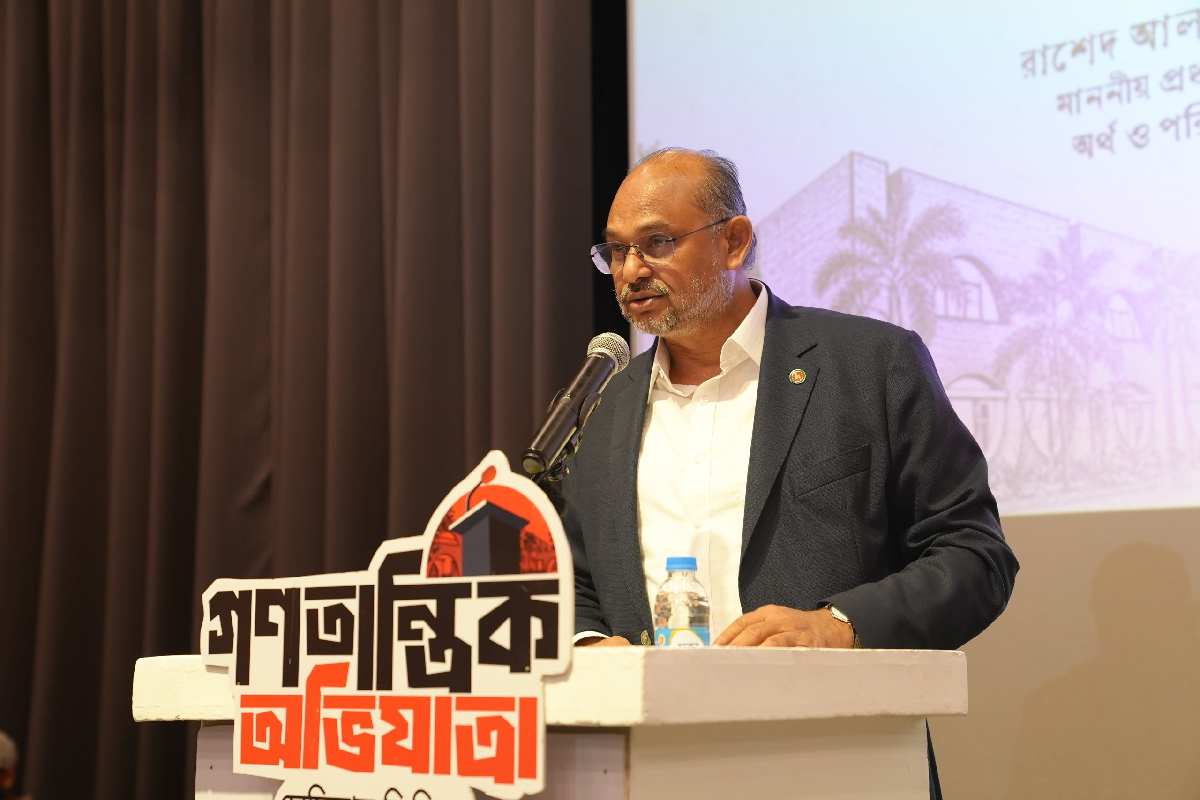
Rashed Al Mahmud Titumir, Adviser to the Prime Minister on the Ministry of Finance and the Ministry of Planning, remarked that the 1974 famine engulfed Bangladesh because the regime acted contrary to the aspirations of the people. He made these remarks on Sunday at a seminar titled ‘The 1974 Famine: Post-Independence Economic Crisis,’ organized by the July Mass Uprising Memorial Museum in the capital's Sher-e-Bangla Nagar.
He stated, ‘The government during the 1972–1975 period did not adhere to any of the fundamental characteristics required to govern a state. They established an administration that maintained virtually no connection with the populace. Consequently, paramilitary forces were formed specifically to repress citizens.’
He further noted, ‘In 1972, when the international market price of rice stood at $147 per metric ton, it was $316 per metric ton in Bangladesh. This stark disparity clearly demonstrates the total absence of market regulation and accountability. Beyond the economy, they failed across almost every facet of governance. The then-rulers possessed no real engagement with how a state operates; they did not believe in the sovereignty of the people.’
Drawing a comparison between the 1972–1975 era and the Sheikh Hasina administration, he remarked, ‘They never hesitated to unleash oppression on people just to hold on to power. They lacked public legitimacy. Whoever opposed the government was murdered. If you observe closely, dissenting voices were suppressed in an identical manner throughout Sheikh Hasina’s tenure from 2009 to 2024. The Sheikh Hasina regime was essentially an extension of the 1972–1975 rule.’
Rashed Al Mahmud Titumir added, ‘Some claim they wish to return to the country this December. In reality, they never had any connection with this land’s soil, grass, water, or its people. They will never be able to return to this country.’
Writer and Treasurer of Panam Institute Asif Iqbal, alongside economist and researcher Dr. Nahian Bin Khaled, participated as discussants in this event, the fifth episode of the July Museum’s Democratic Journey Seminar Series.
Asif Iqbal stated, ‘Nearly 1.5 million people lost their lives due to the post-independence economic crisis. Nowhere in the world is there a precedent of such massive loss of life resulting from an economic crisis. Therefore, rather than a mere crisis, it should rightly be characterized as an economic catastrophe.’
He continued, ‘Following the fall of the regime in 1975, there was no grief or mourning among the public. Just months earlier, the searing memory of starvation deaths was fresh in their minds. It was those very citizens who took to the streets alongside the soldiers just two months later to stage an uprising, as the people had no desire to return to that past political framework.’
He also noted, ‘This year, on National Revolution and Solidarity Day, the head of government walked out in front alongside ordinary citizens in a public rally. This is a model of connecting directly with the people. He understands that citizens hold expectations of him and his government, and that he must walk among them—a leadership presence entirely missing during the 1974 famine.’
Economist Dr. Nahian Bin Khaled observed, ‘A major cause of the 1974 famine was the hoarding and monopolization of food security and resources by a group of vested beneficiaries. The rationing cards at the time fell into the hands of a privileged class. Consequently, rural farmers, laborers, and ordinary citizens were left completely deprived.’
He added, ‘Hoarders back then stockpiled rice, yet the government utterly failed to rein in their dominance or regulate the market system. The famine of 1974 sowed deep seeds of public outrage.’
Delivering the presidential address, Ehasan Mahamud, Director General of the July Mass Uprising Memorial Museum, said, ‘While there were certain global crises at the time, gross market failures and political mismanagement were the primary drivers of the 1974 famine. A close look at the 1972–1975 regime reveals that the ruling elite rendered institutions dysfunctional through nepotism and favoritism toward their kin. They dictated who would receive everything from rice and wheat down to relief blankets.’
Highlighting the scarcity of the 1974 famine in art and literature, he stated, ‘Apart from Rafiq Azad’s poem ‘Bhaat De Haramzada Noile Manchitro Khabo’ (Give Me Food, You Scoundrel, Or I’ll Devour the Map), you will find very few references to the 1974 famine in literature. You won't find songs, stage plays, or other forms of fine art centered on the famine. Even what little was produced was deliberately swept under the rug. You will hardly see exhibitions of Shilpacharya Zainul Abedin’s famine-related artwork either; those works may be adorning the private residences of elites, whereas they rightfully belonged on public display for ordinary citizens.’
The seminar was moderated by author and researcher Tuhin Khan. University teachers, researchers, legal professionals, students, and representatives of civil society attended the event.
