
Government says sovereign AI, digital access and tech diplomacy are key to achieving trillion-dollar economy
DHAKA, Oct 8: Bangladesh has placed artificial intelligence at the centre of its technology diplomacy and public service delivery, with the government saying it plans to develop its own sovereign AI capability within the next 12 months.
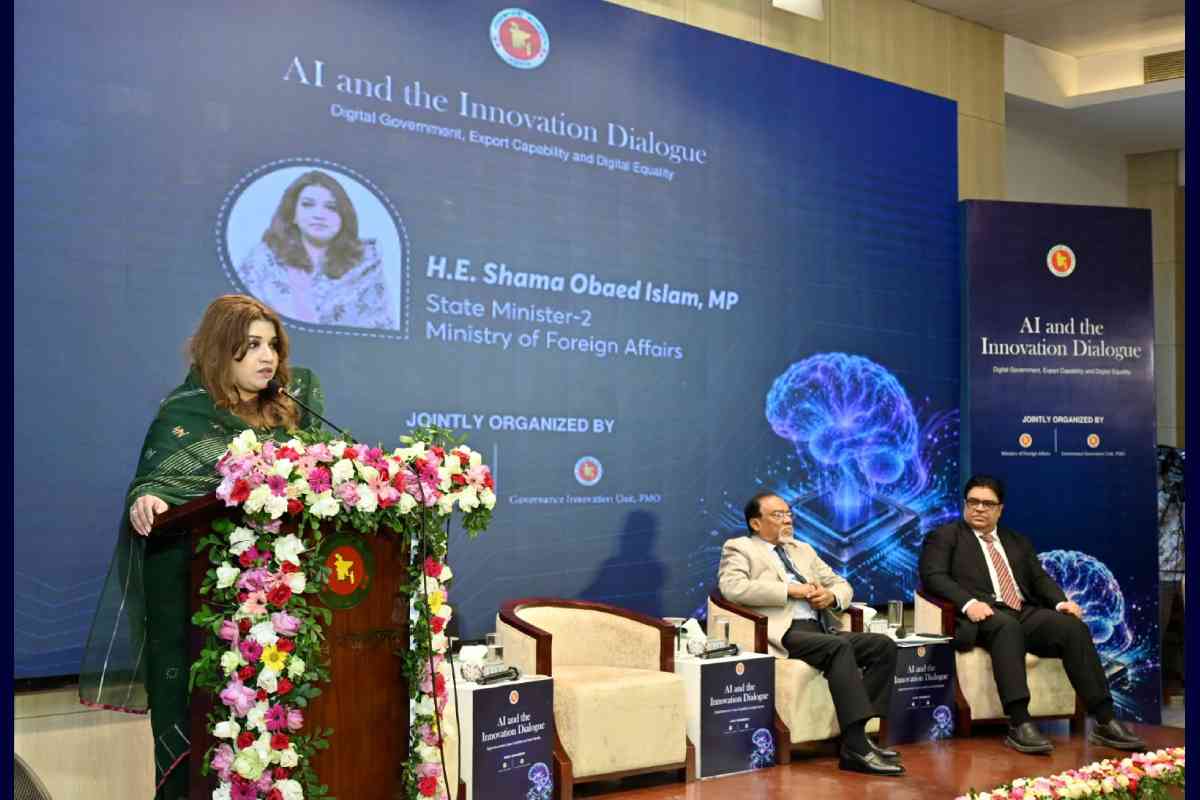
The announcement came at the “AI and Innovation Dialogue”, jointly organised by the Governance Innovation Unit (GIU) of the Prime Minister’s Office and the Ministry of Foreign Affairs in Dhaka on Thursday.
The dialogue was the third in a series that emerged from the thematic discussions on trade, growth and economic diplomacy held in June.
Adviser to the Prime Minister on Public Administration and GIU head Md Ismail Zabihullah, who attended the event as chief guest, stressed the need for a whole-of-government approach to harness the benefits of AI.
He also called for stronger institutional coordination and seamless interoperability among public service delivery systems.
Adviser to the Prime Minister for Posts, Telecommunications, Information Technology and Science and Technology Rehan Asif Asad highlighted the government's focus on expanding public access to digital devices and computing platforms.
He said the government is taking measures to establish high-speed and secure connectivity infrastructure.
According to Rehan, Bangladesh will have its own sovereign AI within the next 12 months, with computing chips and memory blocks for the planned platforms already secured.
He also said Bangladesh would soon be able to produce advanced feature phones at affordable prices, attributing the development to government policies.
State Minister for Foreign Affairs Shama Obaed Islam said AI would become a major driver of Bangladesh's economic growth as the country pursues its trillion-dollar economy target.
“Artificial Intelligence will form the primary axis in the economic engine of the country to achieve the trillion-dollar economy,” she said.
She highlighted recent institutional reforms at the foreign ministry aimed at strengthening the country's focus on the creative economy and emerging areas shaping economic development.
The state minister also stressed government support for technology startups and efforts to reshape economic diplomacy around technological capabilities.
Referring to a recent ministerial visit to Silicon Valley, she called for narrowing the gap between Dhaka and Silicon Valley in terms of technological competence.
She said the government's “Bangladesh First” approach means the country should aspire to become a provider of technology rather than remaining primarily a technology buyer.
Shama also emphasised the need to prevent the misuse of technology for gender-based violence.
She said AI and automation should complement people's capabilities rather than replace workers.
“We don't want AI or automation to replace our people — rather, we want tech to augment our capabilities and business profiles,” she said.
She also highlighted the need for sovereign AI and integrated digital public services as part of the government's broader economic and governance objectives.
State Minister for Foreign Affairs Humaiun Kobir said garments and remittances have historically been major pillars of Bangladesh's economy, but argued that the country now needs to develop a third pillar — knowledge workers.
He said the government's trillion-dollar economy ambition would require stronger national capabilities in AI and other advanced technologies.
Kobir also said “Bangladesh First” should not be interpreted as Bangladesh acting alone.
“It means Bangladesh is ready for investment, for cooperation,” he said.
He called for greater collaboration among ministries to streamline government workflows and improve service delivery.
The state minister also stressed the importance of strengthening the capacity of state institutions to adopt AI and other emerging technologies.
Foreign Secretary Ambassador Salahuddin Noman Chowdhury, in his opening remarks, said the central question surrounding AI is who controls the technology and who benefits from it.
Bangladesh wants to become an equitable beneficiary of AI rather than merely a consumer, he said.
He added that Bangladesh also seeks to play a bridge-building role among different global stakeholders on AI governance.
The foreign ministry will coordinate views from relevant stakeholders to help shape Bangladesh's position at the upcoming UN Global Dialogue on AI Governance, according to the foreign secretary.
Technical papers were presented by the Information Technology and Information Technology (ITIT) Wing of the Ministry of Foreign Affairs and the UNDP as part of efforts to benchmark the discussions and establish an AI Policy Lab in Dhaka.
Lt Gen (retd) Md Mahfuzur Rahman, chairman of the Osmani Centre for Peace and Security Studies, discussed the security dimensions of AI in Bangladesh and beyond.
Joan Ai, co-founder and executive director of the Blanchard House Institute, delivered a special address, while Dr Delwar Hossain, director general (additional secretary) of GIU, gave the vote of thanks.
Twenty-five international organisations and 85 Bangladeshi diplomatic missions joined the session online.
Senior officials from relevant ministries and agencies, members of the diplomatic corps, development partners, technology companies, startups, enterprises, chambers, academics and think tanks also participated in the dialogue.
