
Non-tariff barriers, jute anti-dumping duties, land ports and trade imbalance among key issues at JWG meeting
DHAKA, Oct 8: India should provide greater market access and trade facilities to Bangladesh, particularly in its northeastern states, instead of pursuing a restrictive approach to bilateral trade, economists have said.
They made the observations ahead of the 16th meeting of the Bangladesh-India Joint Working Group on Trade, scheduled to be held in New Delhi on Thursday and Friday, where Dhaka is expected to raise a range of longstanding bilateral trade concerns.
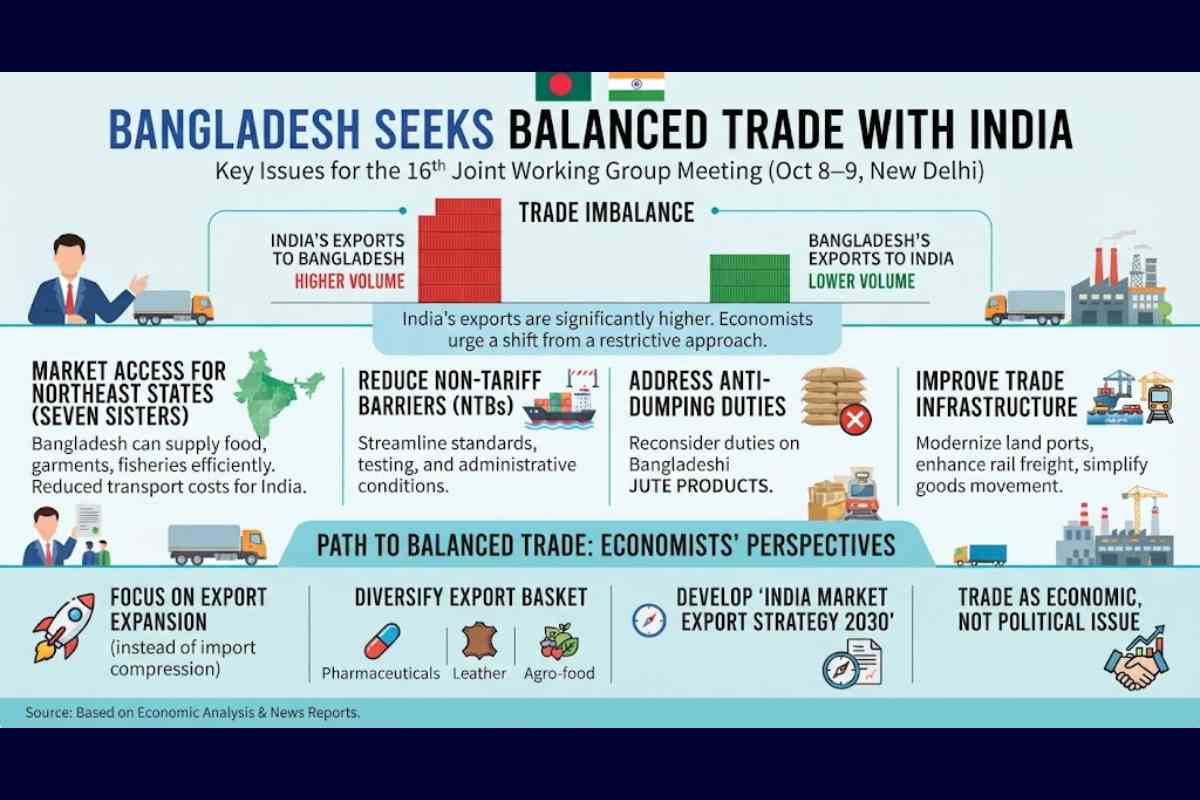
The issues include non-tariff barriers, anti-dumping duties imposed on Bangladeshi jute goods, rail freight, the movement of goods through land ports and the overall trade imbalance between the two countries.
Bangladesh is expected to raise almost all major trade-related issues at the meeting. However, the Comprehensive Economic Partnership Agreement (CEPA) is reportedly not on the agenda this time.
India's exports to Bangladesh remain significantly higher than Bangladesh's exports to India, making the trade deficit another important issue for discussion.
Former Bangladesh Economic Association joint secretary economist Badrul Munir said India has significant scope to expand imports from Bangladesh, particularly to its northeastern region known as the Seven Sisters.
The seven states are Arunachal Pradesh, Assam, Manipur, Meghalaya, Mizoram, Nagaland and Tripura.
"India could allow greater imports of essential products into these states, as transporting goods from other parts of India involves considerable distance, time and cost," Munir told The Shuttle Times.
He said Bangladesh could supply food products, garments and marine fisheries products to the northeastern states at competitive prices.
According to Munir, greater market access for Bangladeshi products would also benefit India by reducing transportation costs and improving supply efficiency in the region.
He, however, argued that India has so far maintained a restrictive approach to granting such market access.
Munir also stressed the importance of cooperation in the Bay of Bengal, saying stronger maritime cooperation between the two countries could create new economic opportunities.
He said Bangladesh needs to strengthen its capacity to utilize and protect its maritime resources while exploring opportunities for greater regional trade and investment.
"India should take a more progressive approach to trade diplomacy with Bangladesh," he said.
Agricultural economist Dr Jahangir Alam urged India to reduce anti-dumping duties on Bangladeshi jute products and adopt a more positive approach to bilateral trade.
"Given the size of the Indian economy and the fact that we share a border, we need to pursue a very careful and constructive approach," he said.
He also stressed the importance of cooperation in the agricultural sector.
Bangladesh imports a number of agricultural products, and disruptions or restrictions in agricultural trade could have implications for both countries, he said.
"There is huge scope for India to provide greater trade facilities to Bangladesh. Both sides need to work toward mutual understanding," Jahangir said.
CPD Senior Research Fellow economist Towfiqul Islam Khan said bilateral trade should be viewed primarily from an economic and business perspective rather than being politicised.
"The economy and trade should not be politicised. The trade environment should remain favourable for businesses in both countries," he said.
Towfiqul said governments facilitate the trade environment, while businesses and entrepreneurs are ultimately responsible for conducting trade.
He also cautioned against viewing the bilateral trade deficit in isolation.
"For example, if Bangladesh imports cotton as a raw material, produces garments and exports those products to third countries, the import itself can create greater export opportunities," he said.
Therefore, Bangladesh should assess the trade deficit in terms of the broader business and production opportunities generated by imports, he added.
Former Bangladesh Economic Association general secretary economist Dr Aynul Islam said Bangladesh should focus on expanding exports rather than simply trying to reduce imports to narrow the trade deficit.
He suggested diversifying Bangladesh's exports to Indian state-level markets beyond traditional garment products.
Potential areas include pharmaceuticals, leather and agro-food products, he said.
Aynul also called for the removal of non-tariff barriers, modernisation of land ports and greater value addition to Bangladeshi products.
He said Bangladesh could also explore joint ventures, use Indian industrial raw materials for export-oriented production and expand services exports.
He proposed developing a targeted "India Market Export Strategy 2030" to promote sustainable and more balanced trade between the two neighbours.
Economists said Bangladesh's priority should therefore be to secure predictable market access, reduce non-tariff barriers and improve trade infrastructure while developing products and services that can compete effectively in the Indian market.
They also stressed that a more balanced trading relationship would depend not only on reducing India's exports to Bangladesh, but on creating greater opportunities for Bangladeshi exporters in India.
