
Bangladesh pushes interoperable, secure, shared digital government systems.
Posts, Telecommunications and Information Technology Minister Faqir Mahbub Anam today said the government needs to move away from the mindset of "every organization builds its own system" towards a model where common capabilities are built and shared across government.
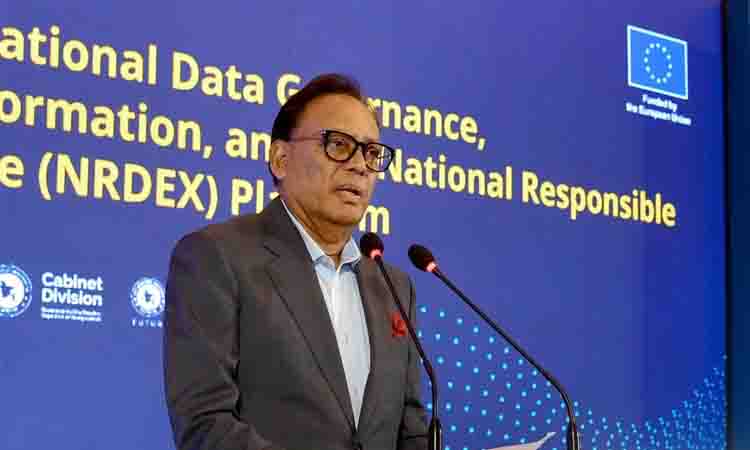
"That is why today's discussion around interoperability and the National Data Exchange is particularly relevant," he said while speaking as the chief guest at a seminar on National Data Governance, Digital Transformation, and the National Responsible Data Exchange (NRDEX) Platform.
Information and Communication Technology (ICT) Division organised it in the capital's Hotel Pan Pacific Sonargaon in collaboration with the e-Governance Academy (eGA) and Funded by the European Union under the Global Gateway Initiative.
Prime Minister's Adviser on Posts, Telecommunications and Information Technology spoke as special guest.
Michal Krejza, Head of Unit - Head of Cooperation, EU Delegation to Bangladesh and Farah Shammi, Secretary, Coordination and Reforms, Cabinet also spoke as special guests.
Nahid Sultana Mallik, Executive Director, Bangladesh Computer Council and PD of E-ffective e-governance project and Ingrid Toonekurg, Member of the E- Governance Academy Management Board delivered Welcome remarks.
Information and Communication Technology Division Secretary Md. Mamunur Rashid Bhuiyan chaired the event.
The minister said Bangladesh had invested significantly in digital systems over the years, with many organisations developing databases, applications, portals and infrastructure.
"But we must also be honest about an important reality: having many digital systems does not automatically create a digital government," he said.
With the leadership of Prime Minister Tarique Rahman, the government is working to create an integrated digital ecosystem, he said, adding that citizens are repeatedly asked to provide the same information to different agencies.
Government organisations sometimes build similar capabilities separately, while new projects are occasionally designed without sufficient consideration of how they will connect with the wider digital ecosystem, he said.
"This is not a criticism of technology itself. It is a question of approach," the minister said.
He said government institutions, where appropriate, should be able to verify information rather than repeatedly collect it, reuse common infrastructure rather than continuously duplicate investment, and securely exchange authorised data under clear rules.
"But interoperability is not simply a technical matter," he said, adding that it requires governance, standards, accountability and, above all, institutional willingness to work together.
The minister cautioned against creating a new central platform without addressing the underlying coordination problem, saying technology cannot compensate for weak governance.
"A national architecture must therefore be supported by clear institutional responsibilities, legal safeguards, data protection and trust," he said.
He said the objective should not be to centralise everything, but to make government work together where coordination creates value.
As Bangladesh moves forward, the focus should increasingly shift from isolated digital projects to reusable national capabilities, including identity, trusted data exchange, common infrastructure, secure computing capacity and other shared digital public infrastructure, he said.
"Every taka invested in digital transformation should raise a simple question: Can this capability be reused by others?" he said.
"If the answer is yes, we should avoid building the same thing again," he added.
The minister said citizens do not experience government as separate databases and ministries, but as a whole, and therefore government systems must increasingly operate as a connected ecosystem.
He said the programme was an opportunity to discuss the transition seriously, not to defend previous approaches, but to identify what needs to change.
"The task ahead is substantial. But the direction is clear," he said, adding, "We need less duplication and less fragmentation."
In his speech, Rehan Asif Asad stressed the importance of connectivity, artificial intelligence (AI) and cybersecurity for the country's digital future.
"If we do not have connection with you, we have nothing to eat," he said, emphasising the growing importance of connectivity in people's lives and the digital world.
He said connectivity could come through multiple means, including mobile and broadband networks, while customers or services ultimately do not care how their devices are connected.
Asad said it was surprising that even after over more than 20 years of digital transformation, the country still lacks digital public infrastructure.
He said that over the past six months, multiple options had been examined, including experiences of neighbouring countries.
The adviser also stressed the need to teach the new generation about AI so that Bangladesh could leap forward and become one of the best countries in the world in AI-related technology.
At the same time, he cautioned that the deployment of AI must be accompanied by greater attention to cybersecurity, saying the country's infrastructure and systems face significant cybersecurity challenges.
A question and answer session was also taken place where the minister, adviser, secretaries and expert were present and replied answers.
Exchange (NRDEX), which provides the foundation for secure, standardised and accountable data exchange between government institutions.
The seminar brought together senior government leaders, policymakers, public institutions, development partners, private sector representatives and international experts to discuss Bangladesh's digital transformation priorities, explore international experiences and highlight the role of NRDEX as a foundational component of the country's digital government ecosystem.
The seminar aims to raise awareness of the Government of Bangladesh's digital transformation agenda and strategic priorities while supporting understanding of the implementation of the National Data Governance Act 2026, Personal Data Protection Act 2026 and Cyber Security Act 2026.
It highlighted the role of digital public infrastructure, particularly digital identity and foundational registries, as key enablers of modern e-government, and provide a platform for sharing international experience on interoperability, shared government services and secure data exchange.
The programme showcased Estonia's experience in implementing the Once-Only Principle and trusted data exchange services, promote understanding of data ownership, responsible data sharing and privacy-by-design principles, and introduce the operational model, governance arrangements and membership process of the NRDEX.
In addition, the seminar sought to encourage participation by prospective member institutions for secure and accountable data exchange.
