
Government reinforces zero-tolerance policy against drugs, trafficking.
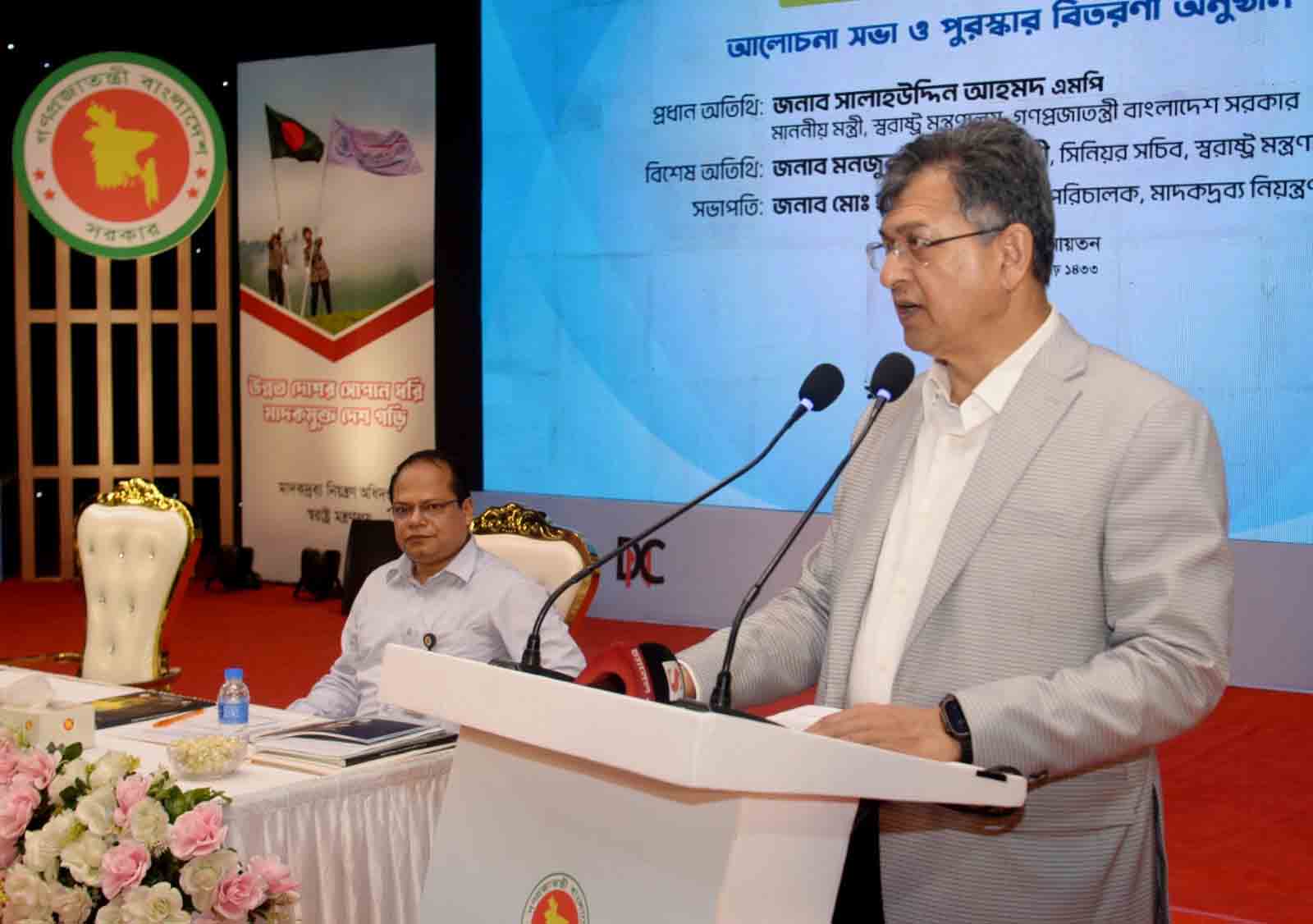
Home Minister Salahuddin Ahmed today said the government is following a 'zero tolerance' policy against drugs and is working to implement the strategy strictly.
“To pave the way for the country's promising and bright future and maintain economic growth, the youth must be kept drug-free,” said Salahuddin.
He said one of the commitments in the BNP’s election manifesto was to protect the youth of the country from drugs and gambling and the incumbent government is working accordingly.
He made the remarks while addressing as the chief guest at a discussion and award-distribution ceremony here.
The event was organised by the Department of Narcotics Control (DNC) at the Osmani Memorial Auditorium here on the occasion of 'International Day against Drug Abuse and Illicit Trafficking 2026'.
DNC Director General Md Hasan Maruf presided over the event, while Home Senior Secretary Manzur Morshed Chowdhury spoke as the special guest.
Senior officials of different ministries and departments, DNC officers and employees, representatives of government and non-government organisations involved in drug treatment and research, as well as voluntary organisations, teachers, students, guardians, religious leaders, civil society and journalists were present.
The minister said the DNC officers are fighting with armed drug dealers risking their lives, but they do not have any weapons.
To remove this legal vacuum and modern challenges, the 'Amendment Bill to the Narcotics Control Act' will be introduced in the National Parliament within the next 2-1 days, he said.
Through this, this force will be strengthened, he added.
Salahuddin said the DNC officers will be given modern weapons along with up-to-date training to crack down on armed drug dealers and smugglers using modern technology.
He said there are about 80,000 drug cases pending in Dhaka alone.
Due to the shortage of judges, it is not possible to settle the large number of cases quickly, he said.
The home minister said to overcome this situation, the amended law has made strict provisions for establishing 'special tribunals' to ensure speedy trial of drugs wherever necessary considering the number of cases.
He said in addition, a legal proposal has been made to add a modern ‘dog squad’ to the DNC for accurate drug identification and to establish 'detention centres' to keep the accused during the interim legal process after their arrest.
An advanced chemical laboratory will be set up in each district of the country to prevent fraud in chemical tests of drugs, he said.
Referring to the challenge of digital crime, the minister said currently, drug and gambling crimes have shifted to cyberspace and various digital platforms.
Drug trafficking gangs are currently targeting young people through digital platforms, especially social media and encrypted communication systems, he said.
Salahuddin said it is not possible to prevent the modern online betting and crypto-crime of the present era with the old Gambling Prevention Act of 1867.
Changes are being made in the legal framework on the advice of NTMC to strictly track the money laundering or money laundering that is taking place through anonymous SIMs using Mobile Financial Services (MFS) using OTP and WhatsApp, he said.
The minister said the government is not limited to arresting only retailers or carriers, but is also committed to bringing the main masterminds, financiers or godfathers of the drug trade to justice.
He said strict clauses have been included in the new amendment to confiscate all illegal assets acquired with black money from drugs.
He said strict action is being taken under the ‘Narcotics Control Act, 2018’ and the ‘Money Laundering Prevention Act, 2012’.
The home minister said the Department of Narcotics Control has already filed 9 such money laundering cases and 23 more serious investigations are currently underway.
Praising the joint role of BGB, Coast Guard, RAB and police, he said the discovery of the most heinous synthetic drug 'Ketamine' laboratory in a place like Uttara in Dhaka proves how modern the criminals are.
Along with traditional drugs, the outbreak of new synthetic and semi-synthetic drugs or 'New Psychoactive Substances' has further intensified the risk of drug addiction, he said.
Salahuddin said drug addiction is a serious mental and physical disease and those who fall into its trap are not criminals in the eyes of society or the state, but rather patients.
So, he said, 200-bed government treatment centres will be built at the divisional level to bring them back to a healthy state.
The minister also said it is not possible for any single country or single organisation to eliminate drugs as it requires a collective social movement.
He called upon society, educational institutions, guardians, teachers, religious leaders, civil society and all volunteers and non-governmental development organisations to raise voice against drugs from their respective positions to protect the youth of the country and the future generation.
The minister earlier visited the special anti-drug stall set up on Osmani Memorial Auditorium premises.
