
Indian Media Challenges Dhaka’s Preconditions Ahead of Possible Summit
DHAKA, August 21, 2026 — Indian media and various digital content creators are trying to spread misinterpretations and criticized regarding Prime Minister Tarique Rahman's possible visit to India and the issue of bringing Sheikh Hasina back to the country.
Some Indian media outlets and content creators are claiming that bringing Sheikh Hasina back home is not a key condition for Prime Minister Tarique Rahman's visit to India; rather, it is being brought forward as an element of political bargaining. However, no official position or reliable evidence has been found in all cases to support such statements.
Bangladesh’s Foreign Affairs Advisor Humayun Kabir remarks as these reports speculative and baseless, saying that Bangladesh will not rush the Prime Minister's visit to India beyond national interests and mutual consensus.
Bangladesh has ruled out any high-level engagement with India without established mutual trust and clearly outlined diplomatic objectives.
Speaking on speculation surrounding Prime Minister Tarique Rahman’s potential visit to New Delhi for the BRICS Summit on September 12–13, spokesperson Kabir emphasized that Dhaka will not pursue summit-level talks prematurely.
Any high-level visit, Kabir added, would require mutual respect for sovereignty, formal diplomatic ground preparation, and an honorable invitation from New Delhi.
Some Indian media outlets and digital content creators have portrayed the extradition of Sheikh Hasina as a central issue in discussions surrounding Tarique Rahman’s possible India visit.
Some have further suggested that the extradition issue could be used as political leverage, while alleging that the Bangladesh government may not be actively seeking her return.
However, no official statement or independently verified evidence has emerged to substantiate such claims.
Bangladeshi political observers have urged caution in interpreting such commentary, emphasizing the need to distinguish between media analysis, individual political opinions and the official positions of the governments concerned.
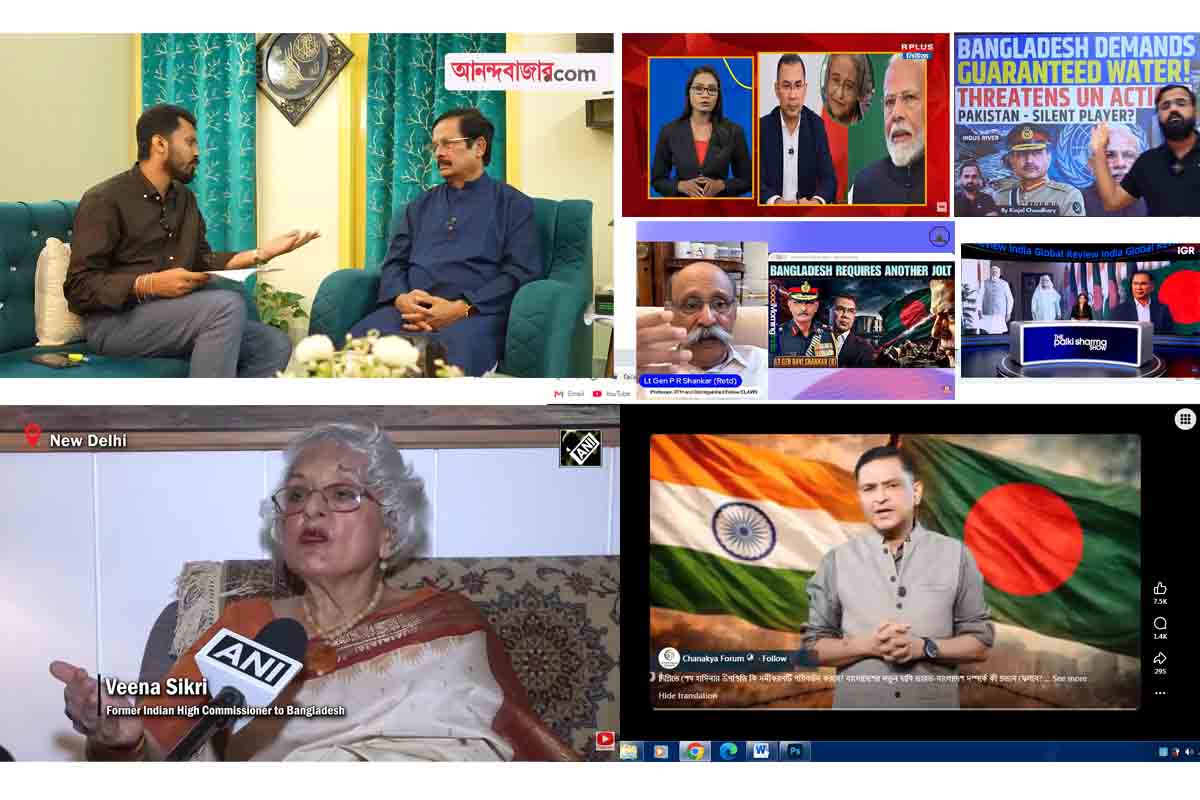
Retired Major Gaurav Arya, associated with the international affairs platform The Chanakya Dialogues, has frequently commented on India-Bangladesh relations and Bangladesh’s political developments.
His analysis tried to explain that the political alignments involving the BNP, Tarique Rahman and Jamaat-e-Islami, as well as Bangladesh’s possible political trajectory, are trying to pressure India to get more.
Similarly, Lt. Gen. (Retd.) P. R. Shankar, former Director General of the Indian Army’s Artillery Corps, has used his personal YouTube platform to comment on Bangladesh-India relations.
In one such commentary, he alleged that Bangladesh was exerting pressure on India and suggested links involving Pakistan, while also making critical remarks and insulting comments about Bangladesh’s economy.
Meanwhile, Indian media outlet Anandabazar has published digital content referring to earlier statements by former Awami League leader Jahangir Kabir Nanak concerning Bangladesh’s political developments and Tarique Rahman.
Former Indian High Commissioner to Bangladesh Veena Sikri has also criticized about the Bangladesh’s July-August 2024 mass uprising, assessed it as political movements of Jaamar and Dr. Younus.
Some of her interpretations concerning the nature and context of the movement have drawn criticism in Bangladesh. During a discussion in 2025, she also commented on the role of Jamaat-e-Islami’s student wing during different phases of the political movement.
Bangladesh-India relations encompass a wide range of strategic, political and economic issues, including extradition, pending legal matters, border management, trade, energy cooperation and regional security.
Bangladeshi political observers therefore caution against reducing the bilateral relationship to a single issue. The extradition of Sheikh Hasina involves Bangladesh’s judicial proceedings, diplomatic engagement, India’s policy considerations and the relevant legal framework, all of which require separate consideration.
Against this backdrop, recent Indian media commentary has generated debate within Bangladesh’s political circles. Analysts, however, stress that India’s diverse media landscape should not be treated as a single voice, nor should individual commentators’ positions be equated with the official policy of the Indian government.
Reiterating that reports about an imminent visit are speculative, Foreign Affairs Advisor Humayun Kabir said Bangladesh would not pursue a summit-level visit without a clear national interest and mutual consensus.
“Reports in the Indian media regarding Prime Minister Tarique Rahman’s visit to India are baseless and speculative,” Kabir said. He added that the future of top-level bilateral engagement would depend on a change in the mindset and perspective of India’s current leadership.
He also urged neighboring countries to properly understand the political realities emerging from Bangladesh’s July Mass Uprising, referring to the sacrifices of more than 1,500 people.
Kabir further questioned what basis India intends to establish for relations with a government elected with a two-thirds majority mandate in Bangladesh.
“There is no justification for rushing a summit-level visit outside of national interests,” he said, adding that without mutual consensus and an honorable invitation creating an appropriate diplomatic environment, the likelihood of a visit before the BRICS Summit remains very low.
For Dhaka and New Delhi, the broader challenge will be to separate political rhetoric and media narratives from formal diplomacy as both sides navigate the next phase of bilateral relations.
