
Recruitment costs soar despite government cap; ACC launches inquiry into alleged links of former lawmakers and their families
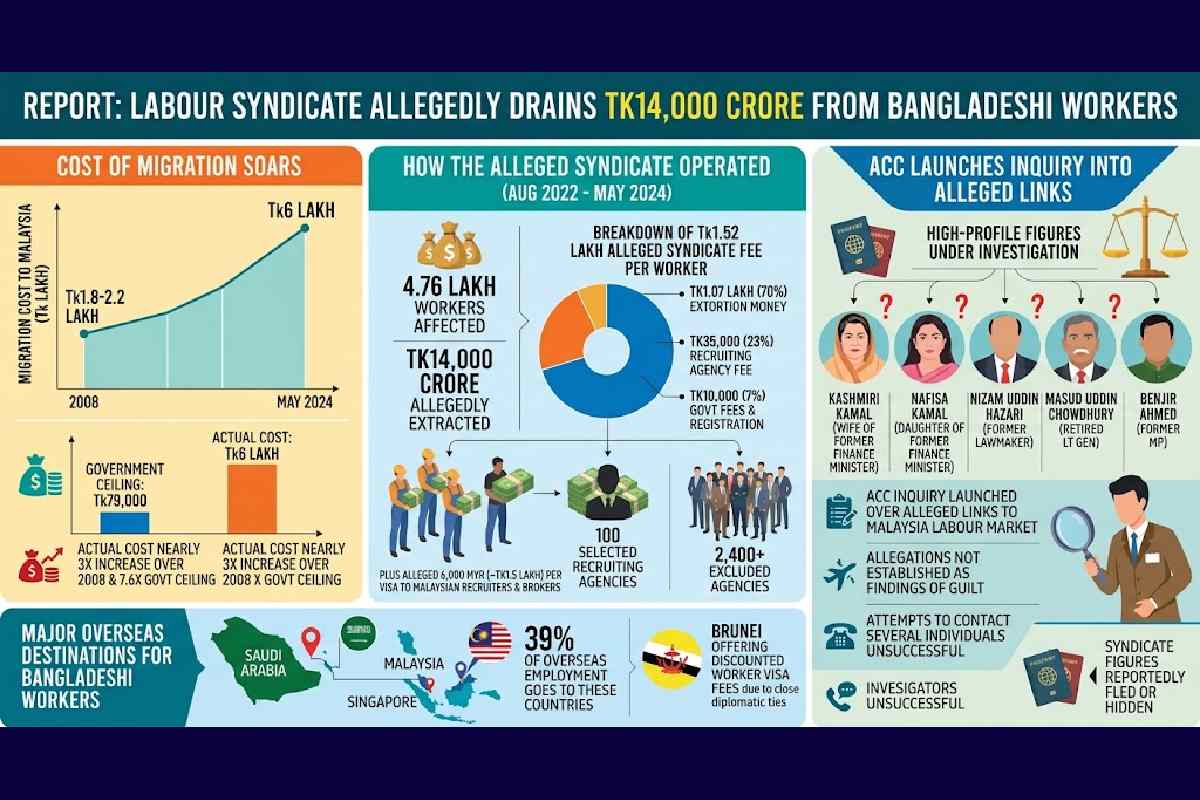
DHAKA: The cost of migrating to Malaysia for work has nearly tripled since 2008, reaching Tk6 lakh per worker by May this year, despite the government’s official ceiling of Tk79,000, highlighting persistent allegations of corruption, illegal visa trading and syndicate control in Bangladesh’s overseas labour recruitment sector.
According to estimates by the Bangladesh Association of International Recruiting Agencies (Baira), a syndicate of 100 recruiting agencies allegedly extracted at least Tk14,000 crore from Bangladeshi workers who migrated to Malaysia and its adjecent areas including Brunei and Singapore between August 2022, when the labour market reopened, and May this year.
The alleged racket has drawn scrutiny over the role of politically connected recruitment businesses, including firms linked to former Awami League lawmakers and their families. The Anti-Corruption Commission (ACC) has recently launched an inquiry into several high-profile figures allegedly connected to the Malaysia and its adjacent labour market.
Those named in the inquiry include former finance minister AHM Mustafa Kamal’s wife, Kashmiri Kamal, their daughter Nafisa Kamal, and former lawmaker Nizam Uddin Hazari. The allegations have not been established as findings of guilt.
The Shuttle Times tried to contact Mustafa Kamal, his wife and daughter were unsuccessful. The report also said former MP Nizam Uddin Hazari, retired Lieutenant General Masud Uddin Chowdhury and Benjir Ahmed could not be reached by phone.
Recruitment costs far exceed official ceiling
The sharp increase in migration expenses has placed a growing financial burden on workers seeking overseas employment.
In 2008, Bangladeshi workers could reportedly migrate to Malaysia by paying recruiters between Tk1.80 lakh and Tk2.20 lakh. By May this year, the cost had risen to around Tk6 lakh, nearly three times the earlier level.
According to the Brunei High Commission, they are offering worker visa fees at a discounted rate due to the close diplomatic ties between the two countries.
The contrast is even more striking over a longer period. In the 1980s, workers could migrate abroad for Tk5,000 to Tk6,000. During the 1990s, the cost rose to between Tk50,000 and Tk1.5 lakh, according to Shamim Ahmed Chowdhury Noman, a former Baira secretary general.
Noman attributed the increase to a growing number of overseas jobseekers, the expansion of visa trading and the increasing involvement of middlemen in recruitment.
The financial burden is not limited to Malaysia. Saudi Arabia, Malaysia and nearby destinations, including Brunei and Singapore, account for more than 39 percent of Bangladesh’s overseas employment destinations, according to the information cited in the report.
How the syndicate allegedly operated
The syndicate’s influence reportedly stems from a 2021 memorandum with the Malaysian government that selected only 100 Bangladeshi recruiting agencies from a pool of around 2,500 agencies.
According to Baira estimates, approximately 4.76 lakh Bangladeshis who travelled to Malaysia between August 2022 and May this year became vulnerable to the alleged system.
Baira Joint Secretary General Fakhrul Islam said the syndicate charged Tk1.52 lakh per worker. Of that amount, Tk10,000 went towards government fees and registration, while Tk1.07 lakh allegedly went to the syndicate as extortion money. The recruiting agency within the syndicate received Tk35,000 per worker.
Manpower traders also alleged that workers had to pay an additional 6,000 Malaysian ringgit, equivalent to around Tk1.5 lakh, for each visa. The amount was reportedly divided among Malaysian recruiters, brokers responsible for demand letters and those managing recruitment operations in Malaysia.
Many workers reportedly paid Tk6 lakh or more to secure jobs but arrived in Malaysia by May this year without employment.
The allegations point to a recruitment system in which workers bear substantial upfront costs while having little assurance that a promised job will materialise.
Political connections under scrutiny
The alleged concentration of recruitment opportunities among a small group of agencies has raised questions about transparency and accountability in labour migration.
In 2016, a syndicate of 10 agencies reportedly controlled Bangladesh’s labour market in Malaysia. The scale of corruption associated with that arrangement was estimated at Tk6,000 crore that year, according to the information cited by the media.
Recruitment firms linked to several former Awami League lawmakers, including Mustafa Kamal, and their families have been accused of involvement in the wider process. Following the fall of the Awami League government on August 5, 2024, several alleged syndicate figures reportedly fled the country or went into hiding.
The ACC’s inquiry marks a significant step in examining the allegations, although the outcome and any eventual legal findings remain to be established.
