
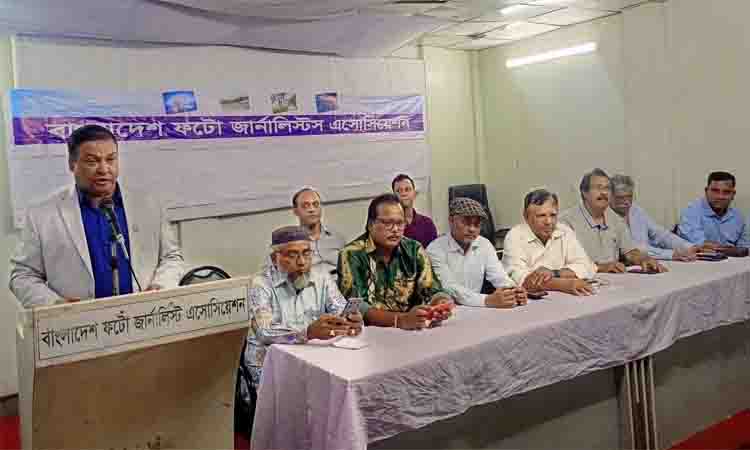
BSS chief editor highlights photojournalism’s role in history and social change
Managing Director and Chief Editor of Bangladesh Sangbad Sangstha (BSS) Kader Gani Chowdhury has said a photograph is not merely a mirror of time, it is a living witness to the history and a powerful tools for social change.
“A single image can convey profound messages regarding human emotions, protest, resistance and humanity without uttering a word,” he said.
The BSS Chief Editor said this while exchanging views with members of Bangladesh Photojournalists Association (BPA) at its office here today.
Kader Gani Chowdhury said photojournalists play undeniable role in presenting the stark realities of war, famine, exploitation and the human struggle to the global audience.
He observed that photography is a monumental innovation that has transformed the perspective of looking the world. Beyond revealing the story behind an event, a photograph can deeply stir the human psyche. Sometimes an image awakens the conscience of people, sometimes it inspires protest against injustice and sometimes it provides the motivation to move forward.
He noted that the image of the lifeless body of three-year-old Syrian child Alan Kurdi, found on a Turkish beach on September 2, 2015, shook the world. That photograph highlighting the refugee crisis and the brutality of war, compelled the global community to rethink the situation.
Similarly, a 1993 photograph capturing a vulture waiting behind a famine-stricken child in South Sudan exposed the horrors of hunger and humanitarian catastrophe for which Canadian photographer Kevin Carter won the Pulitzer Prize.
Highlighting the significant role of photography in the history of Bangladesh, he mentioned how images from the 1974 famine-such as the photograph of two women named Basanti and Durga draped in fishing nets, along with scenes depicting the plight of the starving and the desperate cry for food—stirred public sentiment both at home and abroad.
The photograph of Felani’s body hanging from the barbed-wire border fence also brought the critical issues of human life and safety at the border to the world's attention.
The BSS chief editor stated that photographs are vital components of newspapers. While language conveys information and concepts, photography brings them to life.
“A camera does more than just capture a scene; a photojournalist encapsulates art, language and history within a single frame. Therefore, photojournalism cannot be viewed merely as a secondary branch of journalism,” he added noted.
Kader gani Chowdhuty further stated that the contribution of photojournalists in safeguarding country’s independence, sovereignty, integrity and national unity is beyond doubt. By capturing pivotal moments—such as the Language Movement of 1952, the Mass Uprising of 1969, the glorious Liberation War of 1971, the anti-autocracy movement from 1982 to 1990 and the recent July-August movement—photojournalists are creating living records of history. Many photojournalists have been injured and some have even lost their lives, while carrying out their professional duties.
Highlighting the role of photography in preserving the history of the Language Movement, he noted that the Pakistani ruling regime had attempted to conceal the incidents where people were killed by police gunfire during the movement. However, photographs captured by photographer Amanul Haque thwarted that attempt. Those images, taken at great personal risk, have become vital historical evidence.
Praising the international achievements of Bangladeshi photographers, Kader Gani Chowdhury said our photojournalists have showed success in various prestigious global competitions. In 2018, Reuters photojournalist Mohammad Ponir Hossain won the Pulitzer Prize. Bangladeshi photographers are also earning various international accolades.
He noted that our photographers are not only winning awards on the international stage but are also serving as judges in various prestigious competitions. Photographers Abir Abdullah and Munem Wasif have served as jury members for the World Press Photo contest. In 2022, Tanzim Wahab served as the jury chair for the Asia region of World Press Photo. Images captured by our photographers documenting the Rohingya crisis have also received significant attention in international media.
Highlighting the issue of state recognition for the country's photographers, Kadeer Gani Chowdhury said, to date, no photographer has received the Independence Award. However, the Ekushey Padak and Bangladesh Shilpakala Academy Padak were awarded to many photographers.
He emphasized the need to ensure proper evaluation and recognition of the work done by photojournalists. The images captured by them will inform future generations about the struggles, sacrifices and humanitarian crises of the past and help them to learn from the history.
BPA President AKM Mohsin presided over meeting while Babul Talukdar was the moderator. Senior journalists Rafiqur Rahman and Bulbul Ahmed also participated in the discussion.
