
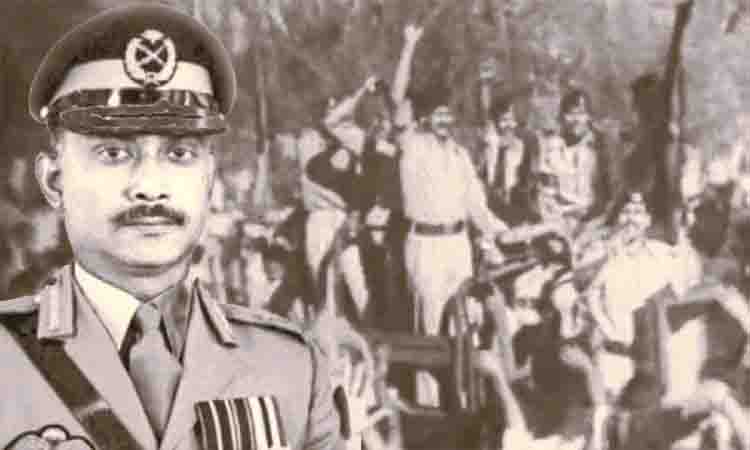
November 7, 1975: A defining moment in Bangladesh’s nationalist history
By Md. Manikul Azad
DHAKA, Nov 6, 2026 (BSS) - The historic November 7, 1975 stands as a defining moment in Bangladesh's political landscape, symbolizing the ideological spirit of 'Bangladeshi nationalism' and the country's aspiration for sovereign identity.
It is not merely a date on the national calendar but represents a defining moment of political upheaval, military realignment and the assertion of a particular strand of Bangladeshi nationalist spirit.
Emerging from the turbulent aftermath of the event of 15 August 1975, the day became associated with the aspirations for national sovereignty, political independence and a distinct sense of national identity.
Its legacy continues to prompt reflection on Bangladesh's political trajectory, given that people at that time were deprived of freedom of speech, political rights, and social equality.
To understand November 7, therefore, is to revisit a pivotal chapter in the country's history and assess its enduring significance in shaping the evolution of Bangladeshi nationalism.
Why is November 7 important? It is important because it actually shaped the evolution of Bangladeshi nationalism in post-independence Bangladesh following the Liberation War.
The very principles for which the country was liberated-equality, human dignity, and social justice-remained unrealized even after independence under the then Awami League government, resulting in the party's ouster in a tragic event on August 15, 1975.

Who was responsible for the events of 15 August? Although a group of military officers carried out the assassination, an internal faction of the Awami League, led by Khondaker Mostaq Ahmad, was also implicated.
Mostaq, who served as the country's first wartime Foreign Minister and later as Commerce Minister under Sheikh Mujibur Rahman, assumed the presidency following the assassination of Sheikh Mujib and most of his family members on August 15, 1975.
The group behind the August 15 events subsequently ousted the then Awami League government and formed a new government under Mostaq's leadership, while retaining a major portion of the Awami League leadership.
Under Mostaq's leadership, one group of army officers was stationed at Bangabhaban, comprising those involved in the August 15 assassinations, while another group emerged at Dhaka Cantonment under Brig Khaled Mosharraf's leadership. This division is the central point of the matter.
At the time of the August 15 assassination, General K M Shafiullah was the Chief of Army Staff, while Major General Ziaur Rahman was serving as his deputy.
Normally, when a coup or similar incident takes place in a country, the Chief of Army Staff is held accountable for the failure to prevent it and may be removed from office. In a similar move, the then Khondaker Mostaq-led Awami League government removed Shafiullah from his post on August 25.
Following his removal, Major General Ziaur Rahman assumed the responsibility of Chief of Army Staff through the normal chain of succession, as he was Shafiullah's deputy.
Subsequently, as events continued to unfold, Ziaur Rahman was arrested and placed under house arrest at his residence inside Dhaka Cantonment around midnight on November 2.
Meanwhile, a coup took place at Dhaka Central Jail, where the four Awami League leaders were assassinated between 4:00 am and 4:10 am on November 3.
The four leaders were killed by a group of army officers who had been involved in the August 15 assassination at Dhanmondi Road No. 32.
At the time, the group behind the August 15 coup, stationed at Bangabhaban, was facing opposition from another faction led by Brigadier Khaled Mosharraf, while Ziaur Rahman remained under arrest.
However, the soldiers under Khaled Mosharraf's leadership were also driven by the aspiration to establish Bangladeshi nationalism. At that crucial juncture, there was a widespread desire to uphold Bangladeshi nationalist consciousness. But they failed to fulfil that aspiration under Khaled Mosharraf's leadership, as he did not pursue the ideology of Bangladeshi nationalism and instead followed what was perceived as the Awami League's political stance.
At the time, Khaled Mosharraf's mother Begum Hamida Rahman and brother, the then Awami League leader Rashed Mosharraf, organised a procession, which marched towards Dhanmondi Road No. 32, demanding justice for the assassination of Sheikh Mujibur Rahman and his family members.
Students and ordinary people perceived the faction led by Khaled Mosharraf as aligned with the Awami League and seeking to advance the party's political interests. This perception fueled widespread anger and resentment among the people.
The soldiers at Dhaka Cantonment under Khaled Mosharraf's leadership grew increasingly frustrated, while another faction, led by Mostaq, remained stationed at Bangabhaban.
As the two rival factions confronted each other, Ziaur Rahman, who had been in custody, remained the most popular leader among the soldiers.
Colonel Shafaat Jamil, who assisted Brigadier Khaled Mosharraf in launching the uprising against Mostaq's government and advancing towards Bangabhaban, maintained communication with the principal factions, including those at Bangabhaban and the cantonment, as well as Ziaur Rahman.
Several military officers, including Shafaat Jamil, acted as intermediaries at that time.
At one stage, Bangladesh Air Force fighter jets and helicopters (including MiG fighters and helicopters/Mi-8s) circled over Bangabhaban, although no confrontation took place. The officers involved in the August 15 coup, including Major Dalim, were eventually allowed to leave the country by air.
Fearing possible attacks on their way to the airport, the departing officers reportedly sought assurances of safe passage and requested that Khaled Mosharraf's wife accompany them. Shafaat Jamil arranged for her to travel with the group to the airport, after which they departed.
Following these developments, Khaled Mosharraf declared himself a Major General and Chief of Army Staff.
The political and military confrontation, however, did not end there. Amid the uncertainty, thousands of soldiers and civilians took to the streets, expressing their anger and demanding a change in the country's political direction.
On November 7, soldiers revolted against the Khaled Mosharraf-led faction and freed Ziaur Rahman from captivity. The uprising was accompanied by widespread public participation, with people joining soldiers in the streets of Dhaka and other parts of the country.
The situation sparked a soldiers' uprising in Zia's favour while they freed him from captivity on November 7 and as a sequel of a disorderly atmosphere, a soldiers' group killed Khaled Mosharraf.
The coup staged by the so-called Biplobi Sainik Sangstha, led by Colonel Taher, quickly faded away after Zia's release.
Zia's freedom from captivity and return to the command as the army chief paved the way for the restoration of order in the government and social sphere while thousands of ordinary people joined the soldiers to rejoice the event with slogans like "Long Live Bangladesh", "Long Live Major General Ziaur Rahman" and "Sepoys and people are brothers".
Since then, the day has been observed as "National Revolution and Solidarity Day" - the day that sowed the seeds of Bangladeshi nationalism.
November 7 marks the victory of the forces and the civilians who stood for Bangladesh, opening the way for multiparty democracy instead of one-party BAKSAL rule and upholding freedom of the press and expression, the rule of law, justice and an equitable society.
