
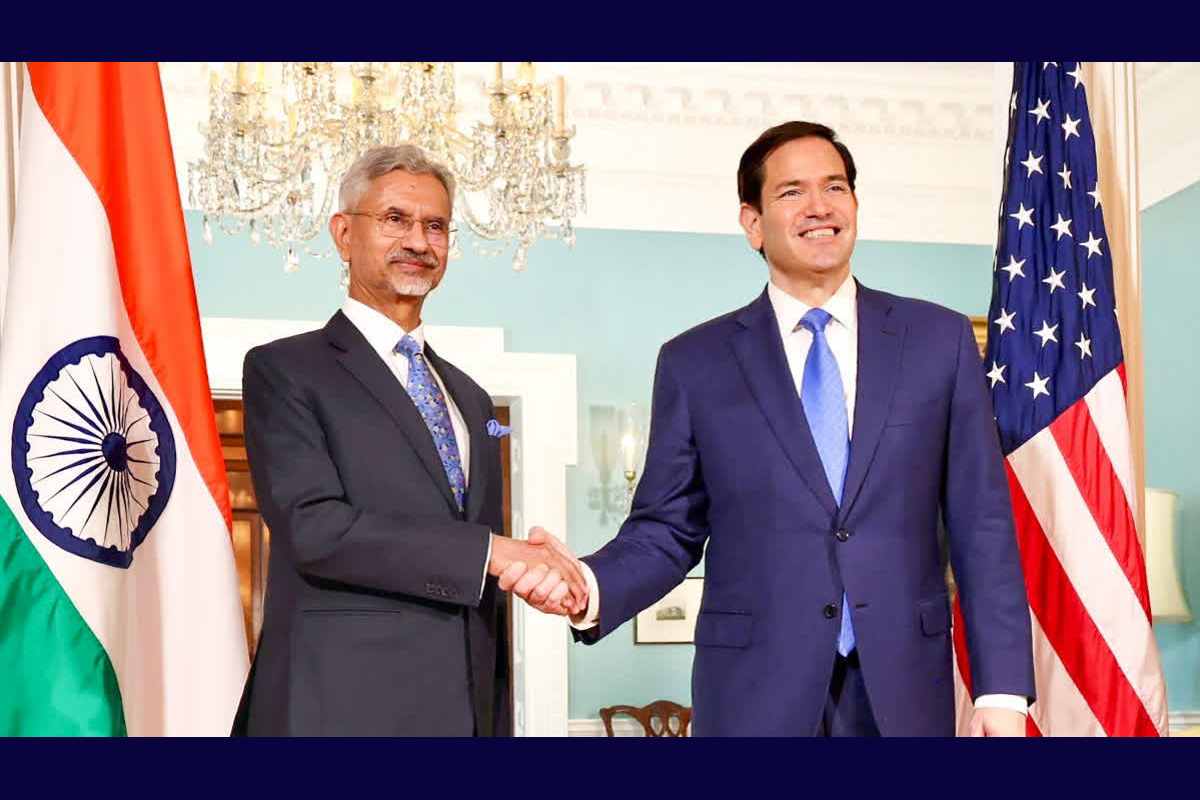
Rubio, Jaishankar highlight energy, technology, defence and Indo-Pacific security cooperation
The United States and India have set an ambitious target of increasing bilateral trade to more than $500 billion within three years, as the two countries seek to deepen cooperation in trade, energy, technology and defence.
US Ambassador to India Sergio Gor announced the target at a reception in Mumbai on October 20, marking the upcoming 250th anniversary of American independence, attended by US Secretary of State Marco Rubio and Indian External Affairs Minister S Jaishankar.
He made this remark in a meeting was held at Jio Convention Center in Mumbai during his visit in India on Tuesday night.
“Today, our bilateral trade has shattered records, reaching over $240 billion,” Gor said, adding that Washington and New Delhi were focused on pushing the figure beyond $500 billion over the next three years.
He described the economic partnership as a key pillar of broader strategic cooperation, highlighting opportunities in semiconductors, critical minerals, energy, defence and advanced technologies.
Rubio, who is visiting India for the second time in a few months, said the relationship between Washington and New Delhi would play a defining role in shaping the 21st century.
“I actually think we don’t come enough,” he said, emphasising India's importance as the world's most populous country and a major geopolitical partner of the United States.
He said both countries shared common interests in technological innovation, economic growth and maintaining a free and secure Indo-Pacific region.
Rubio highlighted the rapid development of artificial intelligence, superintelligence and quantum computing as areas where the two countries could work together.
He said Washington and New Delhi were aligned on harnessing emerging technologies for human advancement while mitigating potential risks.
The US secretary of state also stressed the importance of open sea lanes and freedom of navigation, saying international shipping routes should not be dominated or controlled by any single country.
A secure Indo-Pacific, he said, was essential for international trade and the movement of goods between markets.
Rubio added that although the two countries might disagree on certain issues, their alignment on core national interests offered an opportunity to shape the global order.
He also referred to the Quad, comprising the United States, India, Japan and Australia, as part of the broader framework for regional cooperation.
Jaishankar said India-US relations had expanded considerably over recent decades, developing new areas of cooperation alongside longstanding economic and technological ties.
He cited initiatives including the Quad, Mission 500, Pax Silica and the FORGE Initiative as examples of the evolving partnership.
He also highlighted growing cooperation in energy, defence and civil aviation, alongside opportunities to expand trade, investment and technology collaboration.
“The world order is clearly in transition, and countries are responding accordingly,” Jaishankar said, arguing that expanding areas of common interest would be essential to strengthening bilateral relations.
He said both countries had a shared interest in promoting peace and stability in the Indo-Pacific.
Jaishankar also underscored the importance of counterterrorism cooperation, recalling the November 2008 Mumbai attacks, in which six American citizens were killed.
He thanked Rubio for laying a wreath at the memorial at Mumbai's Taj Hotel and welcomed the US administration's decision to extradite Tahawwur Hussain Rana, whom India links to the attacks.
India expects its partners to maintain zero tolerance towards terrorism, Jaishankar said.
Gor highlighted the extensive American corporate presence in Mumbai, noting that more than 500 major US companies operate in the city across technology, pharmaceuticals, consumer goods and financial services.
He also pointed to American institutional investors as the largest bloc of foreign capital invested in Indian equities, describing this as a vote of confidence in India's economic prospects.
The ambassador traced commercial ties between the two countries to the period immediately after the American Revolution, when US merchant vessels began trading with India.
He said the relationship had evolved from traditional commerce into a broad partnership spanning finance, technology, manufacturing and strategic cooperation.
The reception formed part of celebrations marking 250 years of American independence, with officials from both countries using the occasion to reaffirm their commitment to closer economic and diplomatic engagement.
The proposed $500 billion trade target signals the scale of their ambitions, although achieving it will depend on sustained negotiations, expanded market access and progress in addressing outstanding trade issues.
