
Government keeps diesel price unchanged to curb inflation pressure.
Prime Minister's Information and Broadcasting Adviser Dr Zahed Ur Rahman today said the government has kept diesel prices unchanged to keep the transportation costs of commoners and the prices of essential commodities under control.
"As diesel constitutes the largest portion (82 percent) of the total fuel used in the country, this decision will directly help cut the pressure of inflation on the commoners," he said.
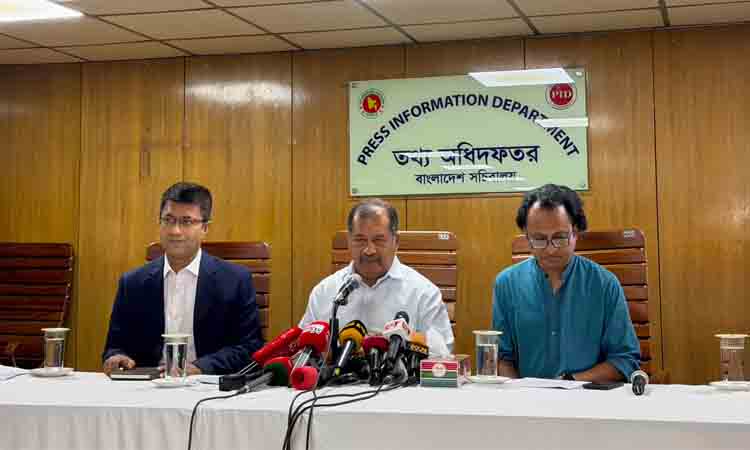
He made this remarks while delivering a written statement at a press briefing held at the Press Information Department (PID) conference room at the Secretariat here this morning.
Information and Broadcasting Minister Zahir Uddin Swapon also spoke at the briefing.
Zahed Ur Rahman said, "Despite the increase in fuel prices in the global market due to the ongoing wars and instability in the world, especially in the Middle East, the government has made every effort to control inflation in the country."
Although the prices of three types of fuel—petrol, octane, and kerosene—have been automatically increased by Taka 5 per liter for June, the price of diesel has been kept unchanged at Taka 115 per liter, he said.
Explaining the rationale for keeping the price of diesel unchanged, the Prime Minister's adviser said 330,000 to 360,000 metric tonnes of diesel are used in the country every month, which is about 82 percent of the total fuel consumption.
Diesel is mainly used in cargo trucks, public transport, and agricultural irrigation, which directly is related to the interests of the common people, he said.
Zahed Ur Rahman said petrol and octane are mainly used in the private cars, whose monthly usage rate is only 9 and 8 percent respectively.
As a result, he said, even if the prices of petrol and octane increase, it will not have any negative impact on the transportation or prices of daily necessities of the common and low-income people.’
Regarding the new electricity tariff and the protection of low-income people, the adviser said although the Bangladesh Energy Regulatory Commission (BERC) increased the electricity price for all categories of consumers after the public hearing, the government took the initiative to appeal again in the interest of the common people.
As a result, he said, ‘lifeline’ consumers using electricity from zero to 50 units and first-stage consumers (up to 75 units) have been kept out of the purview of the electricity price hike.
The adviser said about 65 percent of the total electricity consumers in the country fall under these two categories.
As a result, he said, even after the adjustment of electricity and fuel prices, it has been possible to keep the majority of the country's people completely protected from the pressure of additional expenditure.
He also said even after this price hike, the government will have to provide about Taka 41,000 crore subsidies in the power sector in the next budget.
Referring to the wrong policies of the past and the current reforms, Dr. Zahed Ur Rahman said in the past, an attempt was made to provide benefits to a special group (oligarch) by making the energy sector dependent on imports, due to which onshore gas exploration almost came to a standstill.
The incumbent government is taking immediate steps to break this cycle in offshore and onshore gas exploration, he said.
In addition, he said, it is giving special incentives to solar energy or renewable energy and environment-friendly transport like solar-powered or electric school buses.
The adviser said the government is not only focusing on reducing subsidies, but also strengthening education, health and social safety nets (such as family cards and TCB programs).
He also said all relevant agencies, including the Ministry of Commerce, have been instructed to remain vigilant to prevent unreasonable price hikes in the market.
