
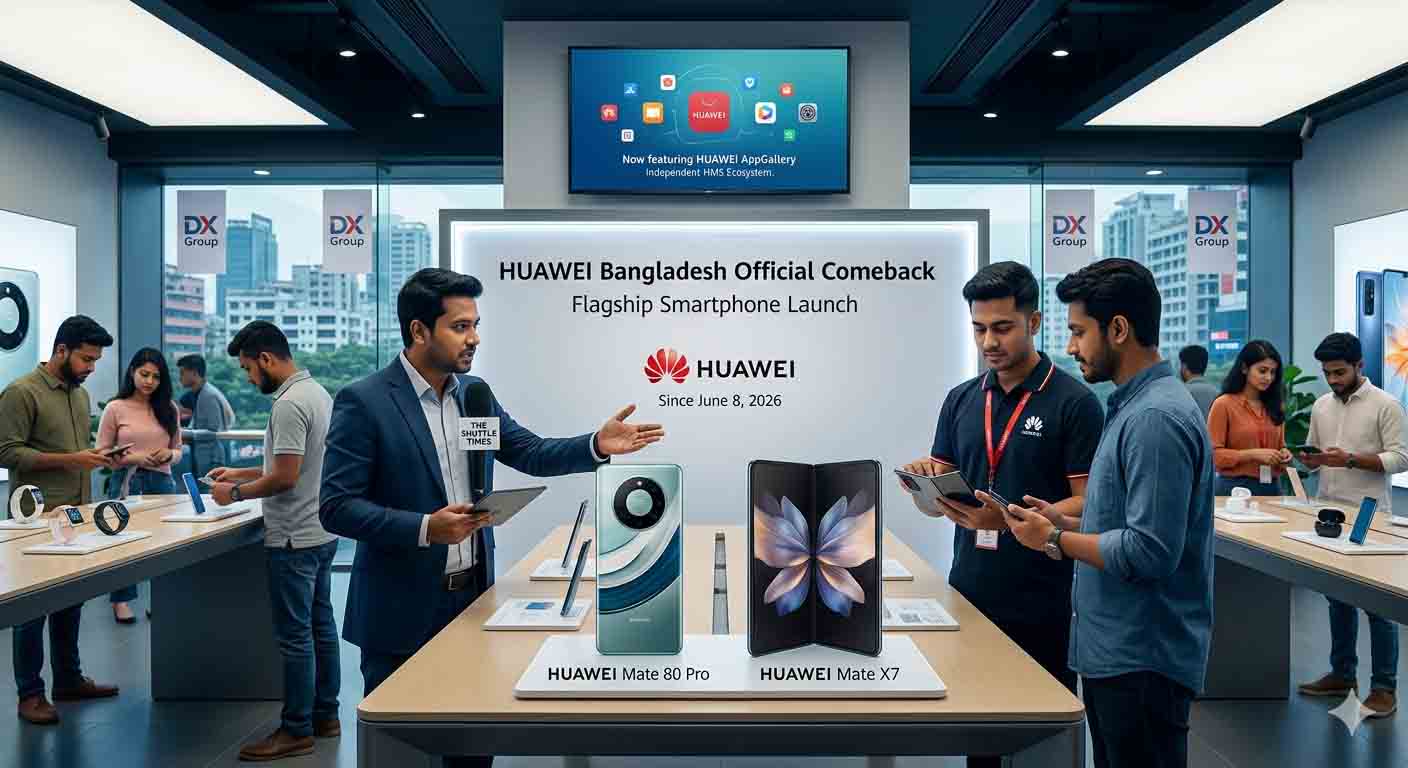
Huawei re-enters Bangladesh with flagship ambition
Global technology company Huawei is officially making a comeback in Bangladesh’s premium smartphone market after a seven-year break, launching its latest flagship devices on June 8.
The return marks a major shift in Bangladesh’s high-end mobile segment, where demand for premium smartphones continues to grow rapidly.
Huawei Bangladesh office confirmed to The Shuttle Times that it will introduce its flagship smartphones, tablets, audio products and wearable devices with official warranty and genuine parts support, seeking to regain a foothold in the country's growing premium smart device segment.
Distribution Strategy in Bangladesh Market
Huawei will distribute its products through local partner DX Group, focusing initially on major retail outlets and leading e-commerce platforms such as Daraz and Pickaboo.
The rollout will begin in Dhaka and gradually expand to other major cities across Bangladesh.
According to company officials, Huawei aims to rebuild its presence in the premium smartphone market in Bangladesh (2026) through strong retail partnerships and after-sales service support.
The company will distribute its devices through a local distributor, DX Group, which plans to initially target major retailers and leading e-commerce platforms in Dhaka and other key cities.
Huawei Bangladesh Marketing Manager Faruk Rahman said that the company's initial product portfolio is expected to include the Huawei Mate 80 Pro, Huawei Mate X7 foldable smartphone, Huawei Nova 15 Max, Huawei MatePad 11.5 tablet, Huawei Watch Fit 5 series, Huawei FreeBuds wireless earbuds and Huawei FreeClipopen-ear audio devices.
Among the headline products are the flagship Huawei Mate 80 Pro, the ultra-premium foldable Huawei Mate X7 and the lifestyle-focused Huawei Nova 15 Max. He added that these devices aim to target both premium users and younger consumers.
According to Faruk, Huawei is immediately targeting Bangladesh's premium and upper mid-range smartphone segments.
DX Group Lead marketer Md Jannatul Naim stated that the company plans to gradually expand Huawei's retail footprint nationwide.
"Our first priority is to reach consumers nationwide. However, we are initially focusing on major retail partners including Gadget & Gear, Sumash Tech, Daraz and Pickaboo-as well as key divisional cities," he said.
According to company officials, Huawei and its local partner have cleared all regulatory hurdles, including securing approval from the Bangladesh Telecommunication Regulatory Commission (BTRC).
Why Huawei Left Bangladesh Market
Huawei exited Bangladesh’s active smartphone competition following global restrictions imposed after the 2019 US trade blacklist.
The restriction prevented Huawei from using Google Mobile Services (GMS), including essential apps like the Play Store, Gmail, and YouTube.
This created a major disadvantage in international markets, including Bangladesh, where Google’s ecosystem dominates smartphone usage.
As a result, Huawei gradually scaled down its smartphone operations and effectively paused its Bangladesh market presence after 2021.
Before market conditions shifted, Huawei was a dominant player in the country’s mobile sector. The turning point came in 2019, when a US trade blacklist restricted the company from sourcing American technology, dealing a massive blow to its global smartphone lineup.
This software ban completely tied Huawei’s hands. Because new devices couldn't use Google Mobile Services, users were suddenly cut off from the Play Store and everyday apps they took for granted. Losing that ecosystem, it makes incredibly hard for Huawei to convince international shoppers to buy their phones over rivals.
The absence of Google apps severely crippled Huawei’s ability to compete internationally. Local buyers in Bangladesh, heavily reliant on Google’s software ecosystem, began shifting to other brands.
Unable to sustain its momentum, Huawei officially paused its smartphone operations in Bangladesh after 2021.
App ecosystem challenge addressed
Huawei Bangladesh Marketing Manager Faruk Rahman said the company is returning with a significantly strengthened software ecosystem built around Huawei's own AppGallery platform.
"Our AppGallery now offers access to WhatsApp, messaging applications, email services and a wide range of essential apps. We also have our own browser and alternative solutions for accessing applications that users previously downloaded through Google Play Store," he told this correspondent.
He said Huawei's latest devices are designed to provide a seamless user experience without depending on Google's traditional ecosystem.
According to the company, AppGallery has grown into one of the world's largest app marketplaces, while Huawei Mobile Services (HMS) now supports a broad range of applications used by consumers globally.
However, sources noted that local apps and those not yet available on AppGallery can still be downloaded through alternative app stores.
Speaking to The Shuttle Times, Faruk mentioned that Huawei's immediate focus would be Bangladesh's premium and upper mid-range smartphone segments.
Local assembly under consideration
Company officials also hinted that Huawei is considering longer-term plans beyond imports and distribution.
Huawei's immediate goal is to revive the brand through official retail networks, but the tech giant is already eyeing local device assembly in Bangladesh for its next phase of growth.
The transition to local manufacturing would back government efforts to build a domestic tech ecosystem, while helping Huawei cut costs and regain a competitive advantage locally.
For the past few years, they’ve been quietly keeping the country connected by building the heavy-duty network towers, cloud systems, and data infrastructure those local internet providers and big businesses rely on every single day.
Will Huawei Win Back Bangladesh’s Premium Smartphone Users?
Whether Huawei can win back Bangladesh’s premium smartphone users will depend less on hype and more on everyday experience.
The brand still carries strong recognition from its earlier dominance, but the market it is returning to is far more competitive than before, with users now deeply attached to ecosystems like Google’s services.
If Huawei can make its AppGallery smooth, reliable, and rich in the apps people actually use—while offering strong hardware at the right price—it may slowly rebuild trust among premium buyers.
Still, regaining lost ground will not happen overnight; it will take consistency, local support, and products that feel not just powerful, but effortless to use in daily life.
Huawei AppGallery and HMS Ecosystem Strategy
Huawei is returning with its independent digital ecosystem built around AppGallery and Huawei Mobile Services (HMS).
Key features include:
However, some locally used apps may still require alternative installation methods if not available on AppGallery.
Huawei claims its ecosystem is now capable of delivering a fully functional smartphone experience without Google services.
Future Plan: Local Assembly in Bangladesh
Huawei is also exploring long-term plans for local smartphone assembly in Bangladesh.
If implemented, this move could:
The company has already been active in Bangladesh’s telecom infrastructure sector, including network systems, cloud services, and enterprise solutions.
Huawei’s Strategy for Bangladesh Market Re-Entry
Huawei’s comeback strategy focuses on three key pillars:
Key Highlights:
| Category | Key Details & Highlights |
| The Big News | Huawei is officially returning to Bangladesh's premium smartphone market after a seven-year break. All regulatory approvals from the BTRC have been cleared. |
| Launch Date | June 8, 2026 |
| Why They Left | Following the 2019 US trade blacklist, Google cut ties with Huawei. Without Google Mobile Services (GMS) and the Play Store, local demand plummeted, forcing Huawei to pause consumer phone sales after 2021. |
| The Software Fix | They are returning with a upgraded, independent software ecosystem built around Huawei AppGallery and HMS, which now natively supports everyday apps like WhatsApp, email engines, and browsers. |
| Launch Lineup |
Smartphones: Mate 80 Pro, Mate X7 (Foldable), Nova 15 Max Ecosystem: MatePad 11.5, Watch Fit 5 series, FreeBuds, FreeClip |
| Local Partner | Distributed officially through DX Group with valid warranties and genuine spare parts support. |
| Where to Buy | Starting in Dhaka before moving nationwide. Available at major physical stores (Gadget & Gear, Sumash Tech) and online platforms (Daraz, Pickaboo). |
| Future Plans | While currently focusing on retail channels, Huawei is actively looking into local device assembly in Bangladesh to cut import costs and boost market competition. |
