
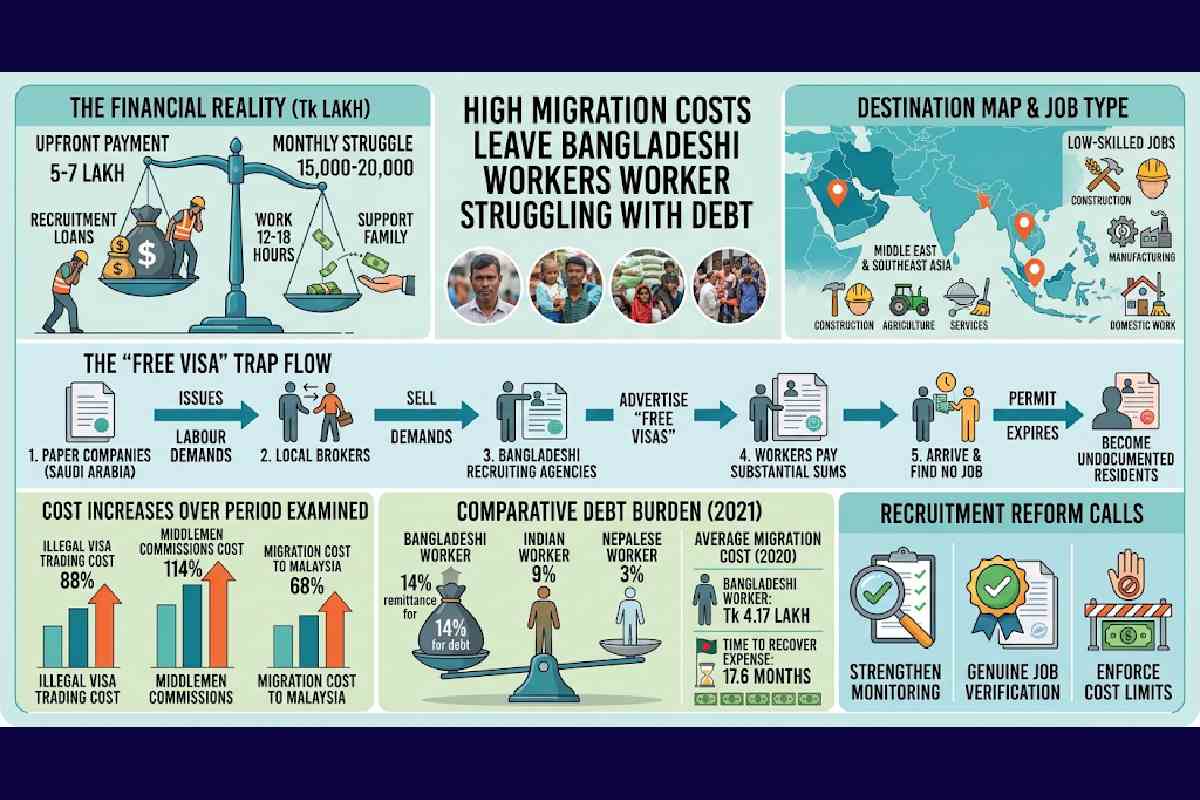
High Migration Costs Leave Bangladeshi Workers Struggling with Debt
Many Bangladeshi migrant workers pay between Tk5 lakh and Tk7 lakh to secure overseas jobs, only to work 12 to 18 hours a day and struggle to send home Tk15,000 to Tk20,000 a month while supporting their families and repaying recruitment loans.
Most Bangladeshi workers in the Middle East and Southeast Asia are employed in low-skilled jobs in construction, agriculture, manufacturing, services and domestic work, migration experts say.
The high upfront costs and uncertain employment prospects often leave workers financially vulnerable, undermining the economic benefits of overseas employment.
Shariful Hasan, head of BRAC’s immigration programme, told The Shuttle Times that some recruiters were sending Bangladeshis to Saudi Arabia on three-month iqamas, or residency permits, through companies that existed only on paper.
According to Hasan, these companies issue labour demands that are sold to local brokers, who then pass them on to Bangladeshi recruiting agencies. The jobs are advertised as “free visas”, but workers must pay substantial sums to obtain them.
Some migrants arrive in Saudi Arabia only to discover that no job is waiting for them. When their three-month permits expire, they risk becoming undocumented residents.
Experts say similar practices occur across the Middle East, exposing workers to exploitation, unpaid wages and uncertain legal status.
The expansion of illegal visa trading and middlemen’s commissions has further increased the financial burden on migrant workers.
According to figures cited in The Shuttle Times report, costs associated with illegal visa trading increased by at least 88 percent, while expenses linked to middlemen rose by 114 percent over the period examined. The total cost of migrating to Malaysia increased by 68 percent over the same comparison period.
The figures highlight the gap between official recruitment regulations and the amounts workers reportedly pay in practice.
Bangladesh has some of the world’s highest migration costs, according to the World Bank. Rakesh Ranjan of the UK-based Institute of Human Rights and Business reported that Bangladeshi workers spent 14 percent of their remittance earnings repaying recruitment debts in 2021, compared with 9 percent for Indian workers and 3 percent for Nepalese workers.
A 2020 Bangladesh Bureau of Statistics survey found that the average migration cost for a Bangladeshi worker was Tk4.17 lakh. Workers needed an average of 17.6 months to recover the expense, with Singapore being the most expensive destination and Oman the least expensive among the destinations examined.
Mohammad Rashed Alam Bhuiyan, a Dhaka University political science teacher and former research associate of the Refugee and Migratory Movements Research Unit, said migration costs to Malaysia had nearly tripled since 2008 because of illegal visa trading and syndicate involvement.
The allegations have renewed concerns over recruitment agency oversight, job-demand verification and enforcement of official migration-cost limits.
For Bangladesh, overseas employment remains a major source of livelihoods and remittances. However, when workers have to borrow heavily to secure jobs abroad, excessive recruitment fees can consume their earnings for months or years.
Strengthening recruitment monitoring, ensuring that advertised jobs are genuine and holding those responsible for exploitation accountable are essential to protecting migrant workers and ensuring that overseas employment delivers lasting economic benefits.
