
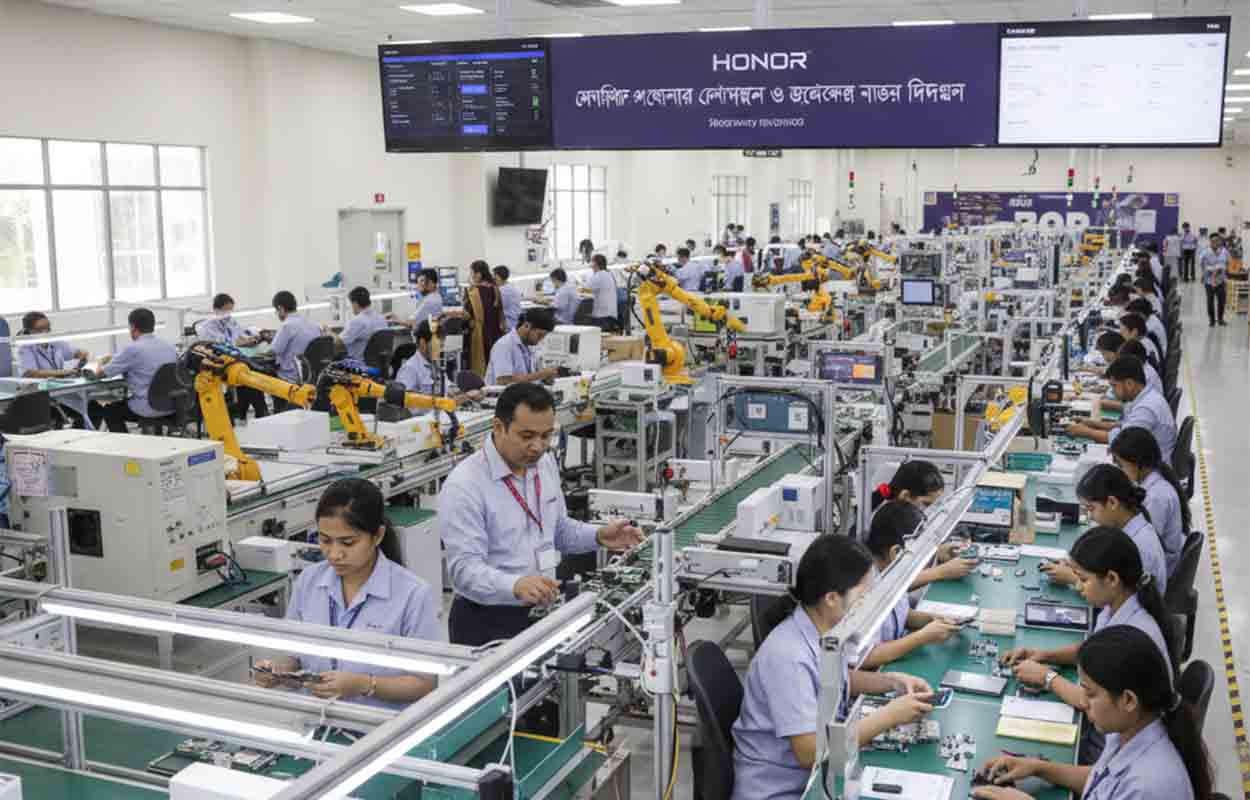
Smartphone manufacturing opens new vistas for employment and skill development
Rising investments in Bangladesh’s technology sector are transforming the smartphone manufacturing industry into a major engine for job creation, youth skill development and increased female workforce participation, industry sources say.
Honor’s Gazipur plant currently employs about 2,000 workers across production, quality control, technical management, packaging, logistics and administration, Zahirul Islam, managing director of Honor Bangladesh, told reporters.
The company expects to scale the workforce as production ramps up, with a target annual capacity of more than 500,000 units once full operations begin, he added.
Abdullah Al Mamun, general manager of Honor, said the factory will generate both direct and indirect livelihoods. “Beyond factory jobs, expansion will create opportunities in transport, supply-chain logistics, component making, packaging and after‑sales services,” he said, predicting a multiplier effect across local economies.
The company said workforce growth will prioritise local youth, with training programmes designed to convert new hires into skilled technicians.
Plant officials highlighted efforts to boost women’s participation in the tech workforce.
They said female employees already occupy key roles in marketing and management, and the company plans to expand female hiring for factory and technical roles.
To support women, the facility offers dedicated restrooms, healthcare support, enhanced security measures and maternity benefits.
Honor has launched a structured “Knowledge Transfer” programme overseen by technical experts from its manufacturing units in China.
New recruits undergo practical training in advanced machinery operation, complex circuit assembly, quality assurance testing, software configuration and industrial safety, the company said.
Professor Dr. Ainul Islam, former general secretary of the Bangladesh Economic Association, said upskilling the local workforce in tech‑driven industries brings lasting economic returns.
“Training youth and women in manufacturing skills not only addresses unemployment but also builds a talent pool that strengthens the digital economy,” he observed.
Dr. Selim Raihan, professor of economics at the University of Dhaka, added that high‑tech manufacturing expansion could catalyse foreign direct investment.
“A skilled domestic workforce and modern infrastructure send a strong signal to global firms. As technical expertise decentralises locally, it will spur entrepreneurship and support long‑term technological self‑reliance,” he said.
Analysts caution that sustaining these benefits will require continued investment in training, R&D and the local supply chain.
If factories combine production with genuine skills development and inclusive policies, however, smartphone manufacturing could become a strategic pillar of Bangladesh’s industrialisation and digital transformation.
| Category | Key Highlights & Details |
| Current Workforce | Around 2,000 workers currently employed across production, QC, tech management, logistics, and admin at the Gazipur plant. |
| Production Target | Annual capacity target of more than 500,000 units once full operations begin. |
| Economic Multiplier | Indirect job creation in transport, supply chain, component manufacturing, packaging, and after-sales services. |
| Inclusivity & Women Empowerment | Prioritizing local youth and expanding female hiring; providing dedicated restrooms, healthcare, safety, and maternity benefits. |
| Skill Development | Launch of a "Knowledge Transfer" programme led by experts from Honor China. |
| Technical Training Areas | Practical training in advanced machinery, circuit assembly, quality testing, software configuration, and safety. |
| Strategic Benefits | Reduces unemployment, builds a tech talent pool, attracts Foreign Direct Investment (FDI), and encourages local entrepreneurship. |
| Future Outlook | Sustaining growth requires continuous investment in training, R&D, and strengthening the local supply chain. |
