
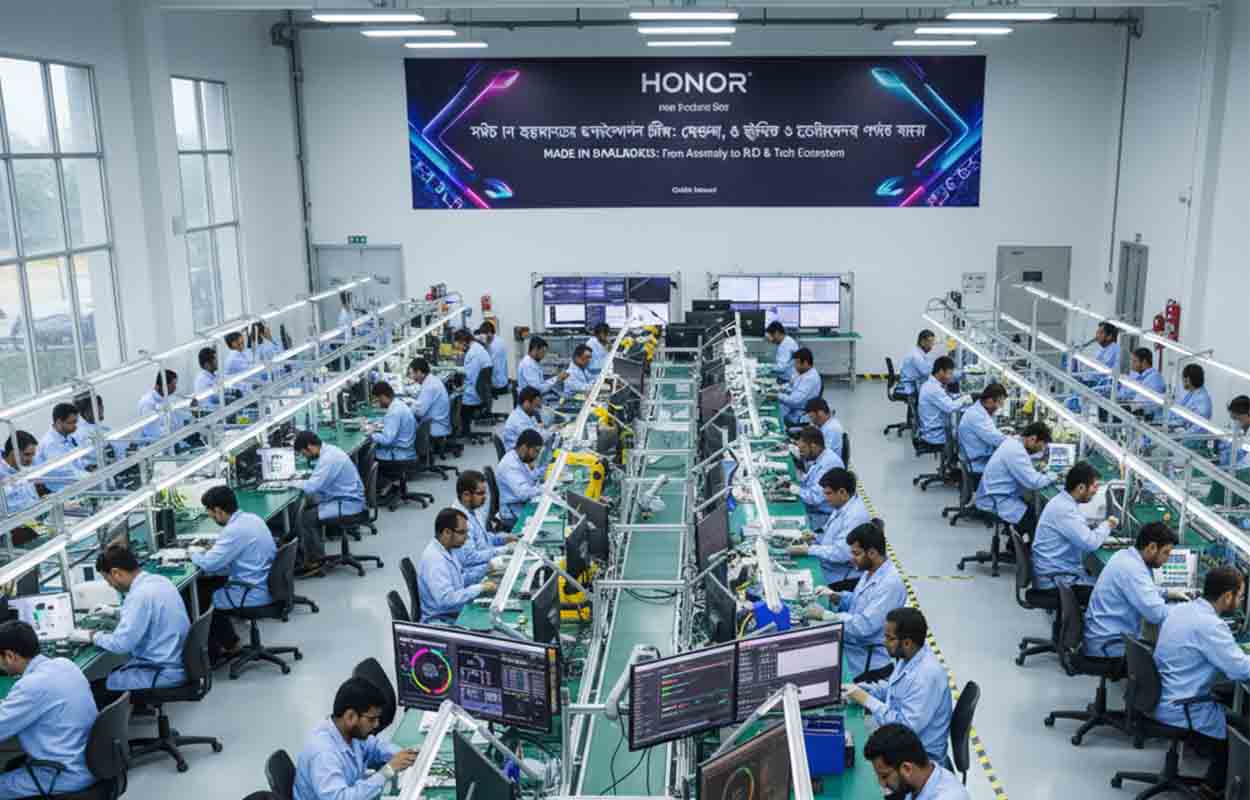
AI‑driven smartphone manufacturing: How Honor’s Gazipur plant maintains global standards
As smartphone production grows in Bangladesh, a key question is whether devices made locally can meet international benchmarks.
Honor’s Gazipur plant says it is bridging that gap by using artificial intelligence, high‑end automation and strict quality‑control systems modelled on the company’s main factories in China.
Honor Bangladesh officials say AI is embedded across several critical stages of production, including camera alignment, display calibration, battery performance testing, circuit‑board diagnostics and final inspections.
“Previously, detecting tiny scratches or pixel defects on a display required relying entirely on the human eye. Today, AI scans and identifies these imperfections within seconds,” said mobile engineer Shafiqul Islam.
He added that AI verification during camera‑module installation has markedly reduced issues such as blurriness and focal displacement.
General Manager Abdullah Al Mamun said parts of the line are linked to Honor’s international network, enabling real‑time monitoring of production data for each unit.
Industry experts stress that modern plants focus on predictive quality control—using data analytics to flag likely faults before they occur.
Seyed Almas Kabir, former president of BASIS, said AI now analyses machine behaviour and issues early warnings, lowering the risk of unexpected line stoppages and aligning local manufacturing with global ecosystems.
A factory visit found production running on two specialised lanes: handset assembly in one, and automated motherboard fabrication in another. Equipment autonomously monitors temperature, vibration and power consumption to pre‑empt errors.
Factory authorities say the Gazipur unit follows the same Standard Operating Procedures (SOPs), equipment configurations and testing protocols as Honor’s Chinese plants.
A foreign technical consultant involved in training noted, “Manufacturing a smartphone involves over a hundred micro‑steps. Each step has a strictly defined tolerance level. If a unit breaches that limit, it is immediately rejected.”
He added that quality‑control software and testing methodologies are overseen by Honor’s global network.
Faruk Rahman, senior marketing manager at Honor, said the plant adheres to ISO‑based quality management frameworks. Devices undergo multi‑stage stress tests, battery‑cycle assessments and structural‑durability trials before release.
Md. Yunus Haque, retailer at Mirpur’s Purebi Shopping Complex, said market trust depends on consistent quality: “If Bangladeshi‑made smartphones can sustain these global standards, it opens up massive export avenues.”
Analysts caution that advanced machinery alone is not enough.
Celia Shahnaz, professor at BUET, said high‑end AI systems require specialised engineers to run and maintain them — a talent pool still limited locally.
She also noted that heavy reliance on imported core components constrains control over the primary supply chain, while power reliability, industrial infrastructure and equipment maintenance pose ongoing challenges.
The use of AI in smartphone manufacturing signals a shift from volume‑driven output to technology‑led production.
If plants like Gazipur can sustain international standards through skilled staffing, supply‑chain resilience and continuous investment, Bangladesh could move from handset assembler to a full‑scale electronics manufacturer.
Industry observers view Honor’s Gazipur plant as more than a commercial project; they see it as a live experiment in building the country’s tech‑driven industrial future.
| Category | Key Highlights & Technological Insights |
| AI Integration on the Floor | AI is deeply embedded in critical production stages: camera alignment, display calibration, battery testing, circuit-board diagnostics, and final inspections. |
| Precision Over Human Error | Automated AI scans detect minute screen scratches or pixel defects within seconds and eliminate camera lens blurriness and focal displacement. |
| Real-Time Global Monitoring | Parts of the automated production lines are directly linked to Honor’s international network, allowing real-time monitoring of each unit's data. |
| Predictive Quality Control | The facility relies on data analytics to analyze machine behavior (tracking temperature, vibration, and power consumption) to flag faults and prevent line stoppages before they happen. |
| Dual-Lane Production | Operations are split into two specialized lines: manual handset assembly on one lane and completely automated motherboard fabrication on the other. |
| Replicating International SOPs | The plant follows the exact Standard Operating Procedures (SOPs) and testing protocols as Honor's Chinese plants, rejecting any unit that breaches micro-step tolerance levels. |
| Certifications & Testing | Adheres to ISO frameworks; devices must undergo multi-stage stress tests, battery-cycle assessments, and structural-durability trials before market release. |
| Structural Challenges |
* BUET Professor Celia Shahnaz notes a limited local talent pool of specialized engineers to maintain advanced AI systems. * Heavy reliance on imported core components limits supply-chain control. * Ongoing infrastructure hurdles like power reliability and high-end equipment maintenance. |
| Strategic Significance | Serves as a live experiment for Bangladesh's transition from a simple handset assembler to a sophisticated, technology-led electronics manufacturing hub. |
