
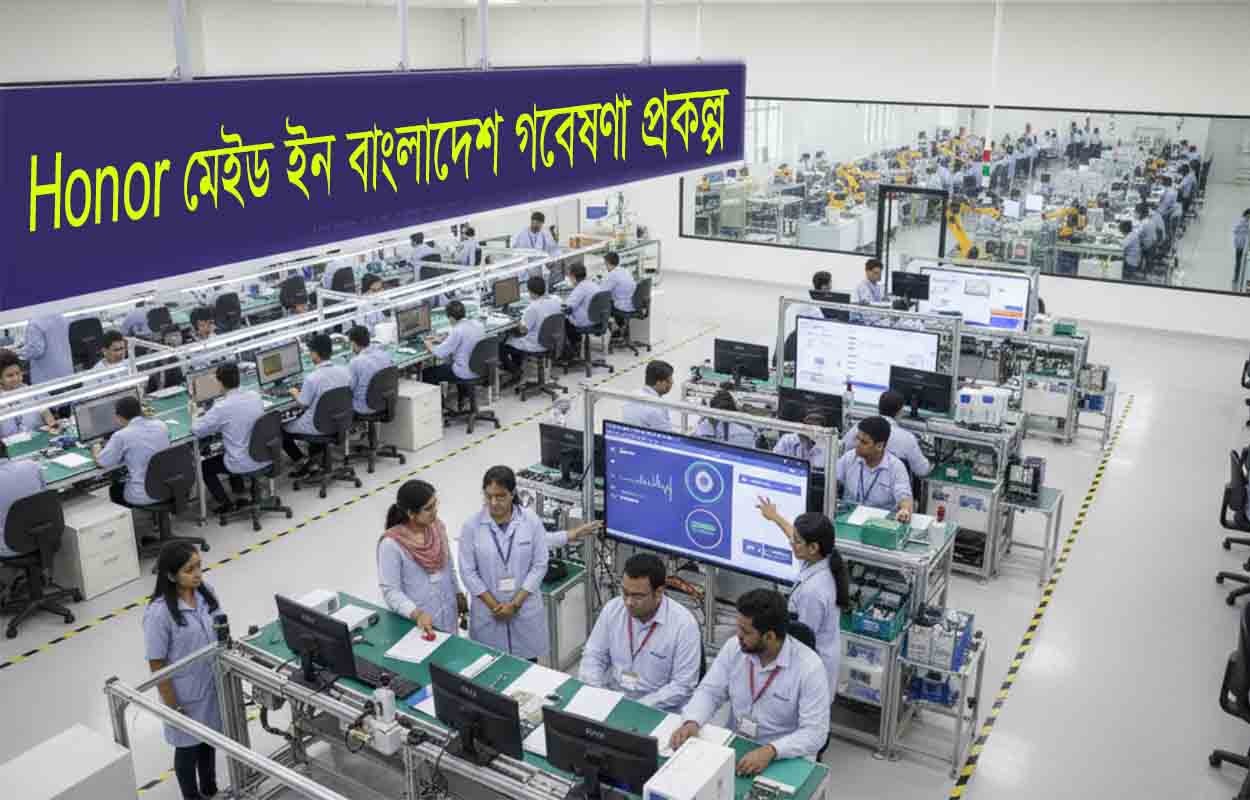
‘Made in Bangladesh’ smartphones: From assembly to R&D, innovation and a tech ecosystem
Bangladesh’s nascent smartphone industry is quietly shifting from basic assembly towards a broader technology ecosystem that emphasises research and development (R&D), local component production and software innovation.
Industry observers say the “Made in Bangladesh” label is evolving from a manufacturing tag into a marker of technological capability.
If the country can scale research infrastructure, strengthen backward linkages and hone software customisation, it could compete with regional electronics hubs such as India and Vietnam.
Most smartphone plants in industrial zones such as Gazipur still focus on hardware assembly.
Analysts, however, argue the next stage should be the establishment of local R&D centres specialising in software engineering and user‑experience (UX) design.
“If local software engineers are given the opportunity to collaborate on sophisticated platforms like Honor’s proprietary MagicOS, Bangladesh can transition from being just a manufacturer to a core partner in global tech innovation,” a technology market analyst said.
Celia Shahnaz, professor at Bangladesh University of Engineering and Technology (BUET), said global recognition of the Bangla language offers an opening for localized operating‑system development.
She identified priority research areas as Bangla‑centric user interfaces, analysis of local user behaviour, localisation of AI voice assistants for regional dialects, optimisation of the Bangladeshi app ecosystem and custom themes.
A local software engineer echoed the view, saying integration into software development would allow features tailored to domestic users rather than merely assembling devices.
A large share of manufacturing costs stems from imported secondary components such as chargers, cables, packaging and battery casings.
Md. Zahirul Islam, managing director of Honor Bangladesh, said the company is evaluating local production of items including charging cables, power adapters, SIM trays and minor mechanical parts.
Abdul Matlub Ahmad, electronics exporter, said developing backward linkages would reduce production costs and lay the groundwork for a self‑sustaining manufacturing sector.
“It establishes the foundational infrastructure required to transform Bangladesh into a fully self‑sustained manufacturing hub,” he said.
Analysts say the sector’s long‑term prospects depend on moving beyond assembly to integrate operating systems, software development and component manufacturing.
Achieving this will require investment in research infrastructure, skills development, and incentives to attract technology investment.
If local innovation and supply‑chain integration meet global standards, the industry could evolve from an outsourced production base into a regional centre for technological innovation.
| Category | Key Highlights & Future Vistas |
| Industrial Shift | Moving beyond basic hardware assembly toward a broader ecosystem emphasizing R&D, local component production, and software innovation. |
| Global Competitiveness | Scaling research infrastructure and backward linkages will allow Bangladesh to directly compete with regional giants like India and Vietnam. |
| Software & R&D Hubs | Creating opportunities for local engineers to collaborate on global platforms like Honor’s proprietary MagicOS, transforming Bangladesh into an innovation partner. |
| Bangla-Centric Innovation |
BUET Professor Celia Shahnaz highlights R&D opportunities in: * Bangla-centric user interfaces (UI) and custom themes. * AI voice assistants localized for regional dialects. * Optimization of the Bangladeshi app ecosystem. |
| Strengthening Backward Linkages | Honor is evaluating local production of secondary components like charging cables, power adapters, SIM trays, and minor mechanical parts to slash import dependency. |
| Economic Value Realization | Industrialist Abdul Matlub Ahmad notes that building backward linkages is foundational to transforming the country into a fully self-sustained manufacturing hub. |
| Strategic Outlook | The industry’s long-term success hinges on moving past outsourcing to integrate software development and component manufacturing under global standards. |
