
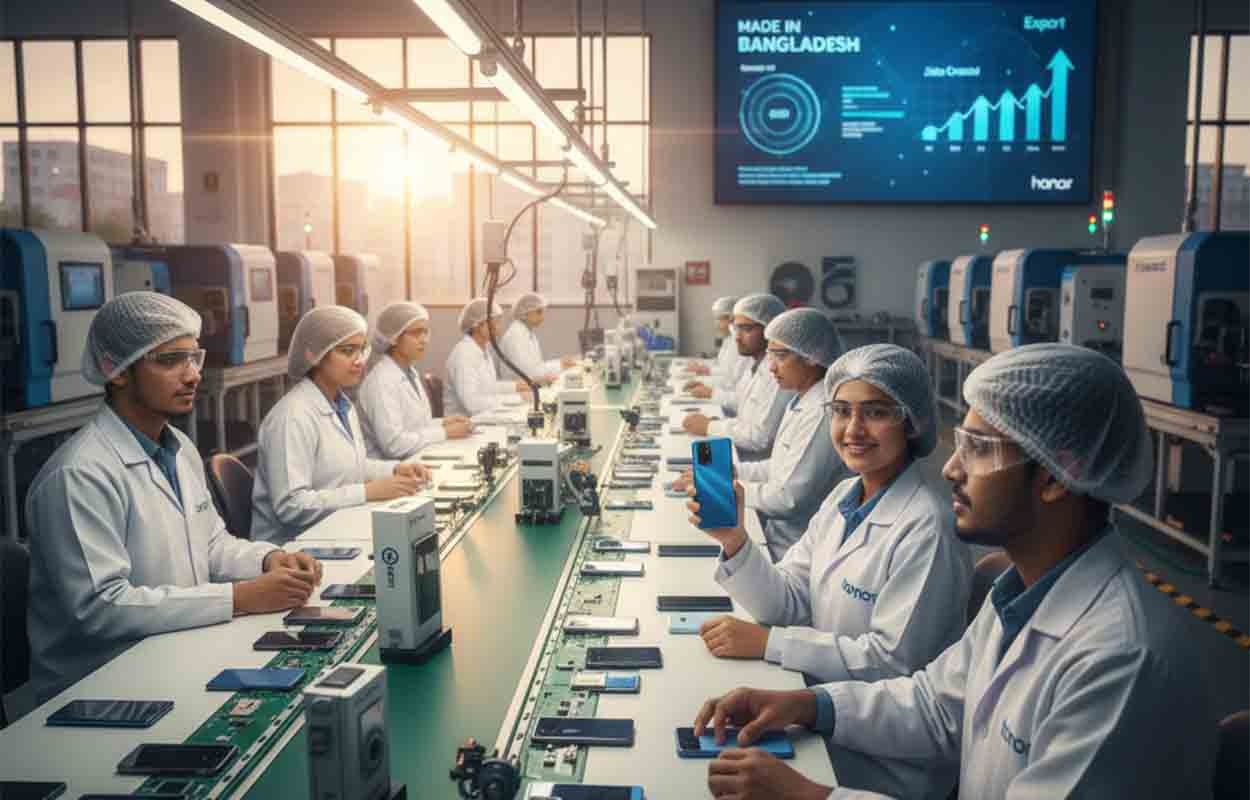
“Made in Bangladesh” Honor phones
The start of local smartphone manufacturing in Bangladesh is being hailed by industry analysts and economists as a potential turning point for the country’s technology sector, following a Tk 150 crore investment by global brand Honor.
Proponents say production at Honor’s new Gazipur plant could lower retail prices by cutting import duties and freight costs.
Economists and tech entrepreneurs add that the move could attract more multinational electronics firms to set up factories here — but questions remain about how much benefit will reach consumers and whether Bangladesh can evolve beyond assembly into a full-fledged electronics manufacturing hub.
Professor Dr. Ainul Islam, economist and former general secretary of the Bangladesh Economic Association, said local production will reduce import dependency and cushion consumers from exchange rate shocks.
“Importing completely built-up (CBU) handsets exposes products to high tariffs, freight charges and dollar volatility. Local output will relieve much of that pressure,” he explained.
Badrul Munir, former joint secretary of the association, said consumers — especially middle-income buyers — are already seeing more competitive pricing as assembly operations grow.
He estimated that duties and import overheads currently add 10–20 percent to the retail price of a mid-range smartphone, a margin that could shrink with expanded local production.
Zakaria Shahid, president of the Mobile Phone Industry Owners Association of Bangladesh (MIOB), added that prices could fall further if local manufacturing of key components begins.
Market analysts say initial savings could reach several thousand taka per handset, with the biggest impact expected in the BDT 20,000–40,000 segment.
“The biggest advantage of local manufacturing is price stability,” said Seyed Almas Kabir, tech market analyst and entrepreneur. “Even during dollar crises or high shipping costs, local output can stabilise the domestic market.”
Kabir cautioned, however, that gains will be limited if operations remain basic assembly. “To achieve meaningful cost efficiency, batteries, chargers, displays and other components must be made locally. The government must also create policy support to encourage export-oriented production,” he added.
Strategic significance of the Tk 150 crore investment
Economists say Honor’s investment sends a strong signal to global tech firms searching for manufacturing alternatives to China.
Dr. M. Khairul Huda, former chairman of the Bangladesh Securities and Exchange Commission, said, “Global tech companies are diversifying their supply chains. If Bangladesh proves cost-competitive and market-ready, more investors will follow.”
While some international brands already assemble phones in Bangladesh, analysts describe Honor’s move as a larger, more tech-intensive bet on the country’s potential.
The expansion of local manufacturing is expected to intensify competition across the smartphone ecosystem — not just on price but in after-sales service, product quality and technology.
“Bangladesh’s large youth population and rising smartphone demand make the market attractive,” said electronics exporter Abdul Matlub Ahmad. “With long-term policy support, we could build a domestic industry that also exports.”
Industry experts caution that manufacturing investment alone will not transform the sector.
The country still relies on imported critical components, and without sustained investment in local research and development (R&D) it risks remaining an assembly hub.
Celia Shahnaz, professor at BUET, warned, “We still import most critical parts. Unless skills, R&D and the local supply chain are developed, Bangladesh may be trapped in assembly-only production.”
Analysts also flagged the ongoing dollar crisis, global supply chain volatility and gaps in technical skills as potential barriers to rapid progress.
Despite risks, stakeholders contend that local smartphone manufacturing can strengthen Bangladesh’s digital economy by creating jobs, building technical capacity and attracting FDI.
If production scales up while meeting international standards, analysts say Bangladesh could emerge as a South Asian electronics manufacturing centre in coming years.
For now, Honor’s Gazipur plant is being viewed as more than a factory: it is a test of Bangladesh’s ability to leverage inward investment into sustained tech-driven industrialisation.
| Category | Key Details, Metrics & Insights |
| 1. Investment Overview |
1. Scale of Investment: Global tech brand Honor has made a landmark Tk 150 crore investment to set up its new manufacturing and assembly plant in Gazipur. 2. Strategic Intent: Viewed by analysts as a massive, tech-intensive bet on Bangladesh, signaling a shift for global companies looking to diversify their manufacturing lines away from China. |
| 2. Price Reduction Potential |
1. Lowering Overhead Costs: Production at the Gazipur plant bypasses steep Completely Built-Up (CBU) import duties, heavy shipping/freight fees, and dollar exchange rate shocks. 2. Shrinking Margins: Duties and import overheads typically add 10% to 20% to a mid-range smartphone’s retail price—a margin expected to shrink considerably with expanded domestic output. 3. Component Factor: Industry experts note that prices will fall even further once key components are manufactured locally rather than just assembled. |
| 3. Consumer Savings & Impact |
1. Projected Savings: Initial retail savings are expected to reach several thousand Taka per handset. 2. Target Price Range: The primary impact and savings will be felt most strongly by middle-income buyers in the BDT 20,000–40,000 price segment. 3. Market Stabilization: Localized output offers price stability, helping insulate the domestic tech market during macroeconomic shifts or international supply chain blockades. |
| 4. Industry Competition & Ecosystem |
1. Heightened Competition: Honor's aggressive expansion forces other multi-national electronics firms to adapt, expanding options for a massive, tech-conscious youth population. 2. Beyond Price: The local market's competitive landscape will pivot from being strictly price-oriented to prioritizing superior after-sales services, product durability, and advanced AI feature integrations. |
| 5. Core Structural Challenges |
1. The "Assembly Trap": Bangladesh still relies heavily on importing critical parts (batteries, chargers, displays). Without local component manufacturing, it risks remaining a basic assembly hub. 2. R&D and Skill Deficits: Maximizing long-term growth requires continuous investment in domestic Research & Development (R&D) and engineering skills. 3. Macroeconomic Hurdles: Ongoing dollar shortages and volatile global supply lines remain active risks to maintaining rapid manufacturing progress. |
| 6. Long-Term Economic Outlook |
1. Digital Transformation: Successful scaling can turn the country into a South Asian electronics manufacturing center, moving the economy away from its over-reliance on a single export industry. 2. Economic Benefits: The industrial shift actively boosts the digital economy by creating sustainable tech jobs, accelerating knowledge transfer, and drawing in foreign direct investment (FDI). |
