
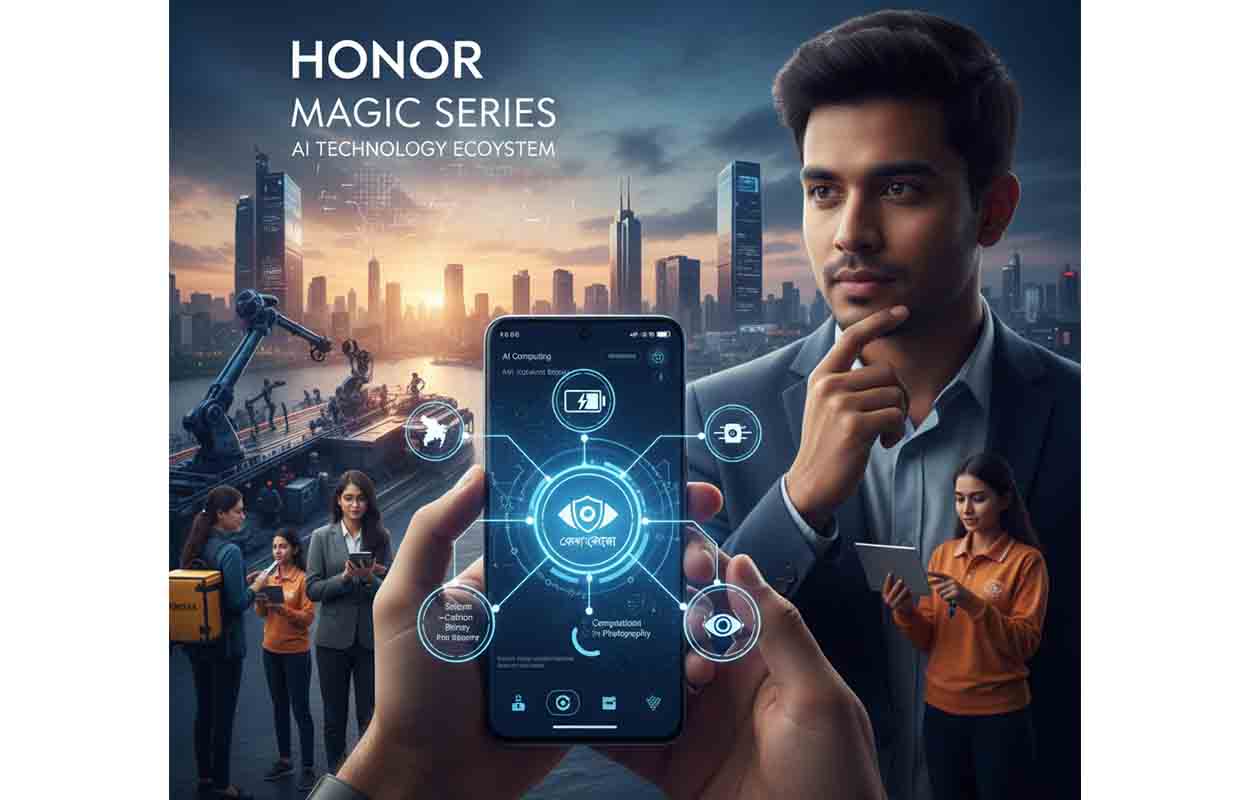
Honor ‘Magic’ Series: Inside the AI, Battery and Camera Technology Behind Bangladesh-Made Smartphones
Honor’s flagship ‘Magic’ series has reignited debate over whether smartphones made or assembled in Bangladesh can match global standards. The devices combine on‑device artificial intelligence, silicon‑carbon battery chemistry, advanced displays and computational photography — technologies that shift value from hardware to software.
Honor’s AI is focused on contextual computing and on‑device intelligence, allowing the phone to learn user patterns and optimise behaviour in real time. The AI runs beyond camera features, managing battery use, resource allocation and predictive app recommendations.
Humayun Kabir, a freelance graphic designer in Dhaka, said the phone filters non‑urgent notifications and adjusts screen brightness during late‑night work. Delivery rider Saiful Islam praised AI‑backed navigation that analyses traffic density to suggest faster routes.
Umme Habiba, product specialist at Honor, said the Magic series uses silicon‑carbon composite anodes to increase energy density over conventional graphite anodes. The result is faster charging, longer retention and the ability to fit larger capacity in a slim chassis. “We can expand battery capacity while maintaining an ultra‑slim, ergonomic phone design,” she said.
With prolonged device use rising, Honor’s displays incorporate high‑frequency Pulse Width Modulation (PWM) dimming and blue‑light mitigation to reduce visual fatigue. Dr. Hafizur Rahman, director at Hikmah Eye Hospital, said reducing flicker and blue‑light exposure helps lower digital eye strain, especially during low‑light use.
Computational photography and user experience
The Magic series relies heavily on software‑driven photography: multi‑frame processing, AI scene recognition and algorithmic noise reduction rather than solely on sensor size. This software focus enables enhanced low‑light performance and adaptive imaging tailored to local use patterns.
Bangladeshi consumers, especially younger buyers, now prioritise AI features, camera performance and battery life over brand alone, said retailer Imamul Haque. He argued that consistent local production of such technologies would strengthen the country’s broader tech ecosystem.
Analysts predict smartphones will increasingly act as personalised AI assistants. Golam Sumdany Don, a tech researcher, said, “Over the next five years, the smartphone will mature into an indispensable personal AI assistant that anticipates user needs.”
Honor’s Magic series highlights how software, battery chemistry and display ergonomics can define device value. If these advanced technologies are consistently produced and supported locally, they could raise the bar for Bangladesh’s manufacturing sector and help position the country as a regional hub for smart‑device innovation.
| Feature Domain | Technology / Component | Core Technical Value | Local Consumer Impact |
| Artificial Intelligence | On-device contextual computing | Real-time adaptive behavior and automated notification filtering. | Optimizes daily productivity for remote professionals and gig-workers. |
| Power Management | Silicon-carbon composite anodes | Superior energy retention and accelerated fast-charging cycles. | Eliminates frequent charging downtime for high-mobility users. |
| Display Ergonomics | Low-flicker blue-light mitigation | Significant reduction in visual fatigue and digital eye strain. | Safer prolonged usage during late-night or low-light work sessions. |
| Image Processing | Software-driven imaging pipelines | Advanced low-light performance through multi-frame algorithms. | Professional-grade media capture tailored to local environments. |
