
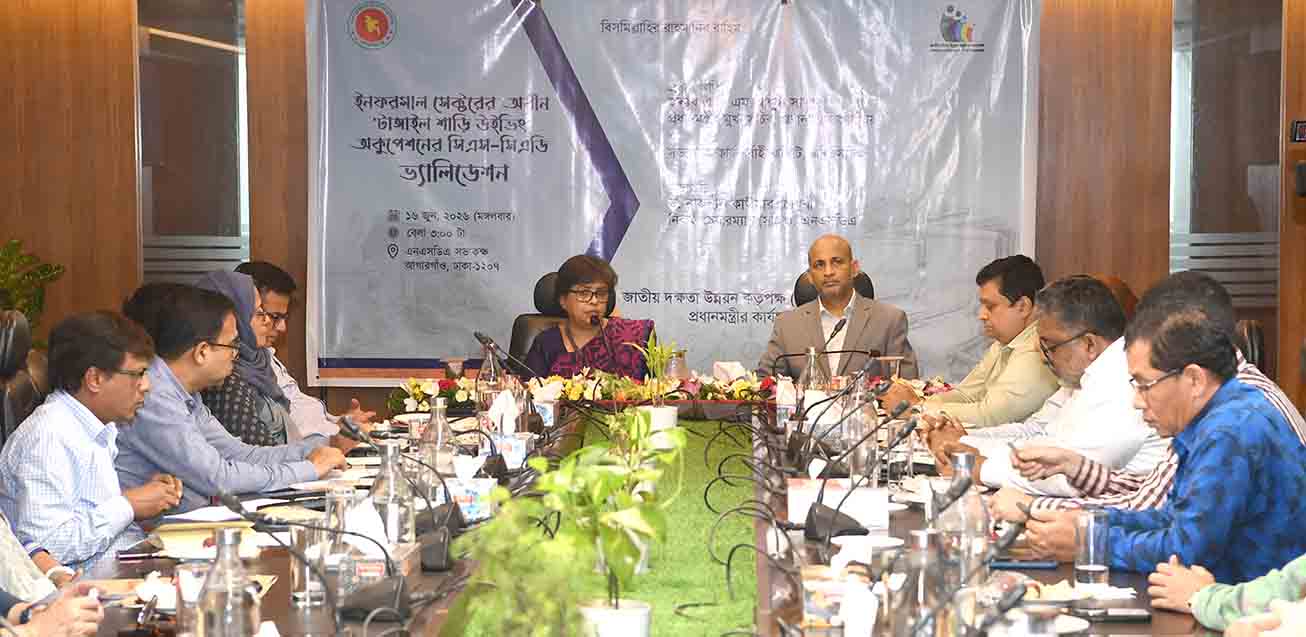
First national training standard for Tangail sarees
The National Skills Development Authority (NSDA) organized a training program to preserve Bangladesh’s handloom heritage, developing the country's first standardized training and certification framework for Tangail saree weaving.
The development came through the validation of the Competency Standard (CS) and Course Accreditation Document (CAD) for the occupation “Tangail Saree Weaving (Level-2)” under the informal sector. The concluding session of a validation workshop was held at the NSDA conference room in Dhaka on Monday.
The initiative aims to bring the traditional weaving profession under the Bangladesh National Qualifications Framework (BNQF), ensuring quality training, formal recognition of skills, and improved employment opportunities for artisans engaged in the renowned Tangail saree industry.
The workshop was chaired by NSDA Executive Chairman (Secretary) Dr. Nazneen Kawsar Chowdhury. Among the special guests were Abu Ahmed Siddiqui, NDC, Chairman of the Bangladesh Handloom Board, and Mirza Nurul Gani Shovon, Chairman of the Informal Sector Industry Skills Council (ISC).
Speaking at the event, Dr. Chowdhury said NSDA is working to integrate both modern and traditional occupations into the national skills development ecosystem. She noted that the newly developed competency standards and accreditation documents for Tangail saree weaving would help enhance workers’ skills, provide formal certification, and create broader employment opportunities in the sector.
“Preserving traditional industries while making them economically sustainable requires skilled human resources and internationally recognized training systems,” she said.
According to NSDA, the authority has reviewed and developed 85 competency standards and training curricula across various sectors over the past ten months. Alongside modern professions, training frameworks have also been introduced for heritage-based occupations such as Jamdani and Tangail saree weaving, reflecting the government's commitment to safeguarding cultural traditions while expanding economic opportunities.
Dr. Chowdhury highlighted the growing impact of Bangladesh’s skills certification system, stating that holders of the National Skills Certificate (NSC) have secured employment opportunities in 58 countries. The system has also facilitated domestic employment for approximately 70,000 certified individuals and supported the creation of more than 20,000 entrepreneurs.
To meet international labor market demands, NSDA has introduced country-specific and language-based training programs. New competency standards have recently been developed for labor markets in South Korea, the United States, Japan, Singapore, and Saudi Arabia, alongside Japanese and English language curricula.
The authority is also expanding international cooperation through mutual recognition agreements, joint certification initiatives, and employment partnerships with organizations in Saudi Arabia, Japan, and Australia to improve the global competitiveness of Bangladeshi skilled workers.
Special guest Abu Ahmed Siddiqui described the competency standard for Tangail saree weaving as a significant milestone for the traditional handloom industry. He said the Bangladesh Handloom Board plans to register its Tangail-based training institute under NSDA and introduce the accredited course in the near future.
Mirza Nurul Gani Shovon emphasized the need for coordinated efforts among government agencies, industry stakeholders, and development partners to recognize and upgrade the skills of workers in the informal sector. He said standardized training would contribute to higher productivity and expanded employment opportunities.
Representatives from the handloom sector, industry bodies, academia, experts, media organizations, and NSDA officials participated in the workshop. Participants reviewed and validated the competency standards and accreditation documents, while recommendations from stakeholders will be incorporated before the documents are finalized.
Industry observers believe the new framework will play a crucial role in developing a skilled workforce for the Tangail saree sector, improving product quality, preserving traditional weaving techniques, and enhancing the global market potential of one of Bangladesh’s most celebrated cultural products.
