
Dhaka seminar highlights Nawab Salimullah Bahadur’s historic contributions
The Pakistan High Commission in Dhaka hosted a seminar on Tuesday to mark the 155th birth anniversary of Sir Salimullah Bahadur.
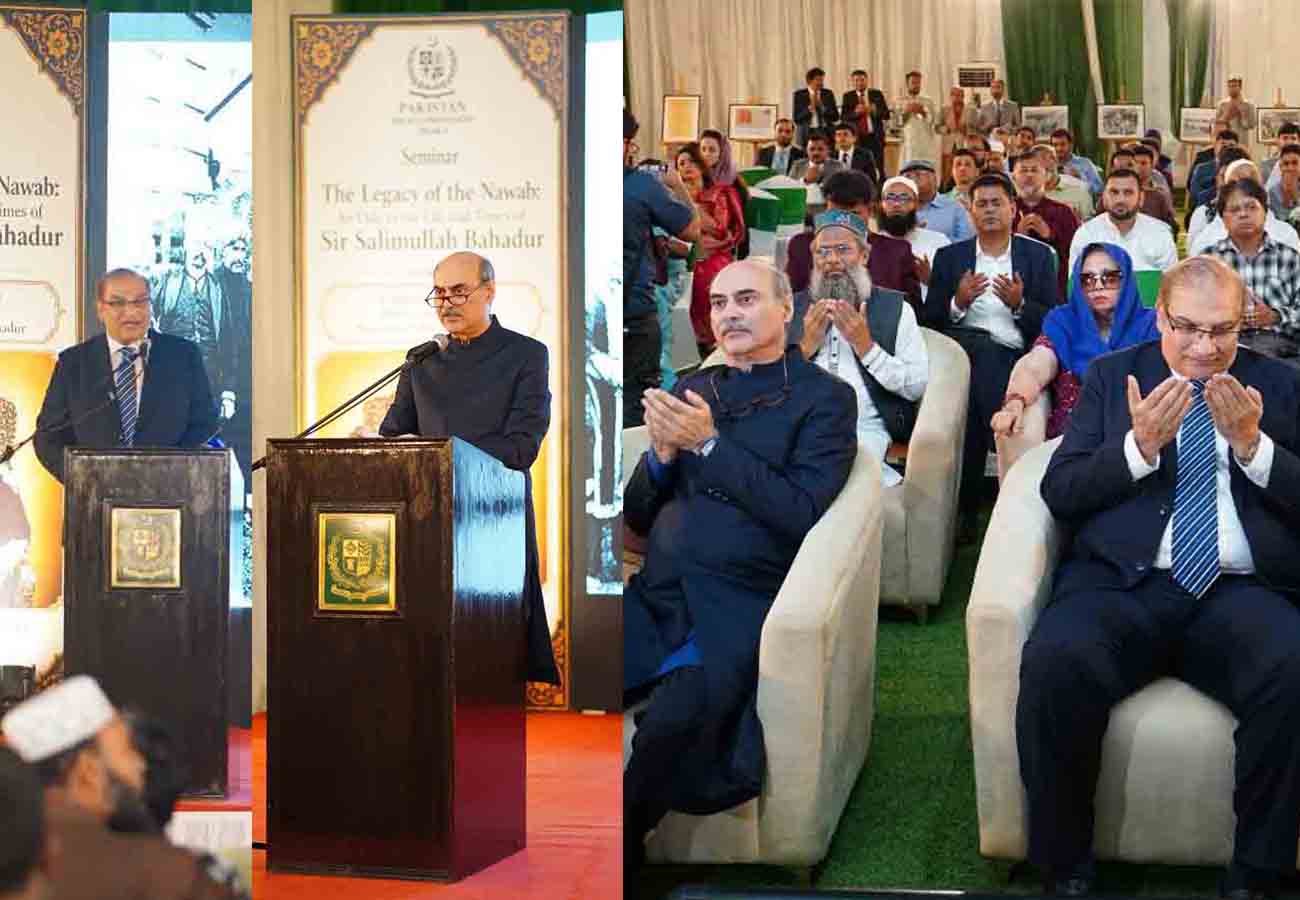
The seminar was organized at the high commission office ground of the city titled “The Legacy of the Nawab: An Ode to the Life and Times of Sir Salimullah Bahadur".
Speakers at the seminar remembered Sir Salimullah Bahadur as a prominent political leader, educator, and philanthropist whose legacy continues to be revered across the history of Bengal and the Indian subcontinent.
Eminent scholars, historians, researchers, media personalities, and representatives of the Dhaka Nawab Family—including Nawabzada Khwaja Samiullah Askari, the great-grandson of Salimullah Bahadur—attended the event.
Addressing the audience and paying respects to the legacy of Nawab Sir Salimullah Bahadur, Pakistan’s High Commissioner to Bangladesh, Mr. Imran Haider said that he had made remarkable contributions in the fields of education, public welfare and political empowerment of Muslims during the colonial era.
“Vision, leadership and public service of Nawab Bahadur became the defining elements of political awakening of the Muslims in the subcontinent,” he added.
Further, he emphasized on the historical contribution of the Nawab towards establishing the All-India Muslim League at Dhaka in 1906, which is considered as a turning point in the political history of South Asia.
Asian University of Bangladesh teacher Dr. Mohammad Alamgir provided a historical account of the Dhaka Nawab family and their contributions to the social and political developments in Bengal.
He pointed out that the Nawabs had made valuable contributions towards the social, educational and civic growth of Dhaka during the nineteenth and early twentieth centuries.
Nahid Afrose Kabir, professor of BRAC University, focused on the contributions of Nawab Sir Salimullah in the field of education in East Bengal.
She emphasized on how his encouragement and support for institutions and scholarships have benefitted thousands of students and have helped them to improve their social status.
"His efforts to improve the condition of society have not only made an impact during his lifetime but also serve as an inspiration for future generations," she added.
Editor of CounterPoint Zafar Sobhan shared his insights on his pivotal role in shaping Muslim politics, as well as his efforts to advance political representation and socio-economic upliftment.
Historians believe that Nawab Salimullah is considered to be one of the most prominent figures from the Muslims of Bengal in the early twentieth century who believed in education, social reform and politics when Muslims had many socio-economic problems. His efforts led to the development of political discourse among Muslims in British India.
Nawabzada Khwaja Samiullah Askari, speaking on behalf of his family, narrated his thoughts about the great-grandfather and how their family valued the principles of education and social services.
"Our family takes pride in his efforts for the betterment of society. His principles and ideals have always been guiding us and inspire us to contribute towards the welfare of the coming generation," he commented.
Souvenirs were awarded to the speakers by the High Commissioner in appreciation of their contributions during the seminar.
An exhibition showcasing rare photographs and documents on the life, works and legacy of Dhaka Nawab family was also organized on the sidelines of the seminar.
The event drew history enthusiasts and researchers eager to explore the cultural heritage of the Dhaka Nawab family and the political landscape of that era.
Special prayers were offered for the departed soul of the Nawab.
The seminar served as an occasion to commemorate the enduring legacy of one of Bengal's greatest historical figures, whose immense contributions spanned the fields of education, social welfare, politics, and public administration.
