
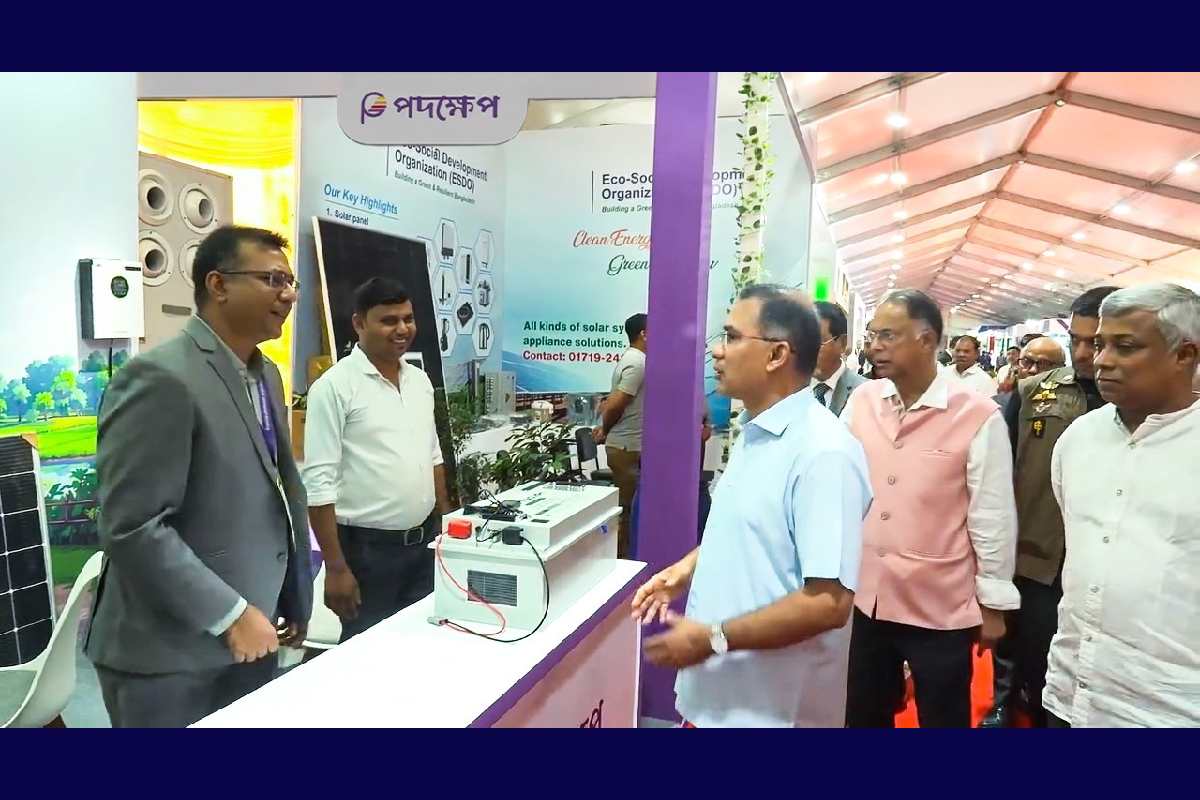
NGO showcases renewable energy experience at Solar Expo 2026, plans to mobilise households and small businesses
DHAKA, November 4: Padakhep Manabik Unnayan Kendra is preparing to expand rooftop solar power adoption among households and small businesses across Bangladesh by working as a Demand Aggregator (DA) under the Infrastructure Development Company Limited's (IDCOL) Domestic Rooftop Solar (DRS) Programme.
The organisation is showcasing its more than two decades of experience in renewable energy projects at the two-day Bangladesh Solar Expo 2026 in Dhaka, highlighting its plans to connect households with affordable rooftop solar solutions, technical services and financing opportunities.
Padakhep's participation comes as the government steps up efforts to expand renewable energy generation and encourage greater use of rooftop spaces for solar power.
The expo was inaugurated by Prime Minister Tarique Rahman on November 3 at the Bangladesh-China Friendship International Conference Centre in Agargaon. Jointly organised by the Power Division, the Ministry of Power, Energy and Mineral Resources, and IDCOL, the exhibition is being held for the first time under the theme, "Utilize every inch of your rooftop and increase income through solar energy".
One of the key objectives is to support implementation of the National Renewable Energy Development Strategy 2026–2030 and familiarise stakeholders with government policies and incentives for expanding solar power generation.
At Stall No. 93, Padakhep is displaying solar panels, off-grid inverters, batteries and related equipment, including a 1.7 kW inverter, 12V 100Ah and 64V 150Ah batteries, and 200W and 350W solar panels.
The exhibits reflect the organisation's experience in implementing solar power and Energy Storage System (ESS) projects across different communities.
Padakhep entered the solar energy sector in 2005, working with IDCOL and government rural infrastructure initiatives to bring Solar Home Systems (SHS) to households in remote and electricity-deprived areas.
Between 2006 and 2018, it installed 36,843 solar energy systems in 10 districts, according to its records. These included 33,823 Solar Home Systems and 3,020 solar streetlights.
The organisation also introduced instalment-based payment facilities to help low-income households access solar electricity.
Beyond community-level projects, Padakhep has expanded renewable energy use across its own operations.
In 2022, it installed a 24.09 kWp grid-connected rooftop solar system at its Dhaka head office, with an estimated annual electricity generation capacity of 33,000 units.
Solar power and lithium battery-based energy storage systems are also being used at its branch offices.
In April this year, four integrated solar power and ESS installations with a combined solar capacity of 8.8 kWp were established in Shibpur and Gaila. The systems serve two residential households, a livestock farm and a mosque-cum-madrasa facility.
Building on this experience, Padakhep plans to launch field-level activities under IDCOL's Domestic Rooftop Solar Programme soon.
The proposed initiative will focus on raising awareness among the organisation's members and beneficiaries, identifying suitable rooftops and assessing electricity demand. It will also connect prospective customers with technical service providers and financing opportunities in line with applicable policies and guidelines.
"The participation of households, small entrepreneurs and local communities is crucial to achieving the country's national solar energy expansion targets," said Mohammad Rakibul Hasan, joint director of Padakhep.
"Our primary objective in participating in this expo is to leverage our experience from previous projects and our extensive member network to bring the opportunities of affordable and environmentally friendly energy to a wider population," he added.
Meanwhile, the special tariff of Tk 10.50 per unit for surplus electricity supplied to the national grid from rooftop solar systems was highlighted at the expo's inauguration.
According to a Power Division notification effective from September 1, 2026, eligible consumers installing qualifying rooftop solar systems and supplying surplus electricity to the grid by February 28, 2027, will receive Tk 10.50 per unit for the electricity supplied until February 28, 2030, subject to compliance with the Net Metering Guidelines 2025.
A government clarification issued on September 18 also confirmed that the incentive applies to eligible solar systems both with and without battery integration.
The incentive is expected to encourage households and businesses to invest in rooftop solar installations while creating opportunities to generate additional income from surplus electricity.
