
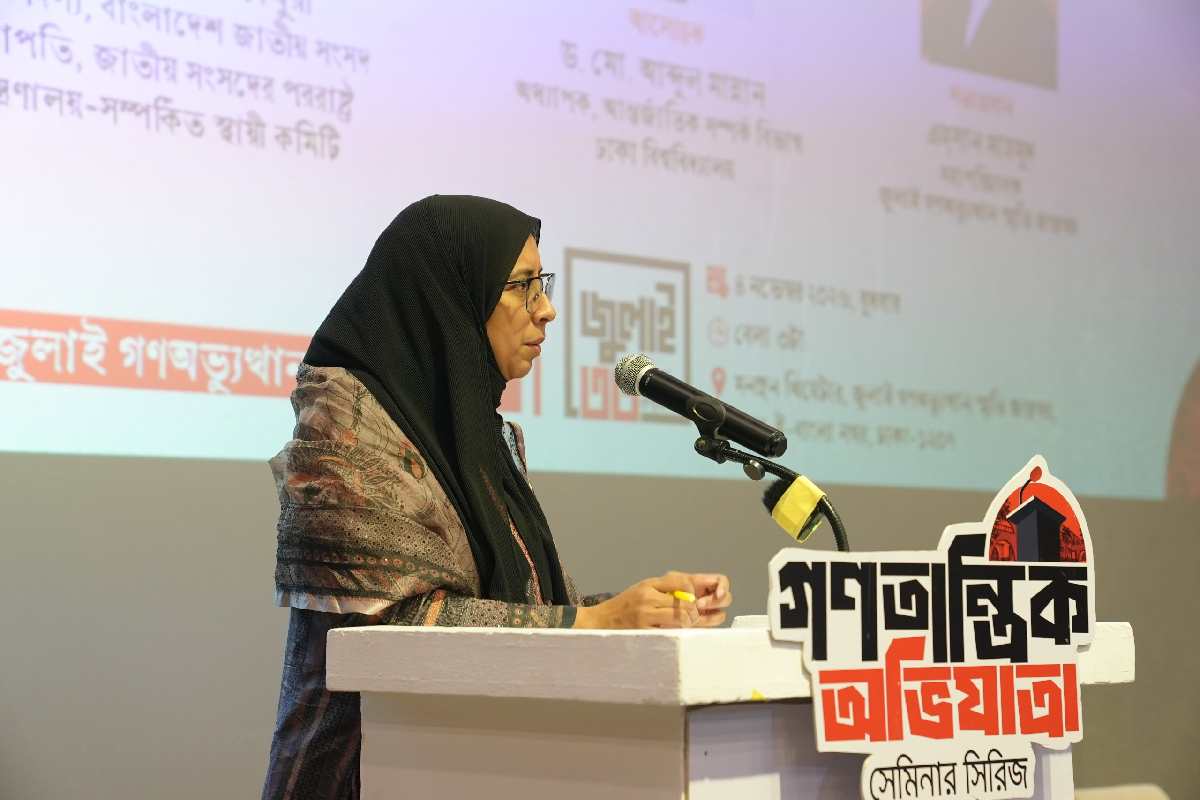
Foreign affairs committee chairman contrasts Sheikh Mujib and Ziaur Rahman's diplomatic approaches at Dhaka seminar
DHAKA, November 4: Bangladesh lost valuable opportunities to build stronger international partnerships in the early years after independence because the government of Sheikh Mujibur Rahman failed to pursue a balanced foreign policy, Zohrat Adib Chowdhury, chairman of the Parliamentary Standing Committee on the Ministry of Foreign Affairs, said on Wednesday.
He argued that the country's excessive dependence on a neighbouring state discouraged other influential countries from developing stronger bilateral relations with Bangladesh at a critical stage of its emergence as an independent nation.
"Following the Liberation War, as a newly independent country, we had an opportunity to forge friendly ties with the nations that were extending recognition to us. However, we squandered that chance," he said.
Zohrat made the remarks at a discussion titled 'A Comparative Review of Bangladesh's Foreign Policy in the First Post-Independence Decade', organised by the July Mass Uprising Memorial Museum in Dhaka.
He alleged that the failure to formulate an effective foreign policy contributed to the suspension of substantial foreign assistance, leaving the newly independent country struggling to manage multiple crises, including famine.
Comparing the diplomatic approaches of the country's first two post-independence leaderships, he said Shaheed President Ziaur Rahman pursued a more balanced foreign policy during the latter half of the decade, prioritising national interests and strengthening relations with countries where Bangladesh had strategic and economic interests.
He also credited Ziaur Rahman with creating opportunities for Bangladeshi workers to seek overseas employment and contribute as skilled human resources.
In contrast, Zohrat criticised the Sheikh Mujib government for ending democratic political competition through the establishment of BAKSAL, arguing that the move damaged Bangladesh's international image.
Highlighting the importance of institutional research in foreign policy formulation, he said Ziaur Rahman established the Bangladesh Institute of International and Strategic Studies (BIISS) to promote strategic research and ensure that foreign policy decisions were not centred solely on individual leaders.
He said such institutions could help future generations strengthen Bangladesh's position in the international arena.
Dr Md Abdul Mannan, a faculty member of the Department of International Relations at the University of Dhaka, also took part in the discussion as a discussant.
He said India's assistance to Bangladesh during the Liberation War was driven partly by its own strategic interests, while criticising what he described as the Awami League government's pre-August 5 narrative that India had effectively gifted Bangladesh its independence.
According to Mannan, such a narrative undermined the contributions and sacrifices of Bangladeshi freedom fighters.
He argued that India had historically sought to maintain influence over Bangladesh, while Pakistan's post-independence campaign portraying Bangladesh's emergence as a division of the Muslim nation created additional diplomatic challenges for the new country.
Mannan said Sheikh Mujibur Rahman's foreign policy approach had complicated efforts to establish an independent diplomatic identity.
He contrasted this with Ziaur Rahman's efforts to develop balanced relations with India and rebuild Bangladesh's standing in the Muslim world, saying the latter helped establish the country's independent identity and international influence.
Delivering the presidential address, Ehasan Mahamud, director general of the July Mass Uprising Memorial Museum, said the foreign policy trajectories under Sheikh Mujibur Rahman and Ziaur Rahman were central to understanding Bangladesh's first decade after independence.
Referring to public dissatisfaction over the country's perceived dependence on India, he said many people who had fought for independence questioned whether Bangladesh had exchanged Pakistani domination for Indian influence.
He said Ziaur Rahman sought to instil a stronger sense of sovereignty and national identity among younger generations.
Mahamud recalled that Ziaur Rahman would take talented students aboard the naval vessel Hizbul Bahar to visit Bangladesh's maritime boundaries, allowing them to understand the country's territorial waters and maritime sovereignty firsthand.
He said such initiatives reflected an effort to develop future generations capable of defending national interests and positioning Bangladesh confidently in the international arena.
The seminar, the fourth instalment of the Democratic Journey Seminar Series organised by the July Mass Uprising Memorial Museum, was moderated by author and researcher Tuhin Khan.
University faculty members, researchers, professionals, students and representatives of civil society attended the event.
