
Uniting efforts to secure safe water for Barind
Integrated efforts of all the government and non-government organizations concerned can be the crucial means of ensuring access to safe water for vulnerable communities in the Barind tract.
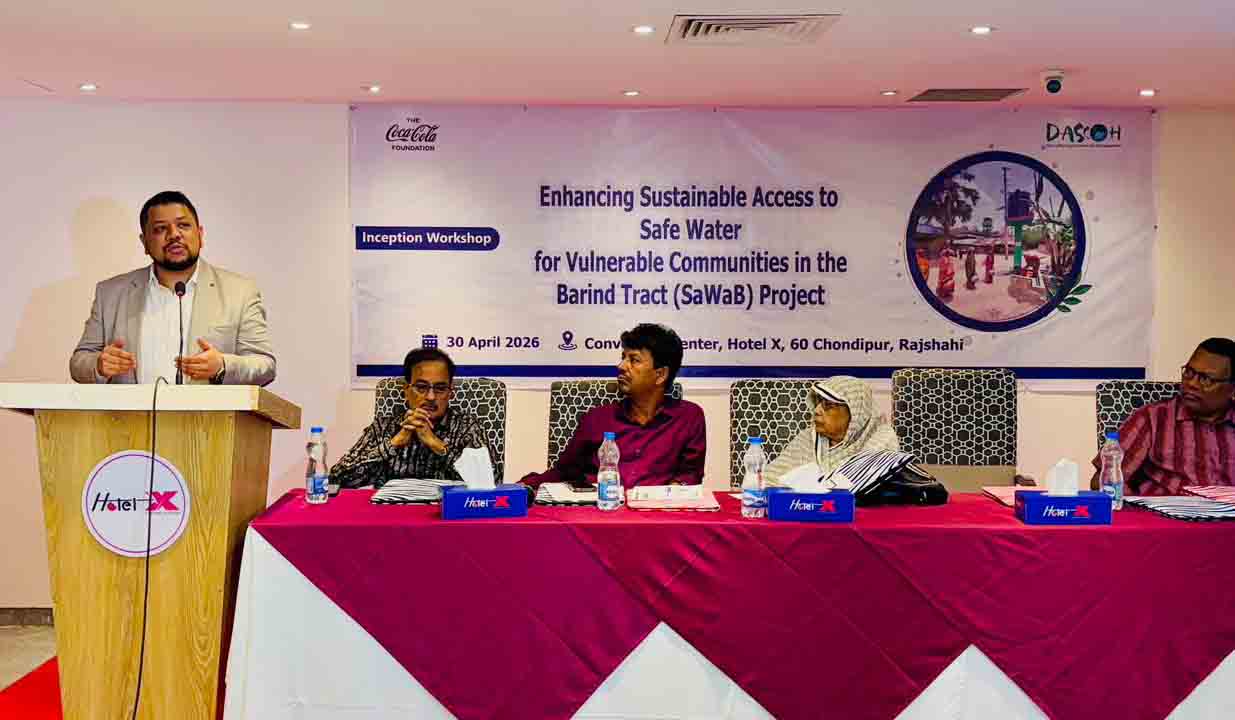
DASCOH Foundation officially launched the project titled “Enhancing Sustainable Access to Safe Water for Vulnerable Communities in the Barind Tract (SaWaB)” through an inception workshop held in Rajshahi recently. The project is being implemented with financial support from The Coca-Cola Foundation (TCCF) to improve sustainable, climate-resilient access to safe drinking water for vulnerable communities in the drought-prone Barind Areas of Bangladesh.
DASCOH Foundation organized the workshop at Hotel X in Rajshahi city bringing together representatives from government departments, local government institutions, academia, media, community leaders and development partners.
Executive Director of Barind Multipurpose Development Authority Abu Sayed Md Kamruzzaman addressed the meeting as the chief guest.
Professor Chowdhury Sarwar Jahan from the Department of Geology and Mining at Rajshahi University, Adviser of Institute of Water Modeling Mantu Kumar Biswas and Managing Director of Coca-Cola Bangladesh Limited Moin Ullah Chowdhury and Social Development Officer at Department of Public Health Engineering Dr Tarun Bondopadhye spoke as special guests.
Chief Executive Officer of DASCOH Foundation Akramul Haque moderated the discussion, while its Chairman Jaituna Khatun gave her vote of thanks.
During his keynote presentation, Project Manager Jahangir Alam Khan said the Barind Tract has been facing increasing water scarcity due to falling groundwater levels, irregular rainfall, long droughts, and climate change impacts.
The three-year SaWaB project will work in Niamatpur Upazila in Naogaon and Gomastapur Upazila in Chapainawabganj aiming to benefit approximately 1.55 lakh vulnerable people through improved and climate-resilient water supply systems and community-based water management approaches.
The project includes piped water systems, solar and electric submersible pumps, rainwater harvesting, pond re-excavation, sanitation facilities, hygiene promotion, and strengthening Water Management Committees, while ensuring community participation, inclusion of women and marginalized groups, and long-term local ownership.
In his remarks, Moin Ullah Chowdhury said: “Access to safe water is not a privilege - it is a fundamental human right. At Coca-Cola, our commitment goes far beyond the beverages we produce. Giving back to the communities we serve and creating lasting positive impact has always been central to who we are”.
“Through The Coca-Cola Foundation, this commitment is transformed into meaningful, long-term action. As we launch Phase 2 of this initiative, I am confident that by working together, we will continue to drive sustainable progress and deliver lasting change for the communities we serve," he added.
The Barind Tract in northwestern Bangladesh has been facing increasing water scarcity due to falling groundwater levels, irregular rainfall, long droughts, and climate change impacts. The Government of Bangladesh recently declared parts of the region as high water-stress areas, highlighting the urgent need for sustainable water management initiatives.
The three-year SaWaB project will work in Niamatpur Upazila (8 unions) and Gomastapur Upazila (5 unions) and aims to benefit approximately 155,000 vulnerable people through improved and climate-resilient water supply systems and community-based water management approaches.
Speaking at the workshop, participants appreciated the continued partnership between DASCOH Foundation and The Coca-Cola Foundation in promoting climate-resilient solutions in vulnerable communities of Bangladesh
The workshop concluded with a shared commitment among stakeholders to work together to ensure safe, sustainable, and equitable access to water in the water-stressed Barind Tract.
