
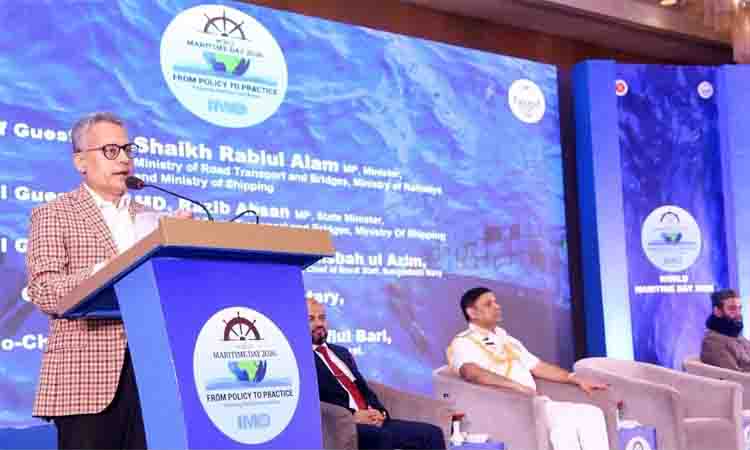
Govt stresses modern ports, skilled seafarers, safe maritime transport.
Shipping Minister Shaikh Rabiul Alam, MP today said coordinated initiatives by all concerned are needed to ensure modern ports, skilled seafarers, a strong regulatory system and safe water transport.
“Simply joining international maritime conventions or enacting laws will not be enough. To ensure their benefits, emphasis must be given to safe ships, clean and modern ports, skilled seafarers, an effective regulatory system and sustainable maritime trade,” he said.
Rabiul, also Minister for Road Transport and Bridges and Railways, said this while addressing a programme as the chief guest organised by the Department of Shipping at a hotel here on the occasion of World Maritime Day 2026.
Organised under the overall supervision of the Ministry of Shipping, this year’s theme was “From Policy to Practice: Achieving Excellence in the Maritime Sector”, said a press release.
Mentioning that the real success of policies, plans and international commitments depends on their effective implementation, the Minister said the government is working to develop the country’s maritime sector as safe, modern, technology-driven, environment-friendly and internationally competitive.
He stressed modernising and automating the country’s ports, expanding their capacity and reducing cargo handling time.
At the same time, he said the Department of Shipping’s regulatory and inspection capacity would be strengthened, while the control activities of flag and port states would be brought up to international standards and compliance with safety and environmental standards would be ensured.
Shaikh Rabiul Alam said the country’s seafarers are Bangladesh’s most valuable maritime resource and important representatives of the country abroad, adding continued investment would be maintained in their welfare, training, certification and professional skill development.
He said coordinated initiatives would be taken to ensure sustainable development of inland waterways and coastal shipping, prevent river pollution and ensure safe navigation.
Chief of Naval Staff Admiral Khondkar Misbah ul Azim attended the programme as a special guest. Highlighting the interrelationship between maritime security and maritime prosperity, he said the development of ports, maritime trade, fisheries resources, ocean-based resources and the blue economy depends on a safe and stable maritime environment.
He called for further strengthening the security of the country’s maritime boundary, information sharing, overall maritime situational awareness and effective coordination among the relevant agencies.
He also stressed increasing investment in maritime education, training, modern technology and professional development.
The programme was told that Chattogram Port is currently handling around 3.4 million containers annually. Matarbari Deep Sea Port will play an important role in meeting the future demand for handling the capacity of around four million additional containers. The port, which is being developed with a target of commencing operations in 2029, will be able to directly receive large ships around 230 metres long with a capacity of 8,000 to 10,000 containers.
This would reduce transportation time and cargo transportation costs while further strengthening Bangladesh’s position in regional and global supply chains.
The programme stressed the need to develop a safe, environment-friendly and technology-driven water transport system, describing the country’s nearly 6,000 kilometres of inland waterways as an important asset for the economy and communication system.
At the event, it was revealed that after the Hong Kong International Maritime Convention came into force, 24 ship recycling yards in the country have met the prescribed standards and another 20 yards are undergoing the certification process. Emphasis was laid on making the industry internationally competitive by ensuring safety, workers’ welfare and environmental standards.
Besides, an initiative has been taken to formulate a national action plan with the support of the International Maritime Organization’s “Green Voyage 2050” programme to reduce greenhouse gas emissions from shipping. Emphasis was given to transitioning to green shipping through low-carbon fuels, energy efficiency, increased use of electricity in port operations and environmentally sound ship recycling.
Highlighting progress in maritime education and training in the country, the programme was told that 15 maritime academies and training institutions and one maritime university are currently working to produce skilled seafarers, marine engineers and port management professionals. More than 138 female cadets have graduated from the country’s maritime academies since 2014.
Shipping Secretary Zakaria, Director General of the Department of Shipping Commodore Md. Shafiul Bari, senior government officials, representatives of port authorities, ship owners, vessel operating companies, representatives of ship management and ship recycling companies, heads of maritime education and training institutions, seafarers and professionals involved in the maritime sector attended the programme.
