
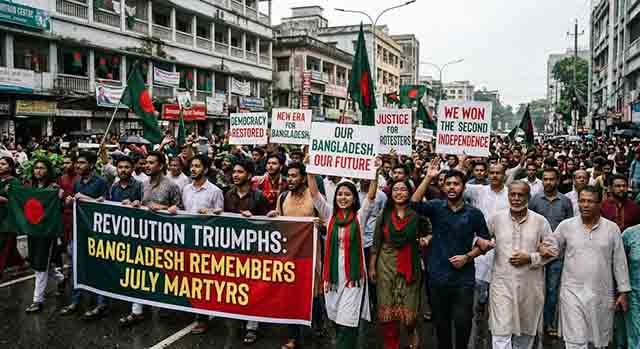
July Revolution: Beyond Hopes and Disappointments
Two years after the student-led people's uprising dismantled the fifteen-year autocracy of Sheikh Hasina, Bangladesh finds itself navigating the complex realities of structural recalibration. The euphoric aftermath of August 2024—baptized by its architects as the "July Revolution"—promised an immediate democratic renaissance. Yet as the initial revolutionary dust settles across the streets of Dhaka, the nation’s political trajectory demonstrates a far more dispassionate truth: revolutions rarely deliver clean breaks; instead, they recalibrate power, national sovereignty, and strategic alignment in an unsparing geopolitical arena.
The fall of the Awami League regime was not merely a domestic collapse; it was a decisive rupture in the regional balance of power. For over a decade, Dhaka operated as the centerpiece of New Delhi’s so-called neighborhood policy—a relationship increasingly viewed by the Bangladeshi public not as a partnership of equals, but as a condition of subordinate clientelism. The seminal 2021 Al Jazeera investigation, All the Prime Minister's Men, laid bare the mechanics of this governance model: a state machinery where national security apparatuses, financial intelligence, and crony networks were deployed to preserve regime continuity at the expense of sovereign autonomy.
Under Hasina, the boundary between domestic law enforcement and foreign geopolitical interests blurred entirely. This institutional degradation reached its zenith in the regime's systematic reliance on enforced disappearances and state-sanctioned extrajudicial measures. As noted by academic and researcher Dr Nabila Idris in her widely circulated commentary and analytical posts on the state’s deep architecture, the captured institutions served a dual purpose: neutralizing internal dissent while securing foreign endorsement through an asymmetric dependency on New Delhi. Idris highlighted how the rhetoric of "counter-terrorism" and "regional stability" was routinely leveraged to justify secret detentions, renditions, and the erosion of territorial and political self-determination.
The July Revolution effectively dismantled this patron-client dynamic. In casting off the Hasina administration, Bangladesh executed a stark restoration of its national sovereignty, asserting that its domestic governance would no longer be adjudicated in foreign capitals.
The Realignment of Foreign Policy
This restoration of sovereign agency has inevitably triggered a sweeping diversification of Dhaka’s foreign policy. For years, Bangladesh’s external relations were constrained by a singular bilateral pivot toward India. Post-revolution, the interim administration and political establishment have adopted a rigorous multi-vector diplomacy, systematically dismantling former regional monopolies in favor of strategic hedge and economic pragmatism.
*China & Infrastructure:* Beijing has emerged as a primary beneficiary of Dhaka’s diplomatic diversification. Unburdened by political conditionalities regarding domestic security arrangements, China’s engagement has shifted toward accelerated infrastructural investments, deep-water port developments, and expanded trade concessions under the Belt and Road Initiative.
*Pakistan & South Asian Rebalancing:* Bilateral channels with Islamabad, deliberately frozen under the previous regime, have experienced a functional thaw. Rather than an ideological pivot, this rapprochement reflects a pragmatic effort to normalize South Asian diplomatic trade and counter-balance regional hegemony.
*Eurasian & Russian Engagements:* Ties with Moscow remain grounded in nuclear energy cooperation and agricultural commerce, demonstrating Dhaka’s refusal to align passively with Western-led sanction regimes or single-power blocs.
*Malaysia, ASEAN, and the Muslim World:* Relations with Southeast Asia—specifically Malaysia—have gained newfound momentum, driven by labor migration frameworks, supply-chain integration, and joint diplomatic ventures within ASEAN. Simultaneously, renewed engagement with the broader Muslim world and the Organization of Islamic Cooperation (OIC) has re-anchored Bangladesh’s identity as a key maritime actor in the Global South.
Beyond Hopes and Disappointments
To view Bangladesh purely through the lens of strategic realignments, however, is to overlook the formidable domestic frictions that persist. Revolutions inevitably generate an economy of expectations that no transitional authority can fully satisfy.
The immediate hopes of July 2024—rapid judicial reform, economic stabilization, and flawless institutional accountability—have run up against the entrenched realities of bureaucratic inertia, inflation, and police demoralization. Critics point to the slow pace of institutional reconstruction as evidence of stagnation; enthusiasts view it as the unavoidable friction of dismantling a decade-and-a-half of authoritarian consolidation.
Yet, stripping away both revolutionary romanticism and partisan pessimism reveals a clear outcome: Bangladesh has reclaimed its position as an independent actor on the global chessboard. By dismantling Indian diplomatic hegemony and establishing a multi-polar foreign posture, the post-Hasina era has redefined the parameters of South Asian geopolitics. Whether the domestic state apparatus can match this external assertiveness with enduring internal stability remains the central question of Bangladesh’s modern history.
