
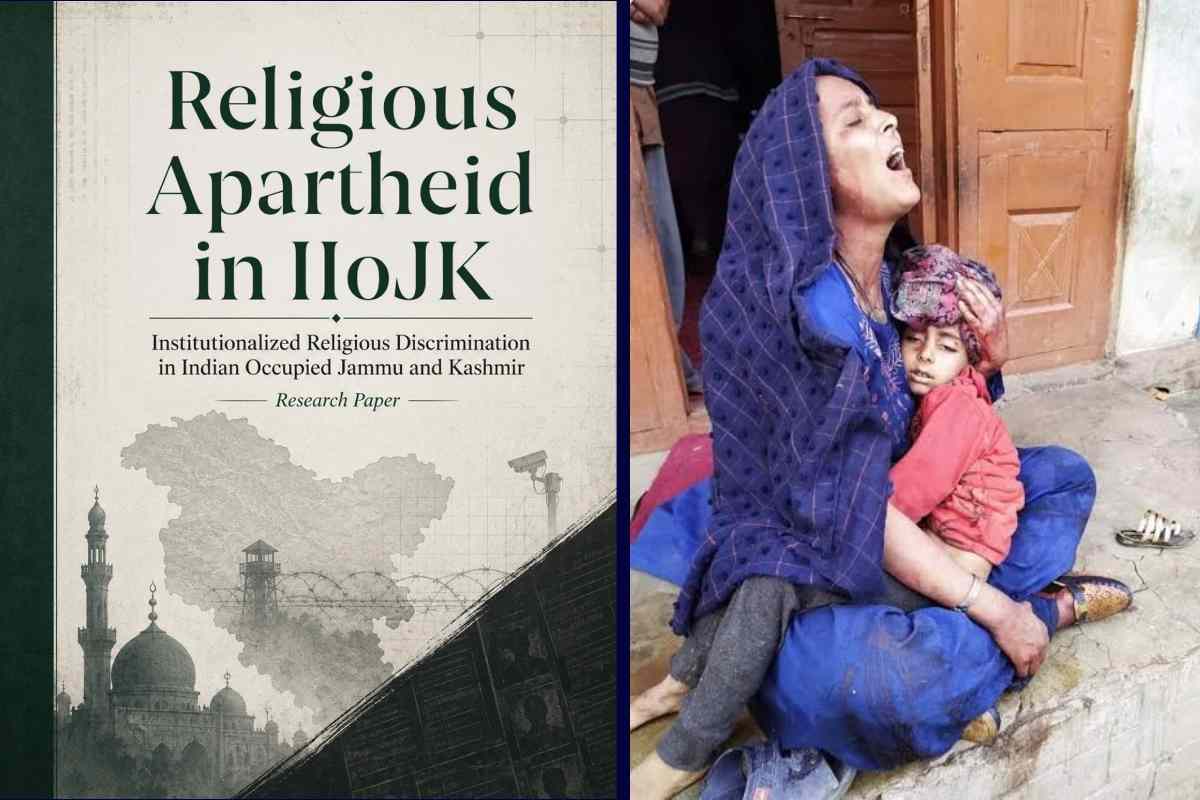
As Kashmir observes Black Day, official crime figures and advocacy data highlight concerns over child protection, missing children, health, education and family separation.
Jammu and Kashmir recorded 887 cases of crimes against children in 2024, including 243 kidnapping and abduction cases, while only 12 cases ended in conviction during the year, according to figures attributed to India's National Crime Records Bureau (NCRB).
The figures have renewed concerns about child protection and access to justice in the disputed Himalayan region, where decades of conflict have left families grappling with loss, insecurity and economic hardship.
As Kashmir observes Black Day on October 27, advocacy materials provided by the International Muslim Women's Union (IMWU) highlight the challenges confronting children, from orphanhood and family separation to psychological distress, nutritional deficiencies and interrupted education.
The organisation cites a reported 108,011 children orphaned in Jammu and Kashmir between January 1989 and July 2026, including 236 since August 5, 2019. These figures require independent verification, but they underscore the importance of examining the long-term consequences of conflict for children and their families.
The latest crime figures also point to continuing challenges for the justice system. Although reported crimes against children declined from 920 in 2022 to 910 in 2023 and 887 in 2024, the numbers do not capture the full extent of vulnerability, including cases that may go unreported.
According to reporting on the NCRB data, 537 cases remained under investigation at the end of 2024, while 2,661 cases involving crimes against children were pending before courts during the year. The 12 convictions recorded in 2024 should be understood alongside the wider backlog and the fact that court outcomes in a given year may relate to cases registered in earlier years. Source: The News Now, May 8, 2026.
For children in conflict-affected communities, insecurity can extend beyond direct exposure to violence. Checkpoints, movement restrictions, security operations and the threat of cross-border firing can affect access to schools, healthcare, recreation and family support.
The IMWU materials describe children growing up in an environment where ordinary activities may be interrupted by security measures and where families remain concerned about their safety.
The organisation estimates that 800,000 to 900,000 Indian security personnel are deployed across Jammu and Kashmir. This figure has not been independently verified for this article and should not be treated as an established current troop count.
The broader issue, however, is the effect of prolonged insecurity on children's everyday lives. In border districts, including areas of Rajouri and Kupwara, the threat of firing and unexploded ordnance can restrict outdoor activities and increase parental concerns about children's safety.
The IMWU also raises concerns about the effects of cordon-and-search operations following the April 22, 2025, Pahalgam attack, in which 26 people were killed. Reports of searches and movement restrictions in affected areas warrant careful examination of their impact on civilian families, including children.
Such concerns do not establish that every security operation violates children's rights. They do, however, highlight the need for security measures to account for civilian safety and to protect children's access to essential services.
The loss of a parent can affect nearly every aspect of a child's life, from household income and education to emotional security and access to healthcare.
The IMWU cites figures indicating that 108,011 children were orphaned in Jammu and Kashmir between 1989 and July 2026. It also refers to human rights documentation recording 936 children killed between 1989 and 2025.
The organisation attributes much of the reported orphanhood to civilian deaths during the prolonged conflict. The figures and their underlying methodology need independent corroboration before they can be considered definitive.
Nevertheless, children who lose parents may face significant financial and social challenges, particularly where surviving family members lack adequate support.
The IMWU argues that vulnerable children may be pushed towards informal employment or forced to leave school when families cannot meet household expenses. It calls for stronger social protection, educational assistance and welfare support for children affected by conflict.
The issue also raises questions about whether existing support systems can identify vulnerable children promptly and provide sustained assistance as they move through childhood and adolescence.
Kidnapping and abduction were the most frequently reported categories of crimes against children in Jammu and Kashmir in 2024, with 243 cases, according to the NCRB figures cited in regional reporting.
The total number of registered crimes against children was 887, including cases under various criminal laws. The figures demonstrate the continuing importance of investigation, prevention and support for victims.
The IMWU also raises concerns about missing children and potential exploitation, particularly in rural and border areas where displacement and economic hardship can weaken family and community support networks.
India has established mechanisms, including TrackChild and the Khoya-Paya platform, to support the tracing of missing children. The effectiveness of these systems depends on timely reporting, coordination among agencies and the capacity to follow up individual cases.
The organisation argues that fragmented monitoring and weak local implementation can leave vulnerable children exposed to exploitation. These claims require district-level evidence to establish the scale of any enforcement gaps.
For families, the central concern is practical: whether missing children can be located quickly, investigations can proceed effectively and victims can receive appropriate protection.
The challenges facing children extend beyond security-related risks to broader questions of health and development.
According to India's National Family Health Survey-5, conducted in 2019–21, 72.7% of children aged 6–59 months in Jammu and Kashmir were anaemic. The figure includes 73.9% of male children and 71.4% of female children, according to data cited in the IMWU materials and reported in regional coverage.
The survey provides an important baseline, although it does not establish the current prevalence of anaemia in 2026. Nor does the overall figure mean that all affected children have severe anaemia.
The findings nevertheless point to a significant public health challenge. Anaemia in early childhood can affect physical growth, immunity and cognitive development, making timely diagnosis, adequate nutrition and access to healthcare important priorities.
The IMWU argues that prolonged insecurity and household financial pressures can make it harder for some families to obtain nutritious food and medical treatment.
A comprehensive response would require effective nutrition programmes, accessible primary healthcare and targeted support for children from economically vulnerable households.
The IMWU materials also highlight concerns about the psychological impact of conflict, including fear, disturbed sleep, anxiety and recurring nightmares among children exposed to violence or insecurity.
The organisation refers to assessments conducted by the Institute of Mental Health and Neurosciences Kashmir, with UNICEF support, in Uri in May 2025. The specific findings and methodology were not independently available for verification in preparing this article.
Even so, the wider need for child mental health support in conflict-affected communities is an important consideration for healthcare and welfare authorities.
Children experiencing bereavement, displacement or prolonged uncertainty may need counselling and other forms of psychosocial assistance. The availability of trained professionals, confidential services and sustained community support can influence whether children receive timely help.
The IMWU also raises concerns about family separations following security-related actions in 2025, including cases involving mothers and children. Individual allegations, including claims about deportation and separation of newborns, require independent corroboration before publication as established facts.
Such cases highlight the importance of assessing the best interests of children when administrative or security decisions affect their families, while ensuring that individual circumstances are reviewed through appropriate legal procedures.
Economic hardship can turn a family's immediate struggle for survival into a long-term obstacle to a child's development.
The IMWU describes households affected by bereavement, detention or disrupted livelihoods turning to informal work as a means of meeting basic expenses. Children may consequently face pressure to work in shops, workshops, agriculture or other informal settings rather than continue their education.
The organisation also raises concerns about school infrastructure, teacher shortages and interruptions to schooling. The scale of these problems and their direct relationship to conflict require further examination through official education data and district-level research.
Nonetheless, the link between poverty and educational disadvantage makes targeted support particularly important for orphans and children from low-income families.
Scholarships, school meals, vocational guidance for older adolescents and stronger enforcement against hazardous child labour can help reduce the pressure on children to contribute to household income at the expense of their education.
Safe recreational spaces are also important. Playgrounds and community facilities allow children to develop social skills, maintain physical health and experience a degree of normality despite the difficulties confronting their families.
International law provides a framework for protecting children affected by armed conflict and other forms of insecurity.
The United Nations Convention on the Rights of the Child establishes protections concerning children's safety, health, education and family relationships. The Geneva Conventions and applicable rules of international humanitarian law provide additional protections for civilians, including children, in situations of armed conflict.
UN Security Council Resolution 1612, adopted in 2005, established a monitoring and reporting mechanism on grave violations against children in armed conflict. Resolution 1998, adopted in 2011, strengthened international attention to attacks on schools and hospitals.
These instruments do not automatically resolve disputes over political status or establish the truth of individual allegations. They do, however, provide standards against which relevant conduct and protection measures can be assessed.
For children in Jammu and Kashmir, the practical question is whether legal safeguards translate into effective protection, access to services and accountability where violations occur.
The IMWU calls for stronger implementation of child protection measures, better monitoring of vulnerable children and greater attention to their physical and psychological needs.
Kashmir remains a major point of disagreement between India and Pakistan, with competing claims and longstanding diplomatic differences over the region's political future.
For Bangladesh and other countries concerned about South Asian stability, the dispute also has a humanitarian dimension. Protecting children, supporting families affected by conflict and ensuring access to education and healthcare are concerns that extend beyond the competing political positions of the parties.
The October 27 anniversary provides an opportunity to examine these issues without losing sight of the need for credible evidence, transparent investigations and constructive diplomatic engagement.
The IMWU's materials argue that the consequences of prolonged conflict cannot be measured solely through military developments or territorial claims. They must also be assessed through the experiences of children who lose parents, struggle to remain in school, face health challenges or grow up without a sense of security.
