
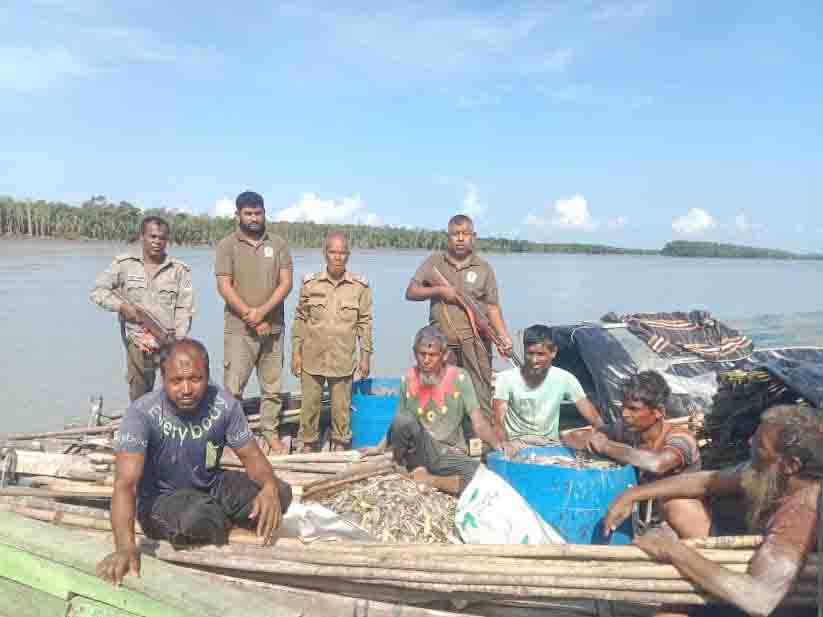
Government plans Sundarbans poison-detection lab to curb toxic fishing practices
The government has planned to establish a poison-detection laboratory to prevent the use of poison for fishing in the Sundarbans.
The Forest Department expressed hope that the establishment of the laboratory would help curb poison fishing. It also expects the facility to enable scientific testing and provide evidence in cases involving the use of poison in fishing.
Talking to BSS, Md. Rezaul Karim Chowdhury, East Divisional Forest Officer of the Sundarbans, said the Forest Department had formulated a project to establish a poison-detection laboratory for fish.
“We will soon send a proposal to the Ministry of Environment, Forest and Climate Change, which will later be forwarded to the Executive Committee of the National Economic Council (ECNEC) for approval,” he said, adding that the project was expected to be launched next year after the completion of all formalities, with funding from the World Bank.
He, however, said that despite regular drives and arrests of people involved in poison fishing in the Sundarbans, the Forest Department faced difficulties in proving such cases in court due to the lack of facilities for prompt scientific testing.
“It is not possible to immediately determine whether fish seized from people engaged in fishing in the Sundarbans have been contaminated with poison or are safe for consumption without conducting scientific tests using appropriate testing kits,” he said.
Although a few people have been sentenced to imprisonment for poisoning fish after the Forest Department successfully proved the cases in court, most accused have been acquitted due to the lack of facilities for immediate testing.
According to the Sundarbans East and West Forest Divisions, which cover Bagerhat, Khulna and Satkhira districts, 73 cases were filed over poison fishing between June and August this year. A total of 74 people were accused, of whom 62 were arrested.
During the period, the Forest Department seized 87 bottles and two litres of poison, 243.5 kilogrammes of shrimp, 210 kilogrammes of white fish, two sacks containing five kilogrammes of dried fish, and 736 kilogrammes of crabs allegedly caught using poison. It also seized 144 boats and 125 illegal fishing nets from the sites where the incidents occurred.
DFO Chowdhury said, “We need immediate testing facilities similar to those available to the Directorate of National Consumer Rights Protection, which can promptly detect formalin in fruits and other food items.”
“The Forest Department has no testing laboratory. There are also complications regarding where samples should be sent for prompt testing. Even when bottles of poison and other equipment are seized, chemical tests cannot be conducted quickly, making it difficult to establish the allegations in court,” he said.
Environmental experts warned that poisoning waterways could harm fish and other aquatic organisms. Toxic water carried by outgoing tides could damage aquatic ecosystems, threaten biodiversity and disrupt the natural reproductive processes of aquatic species. Eating fish caught using poison could also pose health risks to humans.
Contacted, Professor Dr Abdullah Harun Chowdhury of the Environmental Science Discipline at Khulna University told BSS that facilities for testing poison in fish could be developed in the country.
“For this, the government can assign responsibility to the Department of Fisheries and Livestock, the Department of Environment and the Bangladesh Atomic Energy Commission. The government can also import testing kits from abroad as an interim measure before establishing a laboratory in the country,” he said.
He, however, said the spread of toxic water could adversely affect the aquatic environment and disrupt the normal reproductive processes of wildlife.
Talking to BSS, Imran Ahmed, Forest Conservator for the Khulna region, said the United Nations Food and Agriculture Organization (FAO) was working on the issue, although no significant progress had yet been made.
Ahmed said proving cases of poison fishing in court was difficult without scientific tests, allowing accused people to benefit from the lack of adequate evidence.
He also said preparations were underway to establish a testing laboratory in the country with assistance from the World Bank.
A researcher at Khulna University who is studying aquatic resources in the Sundarbans told BSS that he had visited markets in Koyra and Shoronkhola several times this year while conducting research on fish species. He found various types of fish, including shrimp, that had a strong smell.
According to his observations, some of the fish were transported by truck to Dhaka and other parts of the country.
However, smell alone cannot establish whether fish were caught using poison, making specific scientific tests essential.
Contacted, Dr Sujat Ahmed, Deputy Director of Khulna Medical College Hospital (KMCH), told BSS that toxins could accumulate in the human body if people regularly consumed fish contaminated with poison or chemicals.
“Such toxins can spread to different parts of the body through the bloodstream and may eventually cause liver cirrhosis, kidney disease or stomach cancer,” he said.
Meanwhile, on October 1, the Forest Department submitted an investigation report identifying a political activist as the alleged mastermind behind poison fishing in the Sundarbans. Experts described the practice as a severe environmental and economic crisis affecting the world's largest mangrove forest.
