
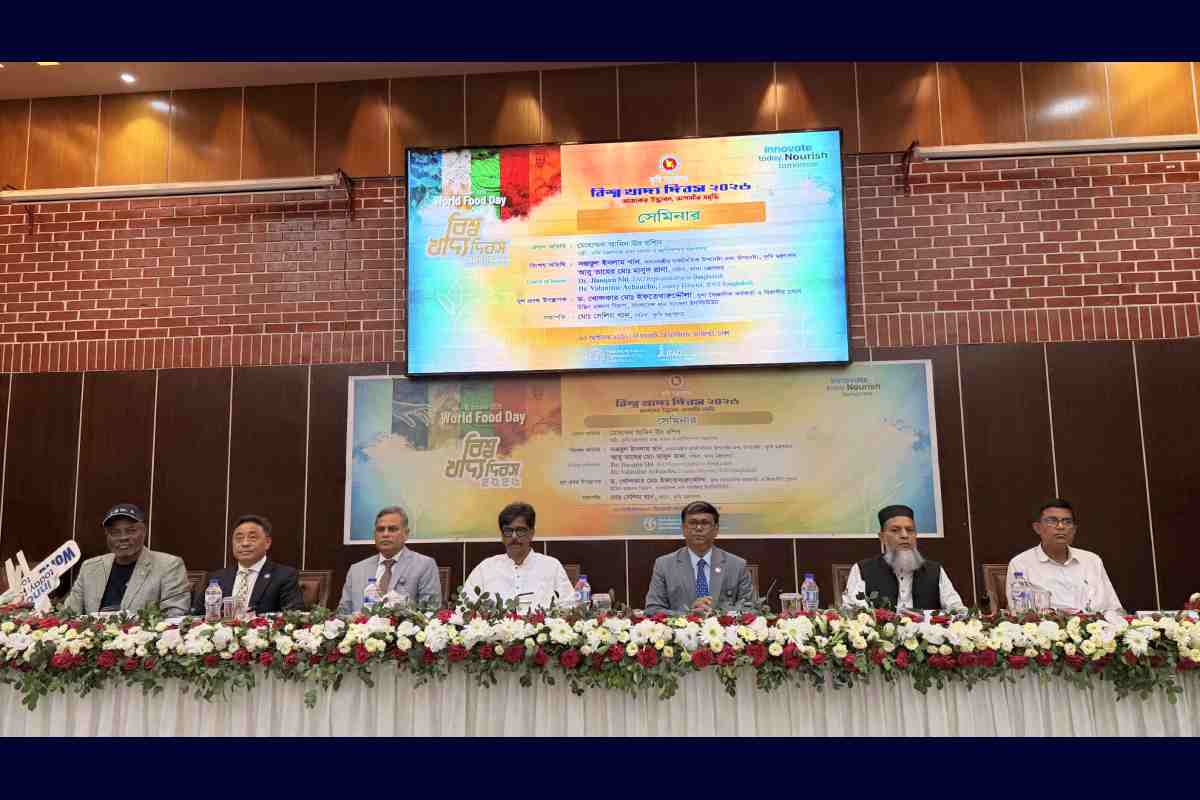
Bangladesh marks World Food Day 2026 with FAO and IFAD, calling for agricultural innovation, rural investment and stronger food security.
DHAKA, October 16, 2026 — Bangladesh has called for greater investment in agricultural innovation, rural communities and sustainable food systems to strengthen food and nutrition security, as the government and international development partners marked World Food Day 2026 in Dhaka.
The Ministry of Agriculture, in collaboration with the Food and Agriculture Organization of the United Nations (FAO), the International Fund for Agricultural Development (IFAD) and other partners, organised a national seminar at the Bangladesh Agricultural Research Council (BARC) auditorium under the theme “Innovate today. Nourish tomorrow.”
The seminar brought together government officials, UN agencies, development partners, farmers’ representatives, researchers, young people and private sector stakeholders to discuss ways to improve agricultural productivity, expand access to nutritious food, reduce food loss and waste, and help farmers cope with climate change and economic pressures.
Mohammed Aminur Rashid, Minister of Agriculture and Ministry of Food and Livestock, attended the event as the chief guest, stressing that sustained government leadership and the active participation of all stakeholders were essential to achieving food and nutrition security.
“Bangladesh’s food security journey must be driven by innovation, investment and collective responsibility,” he said, adding that farmers, researchers, entrepreneurs, policymakers and consumers must work together to turn innovation into tangible improvements in nutrition and food availability.
Mostafa Kamal, additional secretary at the Ministry of Agriculture, welcomed participants and underscored the importance of cooperation among government institutions, researchers, development partners and the private sector in translating innovative ideas into practical solutions for farmers and food producers.
Jiaoqun Shi, FAO representative in Bangladesh, called for faster and coordinated action to tackle hunger and malnutrition while making agrifood systems more inclusive, resilient and sustainable.
He said innovation extended beyond new technologies to include research, traditional knowledge, effective policies, local entrepreneurship and stronger partnerships.
“The future of food depends on the solutions we develop and scale today,” he said, emphasising the need to place farmers and vulnerable communities at the centre of efforts to build sustainable food systems.
Shi also highlighted the need for action across the entire food supply chain, from production and processing to distribution and consumption, alongside efforts to reduce waste.
The discussions underscored the importance of ensuring that agricultural research and technological advances translate into measurable benefits for farmers and consumers, particularly smallholder farmers who face growing climate and economic challenges.
Valantine Achancho, IFAD country director for Bangladesh, said the country's food security depended on investment in rural people who produce food for the nation.
He stressed that access to finance, technology and reliable markets could help small-scale farmers increase their incomes, improve diets and build resilience.
“When small-scale farmers can access finance, technology and reliable markets, innovation becomes a powerful force for higher incomes, healthier diets, and greater resilience,” he said.
Achancho said IFAD's partnership with the government demonstrated the importance of investing in rural communities to secure a better-nourished Bangladesh.
Abu Taher Md. Masud Rana, secretary at the Ministry of Food, called for practical measures to reduce food loss and waste, saying wasted food also meant wasted resources, investment and opportunities to improve nutrition.
He stressed the need for greater public awareness, practical innovations and coordinated action throughout the food supply chain to ensure more safe and nutritious food reached consumers.
Nazrul Islam Khan, political adviser and adviser to the Ministry of Agriculture at the Prime Minister's Office, said the government was committed to advancing agricultural innovation through supportive policies, research and technology to strengthen domestic food production and ensure new solutions reached farmers.
Dr Khandakar Md. Iftekharuddaula, principal scientific officer and head of the Plant Breeding Division at the Bangladesh Rice Research Institute in Gazipur, presented the keynote paper at the seminar.
The event was chaired by Md Selim Khan, secretary at the Ministry of Agriculture, who said the observance should translate awareness into action by strengthening partnerships and encouraging innovation for a more sustainable agrifood system.
World Food Day is observed annually on October 16 to commemorate the founding of the FAO in 1945. The day raises awareness of hunger and malnutrition and promotes global efforts to ensure food security while addressing interconnected challenges, including poverty, inequality and climate change.
The 2026 theme, “Innovate today. Nourish tomorrow,” highlights the role of innovation, investment and collective action in building food systems that can provide sufficient, safe and nutritious food for all.
The Dhaka seminar reinforced the message that innovation must go beyond ideas and technology to deliver practical improvements in agricultural productivity, food quality, nutrition, market access and environmental sustainability.
