
Federal government suspends PTI-led provincial administration in Khyber Pakhtunkhwa, citing worsening security and militant attacks
PESHAWAR, October 12, 2026: Pakistani authorities have detained 278 members of former prime minister Imran Khan’s Pakistan Tehreek-e-Insaf (PTI) party following the imposition of emergency rule in Khyber Pakhtunkhwa, as a protest movement demanding the jailed opposition leader’s release showed signs of losing momentum.
The emergency measures, announced by Pakistan’s federal government on Sunday, have effectively sidelined the PTI-led provincial administration in the northwestern province, which borders Afghanistan and has been grappling with a persistent militant threat.
Police officials told Agence France-Presse (AFP) on Monday that 278 PTI members had been detained since the emergency declaration. They spoke on condition of anonymity because they were not authorised to comment publicly.
The move has intensified tensions between the federal government and Khan’s party, raising fresh questions about political stability, provincial autonomy and the balance between counterterrorism measures and democratic governance in Pakistan.
Federal Law Minister Azam Nazeer Tarar said the PTI-led provincial government would remain “non-functional” until the security situation improved.
Islamabad has accused the provincial administration of failing to contain militancy and maintain law and order, arguing that extraordinary constitutional measures were necessary to address the deteriorating security situation.
The PTI, however, has strongly opposed the decision, describing it as undemocratic and accusing the federal government of attempting to consolidate power by sidelining an elected provincial administration.
The confrontation comes after days of anti-government demonstrations across Khyber Pakhtunkhwa, during which thousands of Khan’s supporters marched through the province and threatened to take their protests to the national capital.
The demonstrations combined demands for Khan’s release with wider grievances over economic hardship and governance.
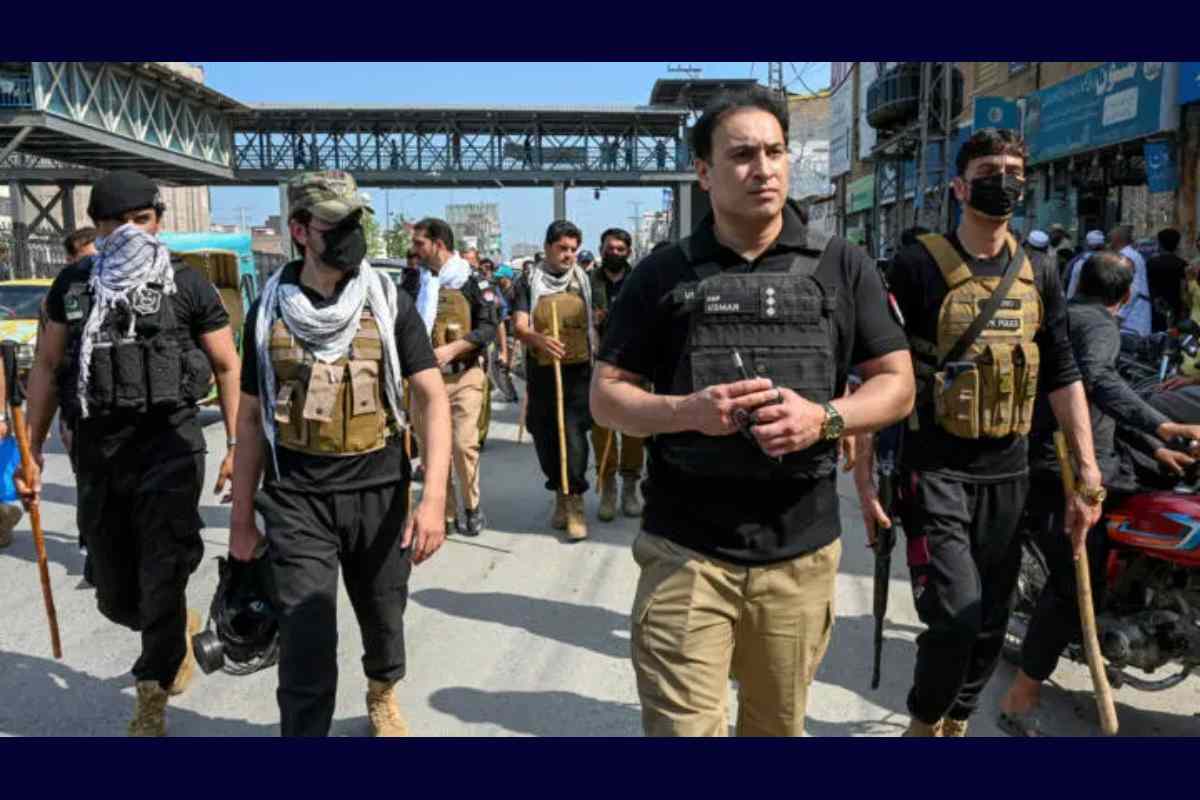
Security was visibly heightened in provincial capital Peshawar on Monday, the first full day under emergency rule.
Large numbers of police personnel were deployed outside Hashtnagri Gate, one of the historic entrances to the city’s old walled quarter. Shipping containers and razor wire remained in place at checkpoints blocking access to the administrative zone.
Schools were closed, while internet-monitoring organisation NetBlocks reported major disruptions to connectivity in parts of the province on Sunday night.
The restrictions have also raised concerns about the impact of emergency measures on daily life and economic activity.
“People are facing difficulties because of this colonial-style rule,” driver Saeed Khan told AFP, citing school closures, blocked roads and losses to businesses.
In Bara, a town in the province’s Khyber district, police fired shots into the air to disperse protesters, and five people were detained, according to a police officer quoted by AFP.
In Peshawar, around 30 PTI supporters briefly chanted slogans demanding Khan’s release before police dispersed them. The demonstrators subsequently returned, prompting further confrontations.
Monday’s protests attracted significantly smaller crowds than the earlier long march, suggesting that the emergency measures and security deployment have weakened the movement’s immediate momentum.
The political confrontation deepened after Khyber Pakhtunkhwa Chief Minister Sohail Afridi was reportedly taken into custody following the announcement of emergency rule.
The PTI said on Sunday that Afridi had been arrested hours after the constitutional measures were announced by Pakistan’s Presidency.
Information Minister Attaullah Tarar confirmed that the chief minister had been taken into custody but said he had not been formally arrested.
An administrative official told AFP that Afridi had initially been placed in “protective custody” at his official residence before being moved to an undisclosed location.
The differing descriptions of his detention have added to the uncertainty surrounding the status of the provincial administration under the emergency measures.
The federal government has defended the move as a necessary step towards restoring security and enabling a more effective counterterrorism response.
Addressing an international conference on Pakistan’s evolving counterterrorism landscape organised by the Institute of Strategic Studies Islamabad, Information Minister Attaullah Tarar described the emergency measures as an opportunity to strengthen the province’s ability to confront militancy.
“A very welcome change took place yesterday, which will now enable and empower the people of Khyber Pakhtunkhwa to fight terrorism and eradicate it once and for all,” Tarar said.
He said the government aimed to achieve peace and eliminate terrorism across Pakistan and the wider region, adding that residents of the province deserved greater prosperity, welfare and security.
The government’s position reflects the security challenges facing Pakistan’s northwestern border region, where militant violence has remained a major concern.
However, the effectiveness of emergency rule will depend not only on security operations but also on public confidence, political cooperation and the protection of constitutional processes.
While some residents have welcomed the federal intervention, others have criticised the restrictions imposed on movement, education and business.
Mahmood Ul Islam, a 72-year-old lawyer from Kohat, south of Peshawar, told AFP that he supported the emergency order, accusing the provincial government of incompetence in controlling terrorism, maintaining law and order and addressing public grievances.
The latest confrontation comes amid a prolonged political crisis surrounding Khan, the former cricket star who remains a prominent figure in Pakistani politics.
Khan has been in prison since August 2023 and faces numerous charges, including corruption and inciting violence, following widespread anti-establishment riots in May 2023.
He and his legal team reject the allegations, describing them as politically motivated.
In recent weeks, PTI supporters have demanded his release and access to his doctors. Talks between party leaders and the federal government broke down on October 4, prompting the latest wave of demonstrations.
The party has called for further protests following the imposition of emergency rule, despite the smaller crowds reported on Monday.
The dispute now extends beyond Khan’s personal legal battles to questions over the authority of an elected provincial government, the federal government’s counterterrorism strategy and the political rights of opposition supporters.
For Pakistan, the challenge will be to address genuine security threats without deepening political polarisation or undermining public confidence in democratic institutions.
Whether emergency rule can deliver lasting security in Khyber Pakhtunkhwa—or instead intensify the confrontation between Islamabad and the PTI—will be a critical test for the country’s political stability.
