
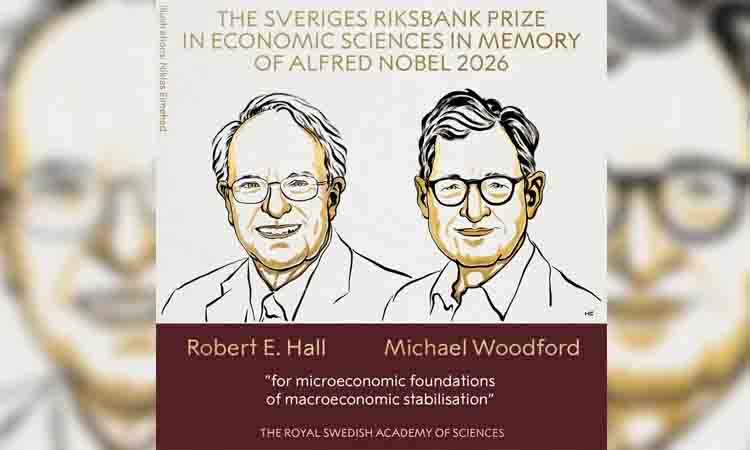
Hall, Woodford win Nobel Economics Prize for macroeconomic stabilisation research
Two American economists, Robert E. Hall and Michael Woodford, have jointly won the 2026 Nobel Prize in Economics (the Sveriges Riksbank Prize in Economic Sciences in Memory of Alfred Nobel) for their groundbreaking research on the microfoundations of macroeconomic stabilisation policy.
The Royal Swedish Academy of Sciences announced the award in Stockholm today.
A statement signed by Nobel Committee science editors Tommy Andersson, Timo Boppart, John Hassler and Per Krusell said the research of Professor Robert E. Hall and Michael Woodford had brought about a paradigm shift in economic stabilisation policy.
Their work has contributed to the development of the ‘New Keynesian model’, which is widely used by central banks and finance ministries to analyse the effects of economic stabilisation policies on business cycles.
Historical background and limitations of Keynesian theory
In the mid-20th century, Keynesian economics strongly influenced macroeconomic policy. One of its principal analytical tools was the ‘Phillips curve’, which describes an inverse relationship between unemployment and inflation. Traditional approaches often relied on historical relationships among macroeconomic variables to guide policy decisions.
However, the economic crises of the 1970s challenged these assumptions. During this period, many countries experienced stagflation—a combination of high inflation and high unemployment. The experience highlighted the limitations of conventional models in explaining economic developments and underscored the need for approaches that account for the expectations and decisions of individuals and businesses.
Against this backdrop, Nobel laureate Robert Lucas argued that the economy could not be understood solely from a top-down, macroeconomic perspective. Instead, economic outcomes had to be analysed in terms of the decisions made by millions of individuals and businesses. Developing comprehensive macroeconomic models grounded in such microeconomic foundations became a major challenge for researchers.
Robert E. Hall’s contribution
Professor Robert E. Hall addressed an important question in this field: the relationship between household consumption and expectations about future income. In a landmark paper published in 1978, Hall developed the proposition that consumption follows a random-walk pattern under the permanent-income hypothesis, meaning that changes in consumption are driven largely by new information about future resources rather than by predictable changes in current income alone.
This framework helped explain why consumers may maintain or increase their spending even when their current income remains unchanged, provided their expectations about future resources support such decisions.
Subsequent research on household consumption has examined how families differ in their responses to income changes. Some households base spending largely on long-term expectations, while others—often described as ‘hand-to-mouth’ consumers—are more constrained by their current income. These differences are important for understanding how monetary and fiscal policies affect consumption and economic activity.
Michael Woodford’s comprehensive macroeconomic
In his seminal 2003 book, Interest and Prices: Foundations of a Theory of Monetary Policy, Professor Michael Woodford developed a comprehensive framework for analysing monetary policy within New Keynesian economics. His work integrated economic theory, firms’ price-setting behaviour and expectations about future policy into a framework widely used in modern monetary economics.
Drawing on the concept of the ‘natural rate of interest’ developed by 19th-century Swedish economist Knut Wicksell, Woodford explained how central banks can influence economic activity and inflation through changes in interest rates. His framework places particular emphasis on the role of expectations and the credibility of monetary policy.
Woodford also examined why prices do not always adjust immediately to changing economic conditions. Firms may face costs or practical constraints when changing the prices of their goods and services, a phenomenon known as ‘price stickiness’. These price-setting frictions influence how monetary policy affects output and inflation.
Another important concept in modern macroeconomic analysis is the ‘output gap’, which measures the difference between actual output and its potential or sustainable level. The output gap helps policymakers assess inflationary pressures and determine an appropriate monetary-policy response.
Woodford’s research has also highlighted the importance of transparent and credible central-bank communication. Businesses and consumers make decisions about spending, investment and prices partly on the basis of their expectations about future monetary policy.
Economic shocks and the application of New Keynesian models
Economic models distinguish between different types of shocks that can disrupt market equilibrium. Positive supply shocks, such as technological advances, can increase productive capacity, while negative supply shocks, such as shortages of raw materials or energy, can raise production costs. Positive demand shocks may result from favourable expectations about future economic conditions, whereas negative demand shocks can arise from deteriorating expectations.
The New Keynesian framework helps policymakers analyse how monetary policy should respond to these different shocks. A negative supply shock, for example, can create a difficult trade-off between containing inflation and limiting losses in economic output. Higher interest rates may help restrain inflation, but the appropriate policy response depends on the nature and persistence of the shock.
New Keynesian models have been used by central banks and governments to assess policy responses to major disruptions, including the COVID-19 pandemic and the global energy crisis. They provide analytical tools for examining changes in interest rates, government spending and other policy measures. However, the effectiveness of any particular policy response depends on the circumstances, and the models alone cannot establish that they prevented prolonged economic stagnation or a depression comparable to that of the 1930s.
Robert E. Hall was born in 1943. He earned his PhD from the Massachusetts Institute of Technology (MIT) in 1967 and is a professor at Stanford University. Michael Woodford, born in 1955, received his PhD from MIT in 1983 and is a professor at Columbia University.
